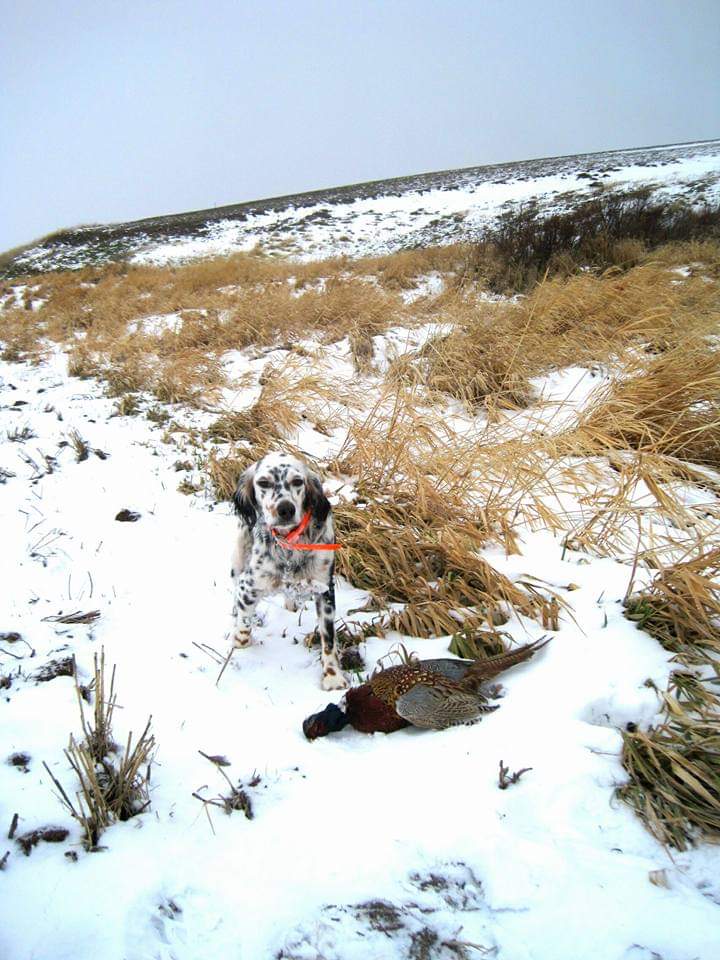
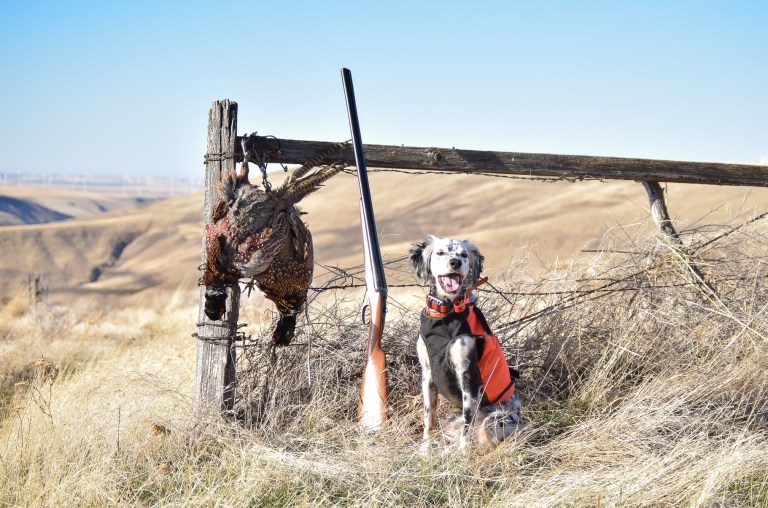
The story that kicked off my professional writing career involves my Llewellin setter, Laurel Mountain’s Yuba, who is equally responsible for my love affair with upland bird hunting. Her first rooster will never be forgotten!
Yuba at 1 year old with her first pheasant – a late-season wild Palouse rooster
Published in the Union Bulletin, September 23rd, 2018.
I sat alone in the gray calm of dawn, gazing contently across my food plot. A few wary whitetails snagged a snack on their morning commute. Steam curled up from a hot cup of coffee, tickling the hairs on my face and nose as I sipped in peace. It was early December. Not quite frigid, but the bunchgrasses were frosted and brittle.
My Llewellin setters, Finn and Yuba, and I hunted pheasant hard the prior six weeks and I needed a break. But the girls lay anxiously at my feet, keeping a keen eye on their orange vests and the cased shotgun by the door. They knew it was a hunting day. Any other morning we would be working roost cover along thick reed canary grass in the low swales, or working a creek side brush line at first light. But not today. This day would be different.
As the clock reported 8:30am, I decided to act like a dedicated bird hunter. The girls had succumbed to pessimism, lying, groaning, sulking. But they cast a suspicious glance as I approached the door. A hand outstretched for my shotgun sparked utter bedlam.
Hunting reliable roost cover early in the day can be productive, but hunting pressure may call for adjustment to keep on the birds as the season progresses. Understanding pheasant behavior provides insight to changing tactics throughout the day, as well as across the season.
Lowland swales, wetlands, and riparian areas provide prime pheasant roost habitat. When left to their own devices, pheasant rise in the morning and move out to feed soon after sunrise. Early in the season, birds may loaf in or near roost cover, but reacting to hunting pressure, birds will push out incredibly early, at times in the dark on public land. While pheasant may adjust their schedules to hunting pressure and weather patterns across the season, when and where to find them at any given time can be predicted with moderate certainty in the Walla Walla Valley.
Seeds and berries are common pheasant diet components in fall and winter. By mid-morning, birds are foraging on upland slopes and moving toward or into crop fields. Tall wheatgrass (an introduced Eurasian bunchgrass common to southeast Washington), wheat, canola, or other seed-producing crops offer forage throughout the season. Woods rose and blue elderberry provide dual function of food and cover when growing in dense patches. Birds may spend more time in this type of cover in the early morning, particularly in freezing conditions.
Pheasant spend a large part of the day working edge habitats such as the crop field/grassland interface common among farmland enrolled in the Conservation Reserve Program. Short wheat stubble lacks adequate cover from avian predators, so pheasant typically don’t roam far from secure refuge when browsing cut crop fields. By late afternoon, birds grab a final snack before flying into roost, within about forty-five minutes of twilight.
As 9:30am approached, the girls quivered with anticipation alongside my old Fox 16-gauge double, broken open across the tailgate. I released the girls and strode quickly through lowland, waist-high Canada thistle and reed canary grass in route to the uplands. A whistle-blast and hand signal turned the girls to the high ground. We worked into the wind up a long ridge spine toward a wheat field, paralleling a steep slope. Native needle-and-thread grass and bluebunch wheatgrass grew low and lush, hiding pheasant along the slope edge.
Having quickly lost sight of Yuba, I turned toward my last visual of her, but a familiar arrythmia pulsed in my chest as Finn locked up mid-stride. Going in for the flush, the hen held tight enough I nearly left her thinking the bird had escaped on foot. A stellar performance by Finn to kick off our late morning jaunt. Upon release, Finn sailed toward the slope, dropping out of sight. My pace quickened.
Approaching the edge, I spied Yuba standing staunch, tail high, with Finn cautiously backing. Hastily, I circled wide, approaching from the front to pin the bird between us. At ten feet out, Yuba’s penetrating gaze identified a thick round of bunchgrass three paces to my right. Turning to face the unseen bird triggered an eruption of parting bunchgrass with the onset of heavy wing beats. A splendid wild rooster gained altitude over a backdrop of rolling golden wheat and grassland.
My Fox came up smoothly, followed by the girls launching over the edge, their eyes fixed firmly on the prize. At approximately 10:00am, I softly slid our first rooster of a lazy morning into my vest, admiring his emerald green head, long, striped tail, and modest spurs.
As the season progresses, get creative. Try new territory. Don’t be afraid to get a late start. Play on pheasant feeding behaviors; consider upland food sources over lowland coverts. Relax. Relish every point. Enjoy the hunt!
UPDATE – I purchased my CZ Bobwhite in 2019 and stand by my earlier perspective on this affordable little upland double. The finish is fading on the barrels near the action and the bottom corners of the box. Otherwise, it’s exactly the same gun it was when I bought it.
At just $650, this sleek yet humble side-by-side boasts attractive design, light weight, superb handling, and is tough as nails.
Published by Project Upland February 21st, 2020. Read it here.
Collapsing my tenkara rod, I reflected on the brilliant California golden trout I had just released back into the trickle of a mountain stream dropping from a series of high lakes in the Ansel Adams Wilderness. The September sun shone golden and warm against my back as dappled light streamed through the forest canopy. That fish put a bow on one of the most memorable weeks of my fly-fishing career, traipsing through the scenic Sierra Nevada Range in search of a trout I had dreamed about for decades.
Descending from 10,000 feet, the trail meandered through various cover types including old-growth pine and small pockets of yellowing aspen. Approaching a unique knob around 8,500 feet was a minute stand of sagebrush, appearing entirely out of place and displaced from the lowland scrub and chapparal. The faint scuffling and whistling of a quail covey piqued my interest.
Climbing the knob, the covey scurried across the trail ahead and levitated above the sage, sailing elegantly into the safety of a nearby snarl. Mountain quail. That first encounter left me mesmerized and wishing to exchange my fly rod for a setter and double gun, and added another hunt to my bucket list. Researching mountain quail habitat and their distribution across the west, I was pleasantly surprised to learn of Oregon’s populations and conservation efforts.
Mountain quail are a North America native, distributed throughout the Oregon Cascades and California’s Sierra Nevada, with a sprinkling in Nevada, Mexico and Washington. Southeast Washington, eastern Oregon and western Idaho historically were home to mountain quail, but over time, their habitat and populations dwindled. In Oregon, mountain quail were once found in every county. Since about 1950, land use practices and fire suppression have contributed to their decline.
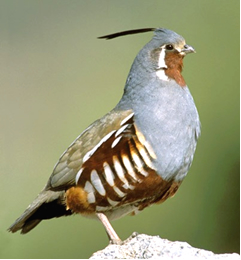
Photo Credit – US Fish and Wildlife Service
Mountain quail are the largest native quail in North America. They are uniquely monomorphic, meaning both sexes are virtually identical in size and appearance, each boasting their most peculiar feature, a black, needle-like “top knot” growing over an inch long from the top of the head.
Preferred habitat consists of dense brush, such as manzanita thickets, chapparal and scrub, in wooded foothills and mountains. Features like burns and clear-cuts are important for providing the appropriate balance of cover and food sources, and water within about one mile. Riparian habitats with an adjacent brushy, upland slope are favorable.
The mountain quail diet consists mainly of vegetation during spring and summer, seeds and berries during fall and winter. Insects are important for spring and summer brood rearing. Mountain quail also exhibit a robust reproductive strategy. Females lay seven to fifteen eggs in two separate nests within about 600 feet of each other. Both adults incubate clutches independently, males typically having greater hatch success.
In 1996, Oregon State University (OSU) began a study to compare life history characteristics between the larger, stable lower Cascades population, and that of a remnant population in Hells Canyon. Additionally, quail were translocated from the Cascades to Hells Canyon to compare life histories of the separate groups in the same habitat.
The OSU study results informed a sixteen-year follow-on translocation study to reintroduce mountain quail to historic eastern Oregon habitats. The Oregon Department of Fish and Wildlife (ODFW) teamed up with OSU and the U.S. Forest Service beginning in 2001, translocating and radio-tracking birds in the Freemont, Deschutes and Malheur National Forests and the Steens Mountain Wilderness.
A total of 2,574 birds were translocated across years. Forty-five percent (1,156) were radio-tracked to obtain habitat selection, survival and nesting success information. Overall, nesting and brooding was successful across sites and years. Survival ranged from approximately sixteen percent to nearly sixty percent, depending upon year and release site. Survival rates and trends observed were similar to those of the Cascades population from which birds were translocated.
Photo Credit- US Fish and Wildlife Service
Concluding the study in 2017, it appears the translocation efforts were at least marginally successful. Mountain quail appear to be maintaining small populations where translocated and are considered an “occasional” species in Wallowa and Union Counties while the lower Cascades population remains strong. Detailed annual reports of the translocation study are available from ODFW online.
Oregon offers hunting opportunity with the eastern Oregon season running October 10th through January 31st this year, including California quail and overlapping the forest grouse season. The lower Cascades season opens September 1st.
Mountain quail are a peculiar and secretive species, and a treasure to the State of Oregon. There is something magical about their presence on the landscape. The memory of flushing a covey over manzanita or juniper scrub will remain etched in your cache of extraordinary upland experiences. Whether pursuing with dog and scatter gun or hiking stick and camera, the marvel of this distinctive native quail and their habitat that we are blessed to have on our public lands is reason enough to seek adventure in the high desert.
I don’t know when dad purchased the gun or from whom or where, but one of its few outings captured on film was in 1981. Dad had hunted a gray squirrel on his parent’s farm in what used to be the middle-of-nowhere Appalachia.
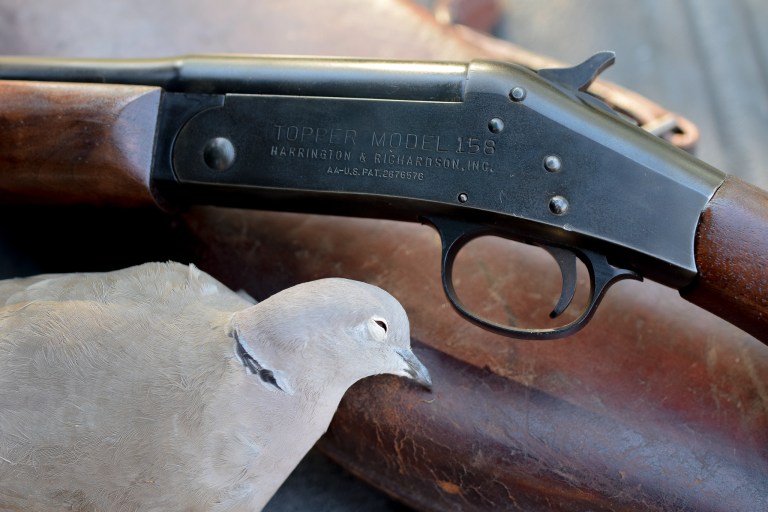
The Herrington and Richardson Topper Model 158 (H&R) was the shotgun built for everyone. An ordinary, functional firearm built for the budget-minded. Overly simplistic yet wholly reliable described the H&R firearms line from 1871 to 1986 under the parent company.
Dad’s H&R saw its last hunt somewhere around 1992 when a zealous child acting crafty with a gray squirrel failed to properly lock the action. I secured provisions for Brunswick stew and learned a frightening lesson in the process. The top-break action blew open, ejecting the casing and busting the gun’s forearm. Miraculously, I did not suffer the same consequence. As a pre-teen, I had little use for a busted gun or the ability or knowledge to repair it. I left it to rust in an attic for nearly thirty years.
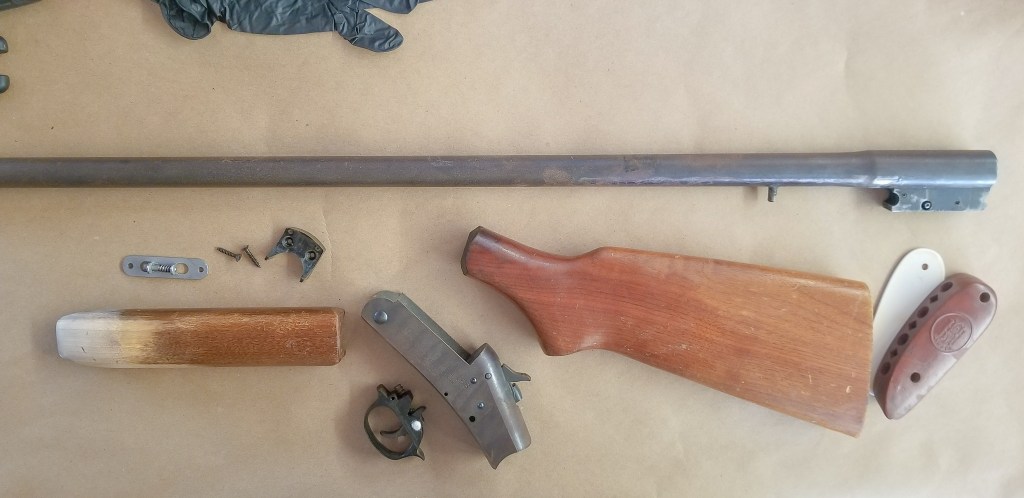
Pre-restoration, rusted and forgotten. What’s pictured here comes with the Burchwood Casey kit (save for the gun).
Returning home in 2020, I finally decided to grab the old H&R from the attic and haul it back to Waitsburg. Given their basic style and seemingly low-grade stocks, H&R firearms don’t carry much monetary value. Given the gun was useless otherwise, I decided to try my hand at a home restoration job, finding my first experience to be as terrifying as expected.
Ordering a Burchwood Casey complete re-bluing kit, I went to work one afternoon in the shop, thinking the directions were straightforward and simplistic. I learned quickly, however, that our hot, dry summer climate play a major role in the complexity of the endeavor, so much so that I basically enjoyed doing the job twice.
The first crucial step was stripping the rust and bluing from the barrel and action. Using a kit-provided swab and applying the rust and blue removal chemical was easy, as was using steel wool to gently rub off rust and debris. The kerfuffle came when the stripping chemical began drying into a sticky paste on the barrel in the 90-degree heat.
Using the supplied degreaser, I quickly removed the gunk from the barrel, performing a second and third coat of rust and blue remover in some cases, quickly working the steel wool and sand paper to remove everything, then promptly cleaning.
Lesson 1: Perform your firearm restoration in a climate-controlled area.
Disassembled and ready for a makover.
During the rust/blue removal step, the directions say to clean the metal until it shines, taking great care in the process. Simple enough. The problem occurs where interpretations of “shine” may vary. My cleaning job resulted in what appeared to be a rust-free, lustrous surface, yet later during the bluing step, I learned otherwise.
Lesson 2: Sand and polish the metal at least twice again once you think you have it “shiny” using the rust removal chemical and degreasing thoroughly when finished. You want as near a mirror finish as possible.
Degreasing is another critical step as bluing will not work with unclean metal. Grease and oil prevent the bluing chemical from contacting the metal surface, creating a blotchy appearance. Be sure to use latex or nitrile gloves during the process as fingerprints can show plainly from skin oils. As with the rust and blue removal, once you think the parts are clean, degrease at least twice again, scrubbing diligently. Sanding tough areas when removing rust and bluing can help tremendously, the gun action being the most difficult area.
Sound fun so far? The above steps are simply tedious. Bluing is utter madness. Bluing is a clear chemical that reacts with the steel, darkening it to the rich, almost black finish most guns bear. The directions say to apply quickly, and thoroughly, with an optimal 30- to 45-second soak and no longer than 60 seconds. This could not be stressed enough, which led me to believe the gun would self-destruct at 61 seconds. I decided to blue the H&R barrel in three sections, similar to what the direction recommended.
Lesson 3: Blue the barrel one or two inches at a time. By the time I had the area evenly coated, the starting point had been sitting for 20 seconds, leaving an uneven soak time before washing in cold water and breaking the chemical reaction.
Although it would have been excruciatingly slow, wiping a single blue streak around the barrel at a time would have been far better in the long-run for creating an even finish and would have required about the same amount of time. Thankfully, the finished darkened as it “cured” over 24-hours.
Lesson 4: Coating many small areas is preferable over fewer large areas providing a better finish.
Makeover complete, awaiting reassembly.
With the metals finally finished, I turned to the stock. The original wood was light and wide-grained with an orangish tint when finished. The replacement forearm was beautiful walnut. How to match them up?
Once sanded clean, I used “special walnut 224” stain from the hardware store for the stock, matching with the new forearm as close as possible. Wiping on two light coats with a rag, I then applied teak oil to both stock and forearm. Finally, a light wipe of clear furniture urethane gave gloss and superior weather protection that looked good to me.
Lesson 5: I am a better carpenter than metalsmith.
Overall, I was pleased with the outcome. The barrel finish could be better and the process simpler, knowing what I know now, but the result was far better than the prior condition. And, I suppose learning a new skill requires starting somewhere.
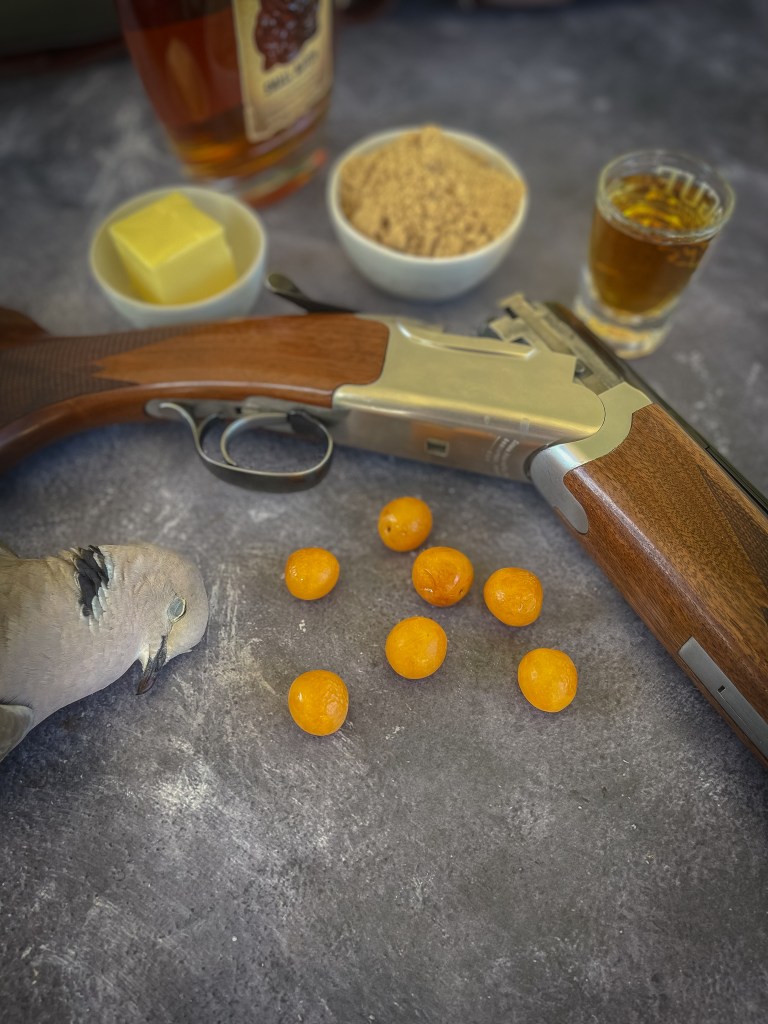
Regardless, the H&R heirloom found its way back into action, plucking a plump collared dove on its first outing as a reborn small game scattergun. A bird I doubt my dad had ever even heard of.
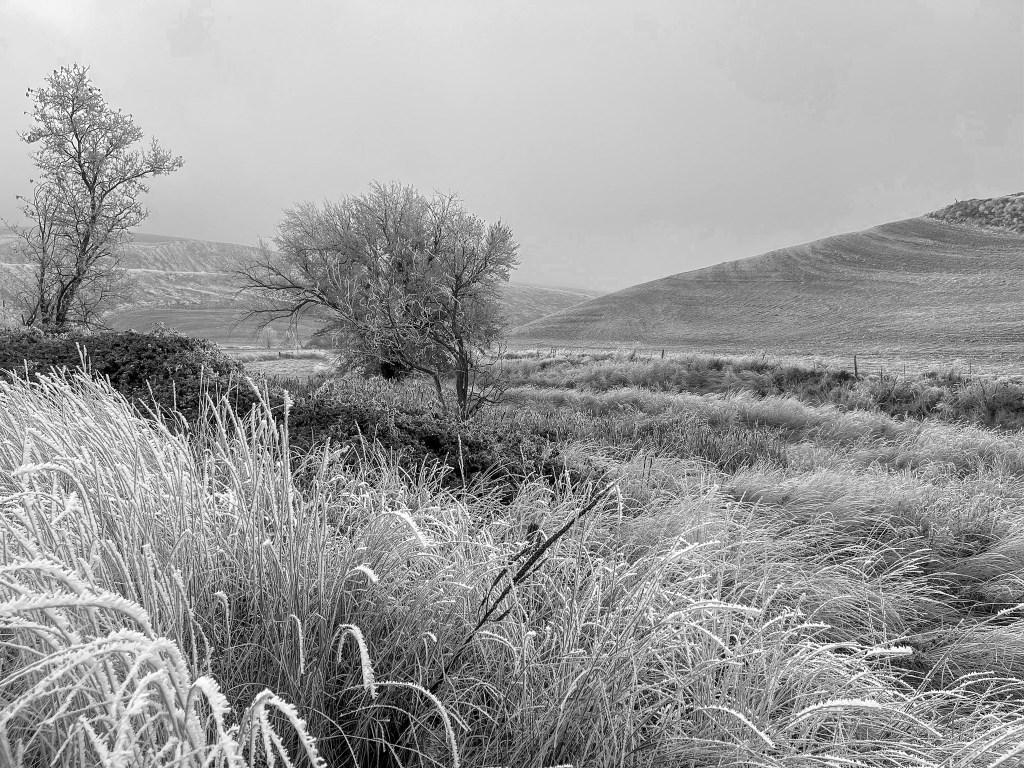
“Still and sunny are rarely simultaneous conditions that present a coveted winter morning in the Walla Walla Valley. Freezing fog often forms thorny ice spikes on the grasses and broken-down fencerows, and limits visibility to feet at times. When enshrouded in fog, the landscape feels like a scene from “north of the wall” in Game of Thrones. “White Walkers” could appear at any moment, seen first by the eerie glow of their piercing blue eyes through the frozen mist.
Beneath the fog on a still morning, the Palouse can be deafeningly quiet. The ominous croak of a midnight-black raven can be heard for miles. The slightest whisp of wind sends the big bunchgrasses into a cracking sway like the crinkling of a mylar balloon. And while the frosty, foggy days feel as though they have locked the landscape down for eternity, a mere hour of sun can free the Palouse from the grips of the icy chains.”
“I pulled the stock and barrels of the sleek Ruger “Red Label” twelve-gauge over/under from the green, leather-lined canvas case. It had been a little over a year since the fine double gun had seen the light of day, and nearly two years since it saw an upland bird season. It was odd to see it in my hands instead of Marvin’s.
As I stepped away from the truck, memories surface of the hunt prior in this same cover. Marvin and his bird dog, Felix, accompanied me beneath the pines and honey locust as we roused a staggering number of collared doves. Marvin carried the Red Label on every one of our upland hunts over the years, and our last collared dove hunt turned out to be our final hunt. Two short months later, the cancer that Marvin had nearly beaten finally bested him.
“Let’s see how I do with this thing” I spoke into the wind, as if Marvin was there with me.”
Published in the Pheasants Forever Journal Winter 2023 edition.
In 2022, Blue Mountain Pheasants Forever, Chapter #258, started a Women on the Wing program to diversify the Chapter’s outreach and opportunities. The initiate was wildly successful and contributed to the Chapter winning the Pheasants Forever National Award for Education and Outreach. I am extremely proud to be an active member and officer of Blue Mountain Pheasants Forever!
One rainy fall morning, I found myself sitting quietly in an old hay shack on the edge of an alfalfa field. My friend Dan sat to my right. A calico barn cat desperate for friendship perched upon a hay bale to my left. As dawn cracked, the sound of raindrops pinging on the rusted tin roof was disrupted by a cacophony of turkey “yelps” from their roost far above us in a pine stand. The cat continued preening, uninterested, but Dan and I glanced at each other in curious anticipation.
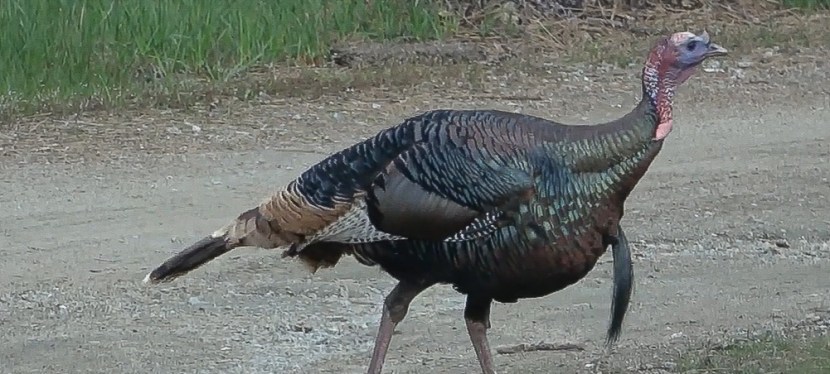
Moments later, over one hundred Rio Grande turkeys sailed down from the roost into the alfalfa field before us. Video of the hunt shows turkeys gliding in from the pines for nearly five minutes. The discordant “kee-kee” and “yelp” calls from a flock that large were defeating as the birds gathered before eventually spreading across the emerald alfalfa carpet where they engaged in synchronized feeding.
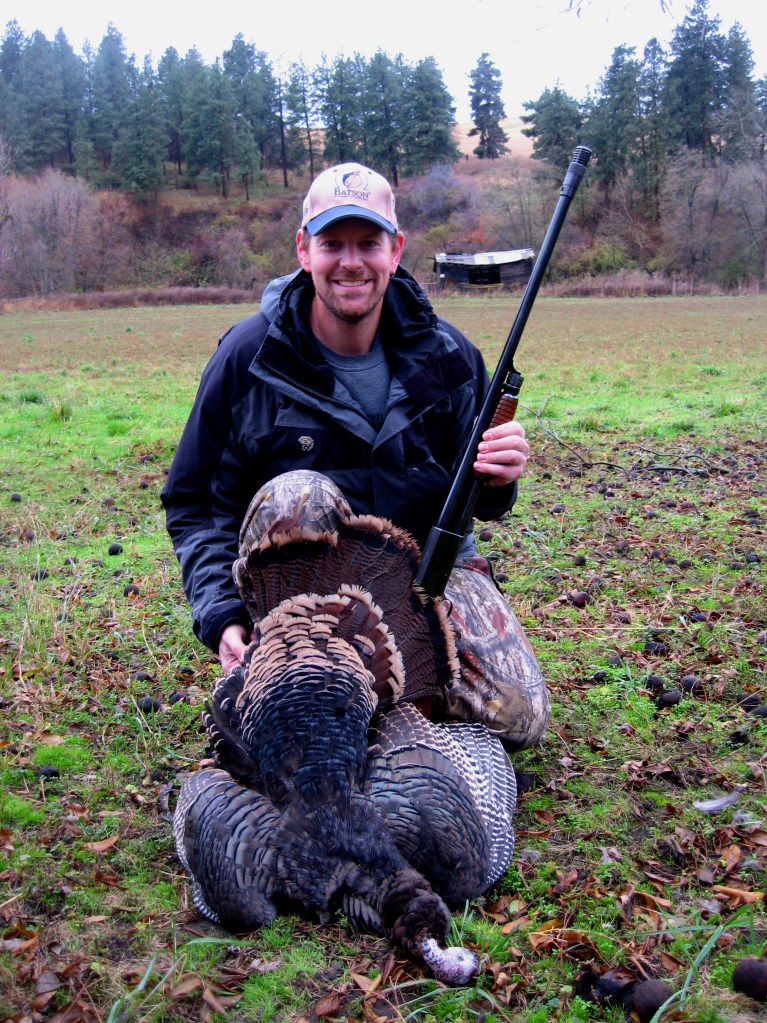
Having never successfully hunted turkeys, it was hard to maintain my composure with that many birds front and center. A large jake (a juvenile male) finally separated from the flock, allowing a safe shot. Upon squeezing the trigger, it was unclear which, the cat or the shot wad, left the shack in the biggest hurry – the cat having launched from the haystack so quickly that it virtually vanished into thin air. At that moment, the largest flock of turkeys I had ever seen before or since lifted off, leaving the jake behind to bless my dinner table.
That parcel has produced most of my wild turkeys over the years, regularly holding flocks with greater than thirty birds during the fall and winter. This is common across the nation in areas with patchwork landscapes of agriculture, forest, and grasslands or pasture, making it hard to believe that the wild turkey was once pushed to the brink of extinction in North America.
According to the National Wild Turkey Federation, approximately 10 million wild turkeys roamed North America at the time of European settlement – a fine food source for settlers. Like most “game species” known today, turkeys were hunted year-round without regulation for subsistence and the market.
As the eastern colonies grew and settlers moved across America, timber was cleared for agriculture and community development. The cumulative impact of hunting and habitat loss decimated and isolated wild turkey populations.
“Connecticut had lost its wild turkeys by 1813. Vermont held out until 1842 and other states followed. By 1920, the wild turkey was lost from 18 of the original 39 states and Ontario, Canada, in its supposed ancestral range[1].“
North American wild turkey populations plummeted below an estimated 250,000 by the 1930s, but pending legislation and the Great Depression would serve the wild turkey well.
In 1900, the first iteration of the Lacey Act regulated market hunting by prohibiting trade in wildlife, fish, and plants that were illegally harvested, possessed, transported, or sold. This Act, in concert with early wildlife management regulations, reduced the overall hunting impact on turkey populations.
The Great Depression fell upon America in 1929, and over the following decade, homesteads and small farms were vacated as 14 million people sought work in cities and factories. With fields left fallow, natural succession converted former cropland to grasslands and shrublands. This natural landscape change resulted in the rebirth of wild turkey habitat.
Another keystone piece of legislation – the Pittman-Robertson Act of 1937 – established a conservation fund via excise tax placed on the sale of sporting goods and ammunition. These funds were used as seed money to establish large-scale conservation efforts. State fish and game agencies began trap-and-transport programs to reestablish turkeys throughout their native range. “By 1952, bird numbers nationwide had grown to 320,000[2].”
By 1973, the national wild turkey population estimate was about 1.3 million birds. At that time, the National Wild Turkey Federation was founded with the mission of “wild turkey conservation and the preservation of North America’s hunting heritage.”
These and other conservation efforts have resulted in the recovery of wild turkeys with over 6 million estimated across 49 US States and five subspecies in 2014 – Eastern (4.5-4.7 million), Osceola or Florida (115,000), Rio Grande (853,000), Merriam’s (260,000), and Gould’s (1,200). This incredible recovery since 1973 is no simple coincidence with the founding of the National Wild Turkey Federation.
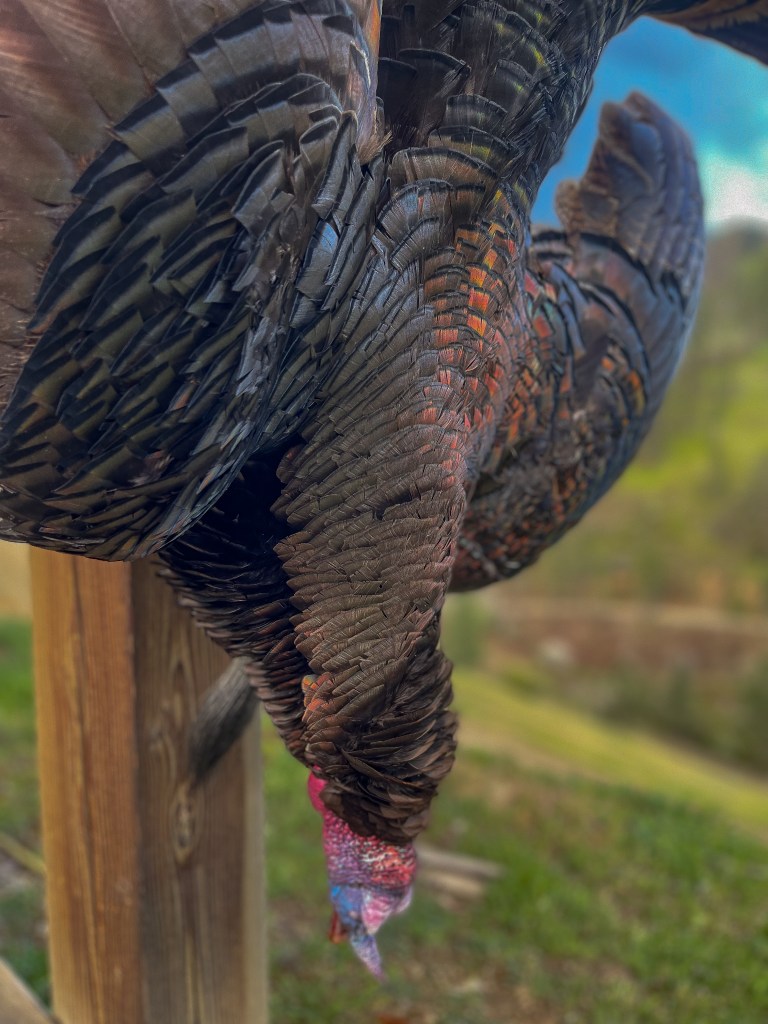
Sitting quietly, tucked into the brush at the bottom of a canyon, I listened to the excited gobbles of seven Rio Grande toms echo between the canyon walls. A young but robust bird with an exceptional beard was en route, lured by my feeble attempts to mimic a hen turkey yelp. Moments later, I stroked the bird’s iridescent plumage in the evening sunlight while the other toms and a dozen hens made their way back up the canyon. The wild turkey is perhaps one of the greatest conservation successes in North America. Moments like this make me proud of our continental conservation model, and thankful for the opportunity to hunt one of this nation’s greatest game birds.
If you have not hunted wild turkeys, now is the time to join the ranks in one of America’s oldest hunting traditions.
[1] History of the Wild Turkey in North America. James Earl Kennamer, Mary C. Kennamer, and Ron Brenneman. National Wild Turkey Federation Bulletin No. 15.
Middle age, the sequential loss of close friends and my dad and being far removed from my hometown, and missing family traditions had compounded into depression and anxiety. The ruffed grouse season opener came and went with little notice; something I had eagerly awaited in years past. The hunt itself was not enough. I needed peace. Meaning. Tradition. I found it in grouse camp.
It’s an utter fact, proven time and again, particularly in a state like Washington: wild birds in the vest are won with “boot leather,” so to speak. Even in a spectacular wild bird year, by December, pheasants are scarce in the public covers of the Palouse. Private lands with the right mix of food and cover harbor dozens of pheasants as they congregate during cold weather. But rest assured, the remainder of the roosters are seasoned escape artists, skittish as hell, and alive, thanks to their uncanny sense of property boundaries and fleet feet.
In southeast Washington, hunters push every stitch of creek bottom on the map day after day. The high ground is often overgrazed or covered in yellow starthistle or common rye sufficient to make the habitat unsuitable. Considering the fraction of suitable habitat available to the overall hunting populace, scoring on wild birds after the new year is a feat.
Washington has 7.6 million citizens, ranks 13th in the U.S. for population, and is comprised of approximately 42.7 million acres. Comparatively, Montana has a little over 1 million people, ranks 45th in population, and is comprised of approximately 93.3 million acres. Both states are comprised of about 29 percent federal land. That equates to about 12.3 million acres of federal land, or 1.6 acres per person in Washington, compared to 27 million federal acres, or 25 acres per person in Montana.
While that coarse bit of number-crunching is no accurate representation of the hunting populace or pressure in Washington State, it does provide perspective on acreage being at a premium with stiff competition for public covers.
Finding birds in the late season requires creativity and a willingness to explore, hike further, and take gambles on new covers. By January, I typically make a hard switch from chasing pheasant to covey birds like quail and Huns, and this means I scour On-X Maps, drive further from home, and hike a lot more new territory. And, every year, I am surprised at what I find.
Parcel size means little to me past Christmas. Habitat quality, distance from the road to the quality habitat, and distance from the nearest popular hunting areas are the qualities to consider. The smallest parcels can hold a surprising number of birds. They can just as likely be vacant. It’s a craps shoot, and striking it rich requires trial and error.
One January morning, Yuba and I struck out across a parcel of Department of Natural Resources (DNR) land we had yet to lay eyes on. Aerial imagery suggested enough native grasses to tempt a Hun covey along the eastern boundary with a wheat field. We worked the boundary that turned out to be covered in cow vetch and starthistle, then dropped into a shallow draw and worked toward cattle grazing in a bunchgrass stand.
Where cattle, bunchgrass, and Llewellin setter met, Yuba came to a jerking halt. Anticipation mounted as Yuba’s demeanor relaxed, signaling that the birds were moving. As she pursued the bird over 200 yards, it became clear that this was no Hun covey. Her final point came with confidence and I circled widely to pin the bird between us. Yuba broke point and locked up again 10 yards thence. This repeated three times before I caught a glimpse of a rooster low-crawling through the sparse bunches. Yuba spotted him too. I couldn’t help but laugh as the grass faded into starthistle, exposing the rooster, and pressuring him to take wing.
Finding good habitat on grazed public lands can be tough; however, don’t judge a book by its cover. Many times, I have parked at the foot of a steep slope, gnawed to the soil, and thought, no way in hell am I plodding up and over that greasy mud mound. There’s not a stitch of cover to be found. But I never let myself get away with a lazy mindset. You never know what hidden gem may lie on the other side of the hill.
Finn ran a parcel like this New Year’s Day, 2021. We hoofed it up and over, crossed a few fences, and found a single 20-acre strip of beautiful Hun cover between two wheat fields. This day, the cover was empty, but the recent scat of a covey that could have been present was reassurance that we were in the right place. While we didn’t get on the birds, I never would have found that little slice of habitat had I not pushed through the marginal cover surrounding it. Two whitetail sheds provided consolation.
Finding those sheds suggested two things. First, I was hunting in the right place. Walking up on a fully exposed, intact shed, bleached white and cracked from the sun, means no one else is hunting that ground. It’s rare to have a tract all to myself, even if it is poor habitat.
Second, I was hunting in the wrong place. With so many hunters and so little public land, sharing covers is expected. When there’s no evidence of other hunters, one may surmise that no one else hunts it because they know better. There is always another hunter out there willing to hike a couple of miles to find good covers. But, when the stars align, you stumble upon a cover so good you don’t even expose it to your mother as she gabs over the phone from her Del Ray Beach retirement condo.
On-X Maps is an amazing tool for mapping out covers across the season, but it takes groundwork to validate the imagery. Each parcel is like a new mine claim. Will you strike it rich or bust? The unknown is part of the fun, and when gambling, one thing is certain: if you don’t play, you can’t win. Wearing out boot leather is the only way to expand your library of public covers and score wild birds.




















 Palouse Upland Media