Upland Pursuits – Status and Conservation of Oregon’s Mountain Quail

Collapsing my tenkara rod, I reflected on the brilliant California golden trout I had just released back into the trickle of a mountain stream dropping from a series of high lakes in the Ansel Adams Wilderness. The September sun shone golden and warm against my back as dappled light streamed through the forest canopy. That fish put a bow on one of the most memorable weeks of my fly-fishing career, traipsing through the scenic Sierra Nevada Range in search of a trout I had dreamed about for decades.

Descending from 10,000 feet, the trail meandered through various cover types including old-growth pine and small pockets of yellowing aspen. Approaching a unique knob around 8,500 feet was a minute stand of sagebrush, appearing entirely out of place and displaced from the lowland scrub and chapparal. The faint scuffling and whistling of a quail covey piqued my interest.

Climbing the knob, the covey scurried across the trail ahead and levitated above the sage, sailing elegantly into the safety of a nearby snarl. Mountain quail. That first encounter left me mesmerized and wishing to exchange my fly rod for a setter and double gun, and added another hunt to my bucket list. Researching mountain quail habitat and their distribution across the west, I was pleasantly surprised to learn of Oregon’s populations and conservation efforts.

Mountain quail are a North America native, distributed throughout the Oregon Cascades and California’s Sierra Nevada, with a sprinkling in Nevada, Mexico and Washington. Southeast Washington, eastern Oregon and western Idaho historically were home to mountain quail, but over time, their habitat and populations dwindled. In Oregon, mountain quail were once found in every county. Since about 1950, land use practices and fire suppression have contributed to their decline.
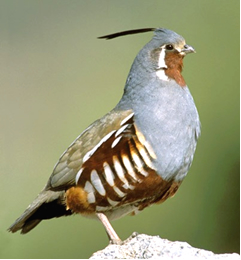
Photo Credit – US Fish and Wildlife Service

Mountain quail are the largest native quail in North America. They are uniquely monomorphic, meaning both sexes are virtually identical in size and appearance, each boasting their most peculiar feature, a black, needle-like “top knot” growing over an inch long from the top of the head.

Preferred habitat consists of dense brush, such as manzanita thickets, chapparal and scrub, in wooded foothills and mountains. Features like burns and clear-cuts are important for providing the appropriate balance of cover and food sources, and water within about one mile. Riparian habitats with an adjacent brushy, upland slope are favorable.

The mountain quail diet consists mainly of vegetation during spring and summer, seeds and berries during fall and winter. Insects are important for spring and summer brood rearing. Mountain quail also exhibit a robust reproductive strategy. Females lay seven to fifteen eggs in two separate nests within about 600 feet of each other. Both adults incubate clutches independently, males typically having greater hatch success.

In 1996, Oregon State University (OSU) began a study to compare life history characteristics between the larger, stable lower Cascades population, and that of a remnant population in Hells Canyon. Additionally, quail were translocated from the Cascades to Hells Canyon to compare life histories of the separate groups in the same habitat.

The OSU study results informed a sixteen-year follow-on translocation study to reintroduce mountain quail to historic eastern Oregon habitats. The Oregon Department of Fish and Wildlife (ODFW) teamed up with OSU and the U.S. Forest Service beginning in 2001, translocating and radio-tracking birds in the Freemont, Deschutes and Malheur National Forests and the Steens Mountain Wilderness.

A total of 2,574 birds were translocated across years. Forty-five percent (1,156) were radio-tracked to obtain habitat selection, survival and nesting success information. Overall, nesting and brooding was successful across sites and years. Survival ranged from approximately sixteen percent to nearly sixty percent, depending upon year and release site. Survival rates and trends observed were similar to those of the Cascades population from which birds were translocated.

Photo Credit- US Fish and Wildlife Service

Concluding the study in 2017, it appears the translocation efforts were at least marginally successful. Mountain quail appear to be maintaining small populations where translocated and are considered an “occasional” species in Wallowa and Union Counties while the lower Cascades population remains strong. Detailed annual reports of the translocation study are available from ODFW online.

Oregon offers hunting opportunity with the eastern Oregon season running October 10th through January 31st this year, including California quail and overlapping the forest grouse season. The lower Cascades season opens September 1st.

Mountain quail are a peculiar and secretive species, and a treasure to the State of Oregon. There is something magical about their presence on the landscape. The memory of flushing a covey over manzanita or juniper scrub will remain etched in your cache of extraordinary upland experiences. Whether pursuing with dog and scatter gun or hiking stick and camera, the marvel of this distinctive native quail and their habitat that we are blessed to have on our public lands is reason enough to seek adventure in the high desert.
Palouse Outdoors – Boot Leather Wins Wild Birds

Originally Published in The Waitsburg Times, November 2nd, 2023.

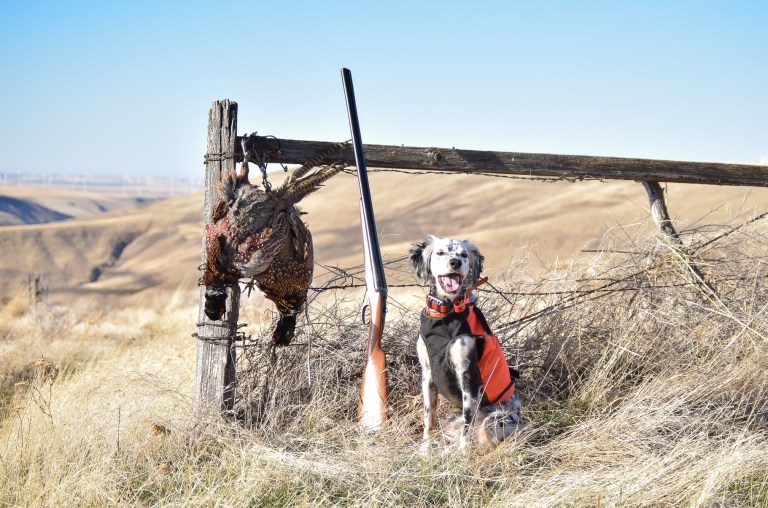
It’s an utter fact, proven time and again, particularly in a state like Washington: wild birds in the vest are won with “boot leather,” so to speak. Even in a spectacular wild bird year, by December, pheasants are scarce in the public covers of the Palouse. Private lands with the right mix of food and cover harbor dozens of pheasants as they congregate during cold weather. But rest assured, the remainder of the roosters are seasoned escape artists, skittish as hell, and alive, thanks to their uncanny sense of property boundaries and fleet feet.

In southeast Washington, hunters push every stitch of creek bottom on the map day after day. The high ground is often overgrazed or covered in yellow starthistle or common rye sufficient to make the habitat unsuitable. Considering the fraction of suitable habitat available to the overall hunting populace, scoring on wild birds after the new year is a feat.

Washington has 7.6 million citizens, ranks 13th in the U.S. for population, and is comprised of approximately 42.7 million acres. Comparatively, Montana has a little over 1 million people, ranks 45th in population, and is comprised of approximately 93.3 million acres. Both states are comprised of about 29 percent federal land. That equates to about 12.3 million acres of federal land, or 1.6 acres per person in Washington, compared to 27 million federal acres, or 25 acres per person in Montana.

While that coarse bit of number-crunching is no accurate representation of the hunting populace or pressure in Washington State, it does provide perspective on acreage being at a premium with stiff competition for public covers.

Finding birds in the late season requires creativity and a willingness to explore, hike further, and take gambles on new covers. By January, I typically make a hard switch from chasing pheasant to covey birds like quail and Huns, and this means I scour On-X Maps, drive further from home, and hike a lot more new territory. And, every year, I am surprised at what I find.

Parcel size means little to me past Christmas. Habitat quality, distance from the road to the quality habitat, and distance from the nearest popular hunting areas are the qualities to consider. The smallest parcels can hold a surprising number of birds. They can just as likely be vacant. It’s a craps shoot, and striking it rich requires trial and error.

One January morning, Yuba and I struck out across a parcel of Department of Natural Resources (DNR) land we had yet to lay eyes on. Aerial imagery suggested enough native grasses to tempt a Hun covey along the eastern boundary with a wheat field. We worked the boundary that turned out to be covered in cow vetch and starthistle, then dropped into a shallow draw and worked toward cattle grazing in a bunchgrass stand.

Where cattle, bunchgrass, and Llewellin setter met, Yuba came to a jerking halt. Anticipation mounted as Yuba’s demeanor relaxed, signaling that the birds were moving. As she pursued the bird over 200 yards, it became clear that this was no Hun covey. Her final point came with confidence and I circled widely to pin the bird between us. Yuba broke point and locked up again 10 yards thence. This repeated three times before I caught a glimpse of a rooster low-crawling through the sparse bunches. Yuba spotted him too. I couldn’t help but laugh as the grass faded into starthistle, exposing the rooster, and pressuring him to take wing.

Finding good habitat on grazed public lands can be tough; however, don’t judge a book by its cover. Many times, I have parked at the foot of a steep slope, gnawed to the soil, and thought, no way in hell am I plodding up and over that greasy mud mound. There’s not a stitch of cover to be found. But I never let myself get away with a lazy mindset. You never know what hidden gem may lie on the other side of the hill.

Finn ran a parcel like this New Year’s Day, 2021. We hoofed it up and over, crossed a few fences, and found a single 20-acre strip of beautiful Hun cover between two wheat fields. This day, the cover was empty, but the recent scat of a covey that could have been present was reassurance that we were in the right place. While we didn’t get on the birds, I never would have found that little slice of habitat had I not pushed through the marginal cover surrounding it. Two whitetail sheds provided consolation.

Finding those sheds suggested two things. First, I was hunting in the right place. Walking up on a fully exposed, intact shed, bleached white and cracked from the sun, means no one else is hunting that ground. It’s rare to have a tract all to myself, even if it is poor habitat.

Second, I was hunting in the wrong place. With so many hunters and so little public land, sharing covers is expected. When there’s no evidence of other hunters, one may surmise that no one else hunts it because they know better. There is always another hunter out there willing to hike a couple of miles to find good covers. But, when the stars align, you stumble upon a cover so good you don’t even expose it to your mother as she gabs over the phone from her Del Ray Beach retirement condo.

On-X Maps is an amazing tool for mapping out covers across the season, but it takes groundwork to validate the imagery. Each parcel is like a new mine claim. Will you strike it rich or bust? The unknown is part of the fun, and when gambling, one thing is certain: if you don’t play, you can’t win. Wearing out boot leather is the only way to expand your library of public covers and score wild birds.