Palouse Outdoors – Playing a Royal Flush

Originally Published in The Waitsburg Times, January 6th, 2025.

Some of the best moments of my life have occurred while following the flashing tail of a bird dog through the whipping grouse covers and amber plains. I’ve found the upland hunting community welcoming, and the tales I’ve shared have connected me with friends I would never have known otherwise. Pheasants Forever holds a subset of this community – like-minded conservationists passionate about nature, bird dogs, and the beautifully plumed game birds that fascinate us.

I’ve had the good fortune of experiencing a variety of hunts and dog breeds, each with unique styles, personalities, and quirks. Yet, I had never hunted with golden retrievers before the 2024 season. Fortunately, Randy, a fellow Pheasants Forever volunteer, recently invited me to walk with him and his brace of stunning strawberry blonde golden retrievers to push up pheasant.

Randy’s casual appearance belies his wisdom and character as one of the most interesting people alive. He has traveled and hunted birds widely with his beloved golden retrievers. A 1970s throwback photo of Randy sitting with his dog and a handful of valley quail after a momentous day in Baja was highlighted in the 2024 Pheasants Forever Journal Upland Bird Super Issue, Volume 43(4). Randy has a story for every occasion, hunting or otherwise, but as I followed him and his bouncing pups into the field, our conversation narrowed to strictly business.
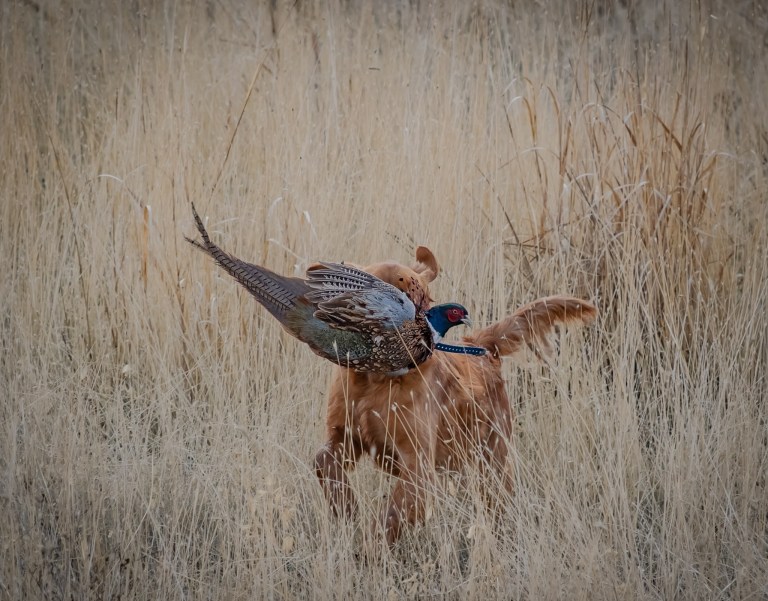
Young golden retriever, Scout, delivers a wily ring-neck rooster to hand.

“I’ve never hunted with flushers, save for a lab or two,” I said. 

“Really?” Randy questioned with surprise. “Well, you’re in for a treat!” Little did I know we would embark on a gentlemanly experience worthy of custom leather boots, twill wool garments, and ivy caps.

Flushing dogs are bred to do just that – find and flush birds. One crucial difference between flushing and pointing dogs like my setters is that flushers must work close to the hunter so the birds get up within shotgun range. Conversely, pointing dogs can range to whatever distance their handler is comfortable because they are bred and trained to stop when they find birds, allowing the hunter to approach and flush. These different dog behaviors also require the hunter to adapt their approach.

“You see the dogs getting ‘birdy’? Get up there fast!” Randy coached.

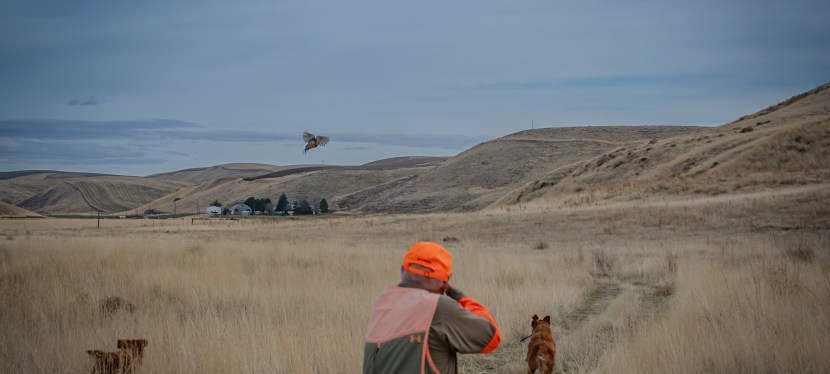
Making a beeline for the youngest dog, Scout, put me in the perfect position as a rooster pheasant broke from Scout’s pursuit. The rooster erupted directly ahead, climbing right-to-left and offering a clean swing. My 1951 C.F. Dumoulin side-by-side arrived at my shoulder with the bead perfectly aligned down range.

“Great shot!” Randy offered as Scout swiftly returned with the bird. 

“Thanks, Randy! My first rooster with the ole Dumoulin. And great dog work! I could get used to having my birds brought to hand. My setters have never cared to retrieve.”

Ten-year-old Tess settles at Randy’s feet with a prized rooster.

“Thank you! I’ll take the next bird,” Randy said with a chuckle as we moved on.

Soon after, Scout and his older companion, Tess, picked up the scent of another bird and began to push out. “Ssssssttt,” Randy quietly hissed, causing the dogs to hit the brakes and circle back toward us – an intelligent bit of training. Keeping quiet is essential to avoid spooking birds, particularly when approaching pheasants. This subtle sound instead of voice, whistle, or collar tone command can be the difference between a rooster flushing at 10 yards versus 100.

“You see how interested they look when they hit that scent? They ramp up to 100 miles per hour instantly, so you’ve got to be paying attention and moving quickly,” Randy advised as he scooted ahead, anticipating the flush. 

Randy carried a beautiful old Browning side-by-side, kept immaculate by his care and appreciation for quality and tradition. I observed Randy’s shot from behind, noting his relaxed technique and lead on the bird. The rooster tumbled, and Tess retrieved it in a textbook moment like a bread-and-butter sports play practiced 1,000 times over.

The hunt continued while Randy and I discussed birds and dogs and switched shooting opportunities with each new bird find. We strolled unhurried, carefree, appreciating every moment. It felt like a hunt for royalty, like we should have had a caddy to tote and reload the guns and serve the occasional sip of fine brandy or rich red wine in a classy sniffer.

By the hunt’s end, we each carried a passel of birds (Randy’s passel a bit heavier than mine) that would later become delicate meals shared with friends and family, sparking reflection on a noble hunt and Randy’s golden retrievers dealing a royal flush.

Classic side-by-sides like this 1951 C.F. Dumoulin 16-gauge are fun to carry, fitting of a classy hunt, and beautifully complemented by a brace of roosters.

Birds, Books, Setters, and Upland Hunting

I’ve had the great pleasure to chat with the Crew at Harvesting Nature about Wingshooting the Palouse, and I believe you will enjoy the conversation. Give it a listen on the Wild Fish and Game Podcast.

Wingshooting the Palouse is available at Amazon.com.

Grass Awns and Gun Dogs

Have you ever stopped to consider the impact upland bird hunting has on your gun dog? Birds hunters are well aware of the physical exertion on ourselves, whether its pounding the prairie for sharptails and pheasant, or pushing through draws of aspen for ruffies. But I often ponder how many hunters really understand the effort a gun dog puts into a hunt, or the stress they endure.

Upland bird hunting is a full-contact sport for a your dog. No, there are no physical altercations with other dogs (generally…), although one of our feathered quarry may be run down and tackled on occasion, but the conditions endured by a gun dog in the field are downright hazardous.

In the grouse coverts, thickets of woody shrubs and aspen, prickly hawthorn, and windfalls stand to challenge your dog’s stamina, but can also poke, pinch, scratch, and gouge. In the southwest quail country, cactus, mesquite, barbed wire, venomous critters, and a hot, dry climate stand to work your dog into the ground. The rolling prairie appears to be the most benign of the common western settings, but are you aware that your hunting companion covers three to seven times the ground you do in a day’s jaunt, not to mention porcupines, badgers, and even grizzly bears on the plains of the Rocky Mountain Front?

Gun dogs are prone to exposure to a variety of habitats in pursuit of upland game across a given season, but among the plethora of potentially harmful phenomena in the field, grass awns stand among the top contenders for most harmful. While there are a number of precautions and post-hunt measures one can take to ensure the well-being of your fur baby, grass awns can go undetected, wreaking havoc on you pup’s health.

Two common, menacing grassesfoxtail barley (left) and cheat grass (right).

Grass awns are responsible for a number of unexplained illnesses, and even deaths among gun dogs annually. But how can a grass seed be so injurious? In the western US, several grass species including cheat grass (Bromus tectorum), foxtail barley (Hordeum jubatum), and cereal rye (Secale cereale), which are largely invasive grass species, form barbed tails on their seeds or awns. The awns attach to the dog’s fur, and the sharp point of the awn may work its way into the skin between toes, in ears, eyes, mouth, nose, arm-pits, etc., and the awn barbs continue to work the awn deeper into the tissue until it can enter the interior body cavity or muscle tissue.

The awn may carry bacteria as it enters the dog’s body, and/or it may carry bacteria that are normal inhabitants of one part of the body, usually the mouth, into other parts of the body where it is abnormal, establishing an infection, typically in the form of an abscess.

As we approach and enter upland bird seasons, late summer through fall, grasses dry out and the awns loosen, becoming prone to drop. The best advice? A careful tailgate inspection of your dog before leaving the field may allow removal and avert any illness. But, with awns that have been ingested, odds are that the damage is already done by the time you and your dog leave the field. Routinely check your dog for swellings, particularly at the lower rear sections of the rib-cage, a prime site for abscess development.

What to look for:

  • Hair: Matted hair that may eventually lead to sores against the skin if not removed.
  • Ear canal: The dog shakes the head, scratches or rubs the ears, holds head at a slightly tilted angle.
  • Between the eye/eyelid: The eyes of the dog get inflamed, sometimes including discharge or tears.
  • Nose: The dog sneezes, paws at the nose, and may experience nasal discharge
  • Gums, Tongue, Mouth: If swallowed, grass awns may stick to the back of the throat causing inflammation and swelling.
  • Lungs and Other Organs (inhalation or migration): The dog shows signs of serious sickness, coughing, short breath, and vomiting.
  • Rectum and Anal Glands: dog abnormally licking or scooting on the ground, trying to defecate often or for prolonged periods.

Zeta at the vetZeta at the vet, June 2019, to have cheat grass awns removed from both anal glands.

Learn to recognize hazardous plants, and be watchful where you are hunting, training, or just exercising your dog.  Typically, a simple tailgate inspection post-hunt or run to remove awns before they have the chance to penetrate the skin and begin to migrate will eliminate problem awns, but inspection may not always reveal hidden awns immediately.  A best practice is continued monitoring of your pup’s behavior after hunting through dangerous grasses. Being mindful of the vegetation in your hunting or training areas, coupled with thorough inspections will keep your four-legged partner pointing or flushing long into their upland career.

Seven Years a Bird Dog Dad

I moved to the southeast Washington State in 2011 shortly after finishing graduate school. It was the first time I had lived in pheasant country. That fall, I harvested my first two roosters thanks to an old yellow lab who was flushing for hunters that happened to pull into the same parking spot at the same time. The feeling of holding that first big, beautiful rooster, admiring his plumage and impressive tail will never betray memory, save for dementia in my older years.

My wife, Ali, was living in California at the time and trying to make her way to Washington. At the notion of hunting pheasant, she insisted on a bird dog pup and began poring over websites and magazine articles, researching different breeds and their characteristics.  She is a bit of a sucker for good looks, mild temperament, style, and grace (and somehow wound up with me), and these traits led her to setters. She finally landed on a Llewellin setter, about which I knew nothing. I was not really interested in a bird dog at the time, but her persistence and disregard for my input (a timeless tradition) resulted in an orange belton pup we call Lynnhill’s Finnigan, Finn for short.

379194_10101418885743453_34390626_n

True to Stockholm’s Syndrome, we fell in love with this beautiful, tiny, spawn of Satan. She was the worst behaved puppy I have ever had the misfortune of raising. Bold in her infant months, anxious and terrified the rest of her first year. She refused to be house-broken or crate-train, and shredded everything including mattresses, wall trim, and any other furniture well into her thirteenth month. She screamed for dear life every time we left the house, literally the entire time we were gone, according to neighbors. She was flat not trainable. I didn’t even consider training her to hunt until she was about eighteen months old. The one thing she did well was walk on a leash, so I took her to a park outside of town most evenings and weekends where quail and pheasant were common to keep her excited about being afield.

Upon finally deciding to introduce basic commands, Finn was easily bored, like most pups, but contrary to my immediate assessment, she was sharp, and picked up the commands quite well. All hope was lost, however, when Ali arrived home from work one evening with a pair of white pigeons. I built a small enclosure in the barn on the farm we were renting, bought a pair of kick traps, and began hiding the birds in the grass and brush around the farm.

Walking Finn on a check-cord, we always began our approach downwind of the bird. Finn would cover the area impressively well, but would never honor the scent. She could smell the bird. That much was clear. Her head would snap into the scent cone, but she continued to sail aimlessly as if being forced toward the bird against her will. In vain, we tried nearly everything we could to get Finn to stop or search for the bird upon catching the scent.

Nevertheless, I hunted Finn at age two with great frustration, but I always tried to keep it fun for her. Around Finn’s second birthday, my wife broke down and bought a second Llewellin, Yuba, with the hopes that she would have a bit more hunting prowess. Yuba was quite a different pup. As a short, stocky tricolor, what Yuba lacked in grace and stature she more than compensated for in prey drive and intelligence. Within a couple months she was crate-trained and quite obedient. Most satisfying was her attention to the songbirds in the yard.

11140092_10102959544131721_5488568607664739472_n

We worked Yuba alongside Finn on the caged pigeons and hikes through bird habitat where she display immense interest and skill. Simultaneously, Finn began to settle down and mature a bit between her second and third season. It was clear that things were coming together, and I think Finn’s maturing helped Yuba learn so much quicker than Finn had as a pup.

When the pheasant season rolled around in 2016, Yuba was just over one year old and I was eager to hunt her. We began that season expecting nothing from either dog; however, we found ourselves smothered in birds opening day. Finn actually appeared to be hunting, but we didn’t count our roosters too early; not before we found her locked up solid and the first bird of the morning hit my vest. Miraculously, a second rooster fell to my Fox sixteen-gauge not ten minutes later. By the time the second rooster hit the ground, Yuba’s prey drive shone fiercely. The light bulb illuminated for Finn that day, and by the third day of the season she was methodically covering ground, honoring the scent cone, slowing down and using her nose, and pointing like a champion.

By the fifth day of the season, Yuba and Finn engaged in friendly competition of who could point the most birds and hold point the longest. Working both girls by myself most days, it was no news to lose track of them, find one on point, and spot the other locked up as I went in for the flush. With repeated exposure they instinctively began backing each other. I nearly fainted upon my first witness of this phenomenon.

DSC_0303a

During the 2017 season, the girls hit the ground running with virtually no prior off-season yard work. Both pups worked famously and I won’t soon forget Yuba’s exuberant eyes as she stood hard and proud, pinning fast the largest wild rooster I have ever seen. He flushed nearly under Yuba’s face as I closed in. My startle at his size and beauty caused me to whiff both barrels on his steep ascent. We stood in awe, looking after the handsome rooster sailing across the grasslands. We could have limited out for the first time that morning, but ole dad was a disappointment with the scatter gun.

As a first time bird dog owner and a mediocre trainer at best, my pups and I have learned a lot from each other; the greatest lesson being patience and persistence. Looking back over the early seasons, I wouldn’t trade the frustrating hunts for anything as they make the reliability of the girls so much sweeter these days. Zeta (my youngest) is not progressing as Finn and Yuba did, but time is on our side. If have learned anything, it’s that a fine dog can be developed when the time is right, and the upcoming season will be her second. A lot can change in the blink of an eye, and I anticipate North Dakota will be the game changer. At some point in the not too distant future, I will reflect proudly on my trials with Zeta. And as dog dad, I cherish the early days.

DSC_0960