Steppe Outside – The Search for Washington’s Dancing Grouse

Published May 18th, 2024, in the Walla Walla Union Bulletin

Rain hammered upon the camper roof throughout the night, robbing me of the restful sleep I envisioned when planning a trip to the north-central scablands. Spring in the scablands is purely magical, and I often find myself float-fishing for trout on the many good fishing lakes. This trip was something different, however.

Rousing groggily to the 4:00 a.m. alarm meant my sleepless night would soon be rewarded with a cold, wet sit in the dark. Surrounded by Columbian sharp-tailed grouse habitat, I was about to embark on my first-ever lek survey to assist the Washington Department of Fish and Wildlife (WDFW) in monitoring one of this species’ seven fragile populations in Washington State.

We’ve all heard the adage that Columbia River salmon once returned so abundant that one could “walk across their backs.” Well, the story is similar for the Columbian sharp-tailed grouse. When the west was settled, sharp-tailed grouse numbered in the millions. Eastern Washington was largely shrub-steppe habitat and supported hundreds of thousands of the subspecies “Columbian” sharp-tailed grouse. They were commonplace. But, like the passenger pigeon, no one considered they would ever face extinction.

A tragedy of being human is that we often fail to notice a gradual decline in something so familiar until we’ve slipped past the point of recovery. The bird’s initial decline was noted as early as the 1950s, and as the vast Washington shrub-steppe disappeared an acre at a time, the Columbian sharp-tailed grouse followed.

The temperature plummeted with the falling rain, which soon turned to heavy snow. The veil of large white flakes impaired visibility on the greasy gravel road, not to mention the waves of muddy water splashing over the windshield from large puddles.

Thirty minutes later, Malika, George, and I sat in the snow overlooking a several-hundred-acre basin supporting a handful of historic and active sharp-tail “leks”. North American grasslands grouse – sharp-tails, sage grouse, and prairie chickens – use these traditional habitat areas year after year where males perform courtship rituals and compete for mates. The word “lek” combines the idea of “mating” (from the Swedish “lek”) and the notion of a “place” (from the Swedish “ställe”). In Swedish, “lekställe” directly translates to “mating ground”[1].

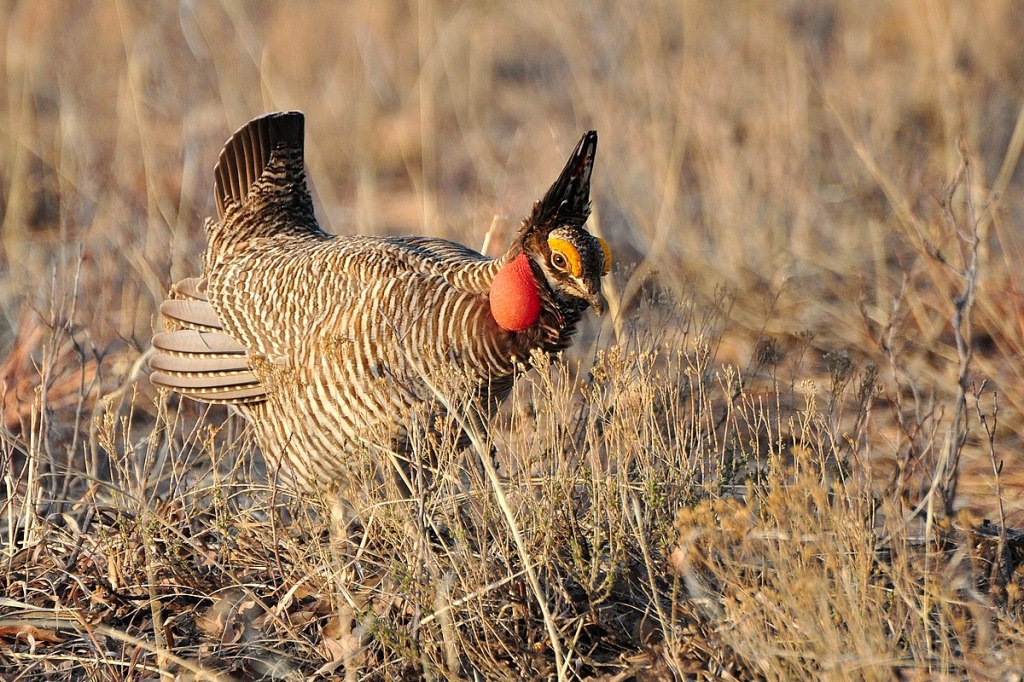
Sharp-tail males flash their “superciliary combs,” or sunflower-yellow eyebrows, and their “drum nape,” which are violet-colored air sacs on either side of their neck, while bowing with their tails high and wings extended, looking like a plane dropping onto the runway. They shuffle and tap their feet swiftly and click their two namesake pointed tailfeathers as they dance. Their tailfeathers clicking sounds like an old film reel movie playing as the birds spin about. In areas with strong sharp-tail populations, grasses on the lek can become beaten down from weeks of morning dancing, “hooting, clucking, and gobbling” rituals.

While I knew we overlooked an active lek, sharp-tails would only dance in my head this morning. We eagerly awaited dawn, listening for any hint of these mythical birds while snowflakes noisily pattered our synthetic jacket hoods. I had seen sharp-tails by the dozen in Montana and the Dakotas, but to see Columbian sharp-tails on their native Washington soil was a spectacle I longed to behold.

Survey protocol was to walk the lek about 45 minutes after sunrise. By then, any birds on an active lek would at least be heard if not seen, and the lek activity would be waning for the day. Flushing the birds provides more accurate counts and allows surveyors to search for scat and feathers; the feathers can be used for genetic testing. Due to the snow and no sign or sound of the birds, we left the lek without bothering to walk it as no feathers or scat would have been visible.

Back at camp, we all returned to our respective mobile shelters and wiled away the day, watching the snow fall, reading, and preparing for another cold morning.

The next morning dawned frigid cold, crystal clear, and with a million shimmering stars. Malika and I went alone to the same lek as before and again awaited dawn while a chorus of wildlife warmed their voices. 

“If I were a grouse, I would be dancing on a morning like this,” I said as we plopped down in the dark with our ears tuned to the sharp-tail channel.

Canada geese, mallards, and a hundred other waterfowl competed with a pack of coyotes in every compass direction for the award of “most obnoxious morning song,” but something different drifted in from our left. The low, two-pitched cluck from what sounded like a single bird somewhere in the grasses was a new sound for both of us.

“I think that’s a sharp-tail,” Malika whispered.

“So do I,” I replied while shifting to scan the lek with my binoculars.

We never spotted the birds from where we sat, but around 7:00 a.m., we strolled down onto the lek in search of scat and feathers. The sun glistened upon the frost-encrusted bunchgrasses in the 27-degree stillness. We walked more than 100 yards of what appeared to be prime lek without a speck of sign, but as Malika turned to make a pass back, the slap of upland bird wings grabbed my ears. My head snapped right so fast that I nearly pulled a neck muscle. The tell-tale flushing “chuckle” of a sharp-tailed grouse was so exciting that I yelled, “Sharp-tailed grouse!” while pointing at the fleeing bird. Moments later, a second bird lifted off, chuckling as it raced toward the horizon.

We finished walking the lek with no further sign of birds, but the sun shining warmly upon our shoulders fortified our sense of triumph. Malika was a 20-year-old college undergrad with a fresh notion of becoming a wildlife biologist. Before that weekend, she had no clue what a sharp-tailed grouse was, much less any awareness of the bird’s struggle for existence in Washington State. The experience was unique for us in different ways, although seeing a sharp-tail in Washington was a first for us both.

For Malika, it was a cool “sciency” encounter with an upland bird. For me, it was like stumbling upon delicate frost flowers or catching a glimpse of UFO-shaped lenticular clouds. These natural phenomena exist, but they are rare enough that it’s unlikely to experience them.

That chuckling sharp-tail flush echoed through my mind on the drive home. Just seven remnant populations of Columbian sharp-tailed grouse remain in Douglas, Lincoln, and Okanogan Counties. The total Washington population is fewer than 1,000 birds, and the largest individual population remains on the Colville Reservation. Columbian sharp-tails occupy approximately three percent of their historic Washington range, making habitat loss events like the September 7th, 2020, Whiney Fire that torched over 127,000 acres a significant threat. That’s a large enough area to wipe out one of the remaining populations completely.

The Colville Tribes are deeply invested in Columbian sharp-tailed grouse conservation efforts, working alongside the WDFW, Bonneville Power Administration, and local Public Utility Districts in the upper Columbia River. According to the WDFW, the Colville Tribes began assisting with translocation efforts as far back as 1999 (possibly before) by providing birds from the Reservation to be released at the WDFW 9,000-acre Scotch Creek Wildlife Area in Okanogan County. The BPA paid for the Scotch Creek land acquisition with mitigation funds for the operation and electricity sales from Chief Joseph and Grand Coulee Dams.

The Columbian sharp-tailed grouse is classified as “endangered” in Washington and protected from hunting. With ongoing efforts by the Colville Tribes, WDFW, and non-profits, Washington’s sharp-tailed grouse can hang on, but how long is unknown.


[1] Lek – Words For Things You Didn’t Know Have Names, Vol. 3 | Merriam-Webster

Cover Photo by the US Fish and Wildlife Service
Rewinding the Kissimmee River

Published May 19th, 2023 at Harvesting Nature.

When country music artist, John Anderson, released his hit song Seminole Wind in 1992, his fans fell in love with it. Music is about storytelling, and Seminole Wind speaks of the Everglades’ history and ecological and cultural collapse.

“They made their plans and they drained the land. Now the glades are going dry.”

Anyone who has heard the song remembers these powerful lyrics. However, the true context was lost on folks that were unaware of the ecological damage that had been done “…in the name of flood control.” The Kissimmee River provides a cut-and-dried case study.

The Kissimmee River once snaked 103 miles south from its Lake Kissimmee headwaters to Lake Okeechobee. The river’s floodplain was a two-mile-wide wetland inundated by seasonal rainfall. This wetland corridor provided prime habitat for at least 38 species of waterbirds and 39 fishes. The life history of these species depended upon the wetlands1.

The “flood pulse concept” is an ecological process involving seasonal flooding and inundation of the lands surrounding a waterbody. Flooding delivers sediment and nutrients to the land, opens spawning habitat for fishes, and creates breeding and feeding opportunities for wildlife. Seasonal flooding also replenishes the water table and shallow aquifers.

As development spread through Central Florida in the mid-1900s, the Kissimmee River’s seasonal flooding became problematic for Florida’s economic growth. The state approached the US Army Corps of Engineers (USACE) with a request for assistance in draining the land for development2

Between 1962 and 1971, USACE channeled the Kissimmee River, creating a 30-foot deep, 300-foot wide, 56-mile-long drainage canal. This project drained approximately 50,000 acres of the Kissimmee’s floodplain wetlands3 and effectively ended the seasonal flood pulse. Within a few years, waterfowl populations dropped by 90 percent, bald eagle numbers by 70 percent, and some fish, bird, and mammal species vanished entirely2. Ironically, the canal system drained too well.

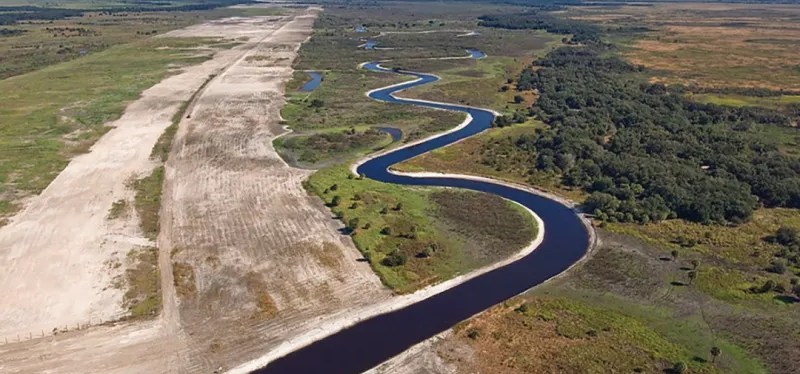
The formerly channelized Kissimmee River – photo by the South Florida Water Management District

“It messed up our water management infrastructure. Now, we drain so much water that when it’s dry, we don’t have enough water for our human needs. We over-drained, and so now we’re trying to rebuild the system where we’re going to catch water instead of wasting it when it’s wet”, said Paul Gray, Everglades Science Center Coordinator of Audubon Florida.

Beginning in the 1990s, USACE and its partners began cooperating to restore the Kissimmee River ecosystem. Coincidentally, Congress authorized the restoration in 1992 as Seminole Wind played through millions of FM radios and televisions.

More than 20 years and over $1 billion later, the restoration of approximately 44 miles of the Kissimmee River and 25,000 acres and 40 square miles of wetlands have been re-established and rehydrated1,2. The restored floodplain and wetlands now support at least 159 bird species3.

Re-winding a river is something rare and nearly impossible to accomplish, particularly at the scale of the Kissimmee River. Fortunately, in our modern world of “engineering with nature” and “nature-based solutions” to infrastructure problems, science and technology can cooperate with the environment to balance needs and functionality. The Kissimmee River restoration is the largest functioning restoration of its kind worldwide – something the USACE and Floridians can be proud of.

[1] Kissimmee River Project – Largest Restoration Initiative of its Kind – Complete After Nearly 30 Years | Audubon Florida

[2] The Kissimmee River has been brought back to life—and wildlife is thriving (nationalgeographic.com)

[3] Kissimmee River Project restores about 40% of river’s twists | South Central Florida Life

Feature Image Credit: US Army Corps of engineers, Jacksonville District

ESA-Listing of the Lesser Prairie Chicken – A Tenuous Move for Species Recovery

On November 17th, 2022, the US Fish and Wildlife Service (USFWS) announced the listing of two distinct population segments (DPS) of lesser prairie chicken – a northern DPS and southern DPS. Over approximately the past 40 years, this iconic bird of the North American Great Plains has lost 90 percent of its habitat to land use practices. Once enumerating in the millions, there are scarcely 30,000 individuals remaining across the states of Colorado, Kansas, New Mexico, Oklahoma and Texas[1].

This recent ESA listing has been a long time coming, dating back to 1998 when the USFWS identified the lesser prairie chicken as a candidate for ESA listing and protections, and a 2014 ESA listing as “threatened” that was “vacated” following a lawsuit. But ESA listing may not be the best approach for protecting the species and their habitats.

Ninety-five percent of the land across the lesser prairie chicken range is privately owned, and significant conservation efforts have been made for the species over the past two decades. The Natural Resources Conservation Service (NRCS), through the Lesser Prairie-Chicken Initiative[2], has worked with nearly 900 landowners to implement conservation actions on approximately 1.6 million acres. Landowners currently have enrolled more than 1.8 million acres in the Conservation Reserve Program across the lesser prairie chicken range. Pheasants Forever and Quail Forever are working in concert with these conservation programs.

Conversely, the ESA protects listed species and designated “critical habitat” from “take”, which is defined as “harass, harm, pursue, hunt, shoot, wound, kill, trap, capture or collect, or attempt to engage in any such conduct”. Rather than working to make improvements for the species, the ESA works to avoid impacts to the species, including those that are short-term and temporary as a result of an action that will benefit the species in the long run (i.e. habitat restoration).

Section 9 of the ESA presents “prohibited acts” that constitute take, for which there is no exception for species listed as “endangered”. This means that every action within the endangered lesser prairie chicken southern DPS range, from a landowner grazing cattle to a habitat restoration project, will require some form of “incidental take coverage” from the USFWS.

“For more than two decades, the [USFWS] and its partners have been working together to conserve this iconic species and its habitat. Together we have developed a suite of conservation tools and plans, including Candidate Conservation Agreements with Assurances (CCAA) and Habitat Conservation Plans (HCP), across the lesser-prairie-chicken’s five-state range to protect the species and provide certainty for industry and landowners”, reported Aislinn Maestas with USFWS Public Affairs.

The “assurances” written into CCAAs and HCPs are basically conservation measures imposed by the USFWS to “minimize and avoid” incidental take, which may or may be relevant to a given action. Depending upon what assurances are written into USFWS regulation, the assurances may require an inappropriate proportional cost for little benefit to the species, when those funds could be better used for proposed restoration efforts.

Additionally, the USFWS Ecological Services Branch is regularly understaffed and overworked, making ESA consultations inefficient to the point of stalling project proponents from taking action. This is a common scenario with federal land management efforts in other parts of the nation, where impact avoidance to an ESA-listed species or critical habitat has stalled important invasive species control efforts, resulting in further degraded habitat for the species in which the proposed management actions are intended to support.

Actions may be taken in the range of the threatened northern DPS under ESA Section 4(d). “The 4(d) rule applies all of the ESA section 9 prohibitions to the Northern DPS, but provides that farmers can continue their routine agriculture activities on existing cultivated lands. In addition, it recognizes the importance of proper grazing management, and includes an exception for those producers who are following a site-specific prescribed grazing plan developed by a qualified party that has been approved by the USFWS. Lastly, the 4(d) rule also provides an exception for implementation of prescribed burning for grassland management[3].” 

Because of the pitfalls of bureaucratic process and the vast majority of private lands where lesser prairie chickens reside, grant funding and non-profit habitat improvement projects likely provide the best opportunity for these imperiled birds.

“These new [ESA listing] classifications will impact landowners who, in the end, are going to be key to saving a species from, yes, extinction”, says Ron Leathers, Quail Forever and Pheasants Forever Chief Conservation Officer. “We believe voluntary, incentive-based conservation programs — the kind of programs we help implement on the landscape — are the greatest opportunity to positively impact lesser prairie chickens and save them.”

Voluntary landowner/non-profit and NRCS partnerships ensure that actions can be planned and implemented, cooperation and buy-in can be gained from neighboring landowners, and improvements can adapt to change on the ground. This has been proven through programs like the Lesser Prairie-Chicken Initiative and the Sage Grouse Initiative. The ESA regulatory and impact avoidance processes work counter to this productivity.

At the end of the day, protection for the lesser prairie chicken and their habitat is a win, but will ESA protection do more harm than good by imposing potentially unnecessary process on progressive habitat restoration and beneficial land management practices? Only time will tell.

The final rule to list the two Distinct Population Segments of the lesser prairie-chicken and the final 4(d) rule published in the Federal Register[4] on November 25th and will become effective 60 days after publication.


[1] Conserving the lesser prairie-chicken | U.S. Fish & Wildlife Service (fws.gov)

[2] Home – Lesser Prairie-Chicken Initiative (lpcinitiative.org)

[3] Lesser Prairie-Chicken Listing FAQs | U.S. Fish & Wildlife Service (fws.gov)

[4] Federal Register :: ESA Status of Two Distinct Population Segments of Lesser Prairie Chicken

Feature Photo – Lesser Prairie Chicken by Ryan Haggerty, US Fish and Wildlife Service, Public Domain

Body Photo – Lesser Prairie Chicken, Public Domain https://www.flickr.com/photos/larry1732/5644328619/in/photostream

Tree Removal Benefits Greater Sage Grouse Population Growth

Tree Removal Benefits Greater Sage Grouse Population Growth – Harvesting Nature

Woody plant expansion into shrub and grasslands poses a significant ecosystem issue for multiple uses. In the Great Basin of North America, pinyon–juniper expansion into the sagebrush biome is threatening the greater sage grouse, a sagebrush obligate species, as well as pronghorn, mule deer, and livestock grazing due a major shift in the vegetation community and associated ecosystem components.

According to Brianna Randall of the Sage Grouse Initiative (SGI), “More than one million acres of sagebrush grazing lands in the Great Basin have turned into pinyon-juniper forests in the past two decades alone.”

This is problematic for sage grouse because they avoid landscapes with trees, likely because trees provide raptor perching and nesting habitat. Additionally, trees crowd out and take precious water from perennial grasses, forbs, and other plants that a variety of wildlife rely on, and can effectively reduce habitat carrying capacity and suitability, causing species to relocate.

Protecting and restoring the sagebrush ecosystem is at the forefront of the Natural Recourse Conservation Service (NRCS) mission. Through the NRCS Working Lands for Wildlife program, the SGI was born and includes partnerships with other land management agencies, universities, and landowners. As a collective, these entities work to enhance the sagebrush ecosystem for cooperative wildlife and agricultural uses.

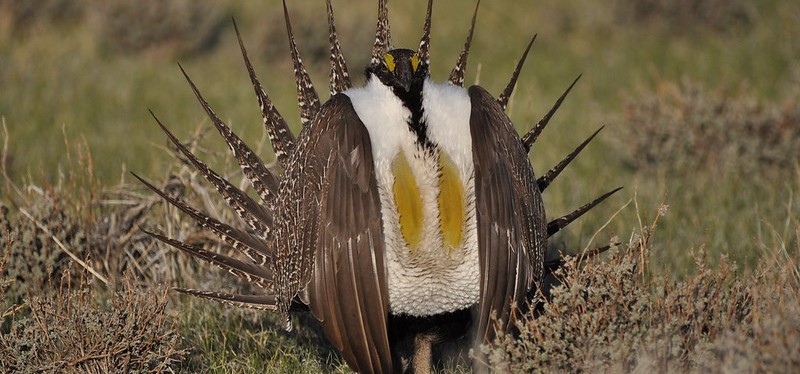
Sage grouse on the lek. (Photo credit USFWS)

Since approximately 2011, a pinyon–juniper removal effort has been underway in the Warner Mountains in south-central Oregon. Concurrently, researchers GPS-tracked 417 hen sage grouse over a 109,000-acre “treatment” area with active tree removal.

Study results published in June (Olsen et al. 2021) show that within the treatment area, sage grouse population growth rates increased approximately 12 percent within five years of tree removal compared to a population within an adjacent 82,000-acre “control” or area with no tree removal. Similarly, a 2017 SGI report identified that 29 percent of tracked hen sage grouse in Oregon returned to restored nesting habitats within four years post-restoration. Encouraging results for the future of sage grouse and the sagebrush ecosystem.

The rarity in seeing such positive population results from habitat management was summarized appropriately by Olsen et al. (2021).

“Examples of positive, population-level responses to habitat management are exceptionally rare for terrestrial vertebrates, and this study provides promising evidence of active management that can be implemented to aid recovery of an imperiled species and biome.”  

References

Olsen, AC., JP Severson, LD Maestas, DE Naugle, JT Smith, JD Tack, KH Yates, and CA Hagen. 2021. Reversing tree expansion in sagebrush steppe yields population-level benefit for imperiled grouse. Ecosphere https://doi.org/10.1002/ecs2.3551.

Sage Grouse Initiative. 2017. Conifer Removal Boosts Sage Grouse Success. Science to Solutions Series Number 12. Conifer Removal Boosts Sage Grouse Success – Sage Grouse Initiative

WDFW takes Important Step in Post-fire Habitat Recovery

Wildfires that tortured the Pacific Northwest in September did a number on the Washington Department of Fish and Wildlife’s (WDFW) Swanson Lakes Wildlife Area (Swanson Lakes), located about 10 miles south of the town of Creston.

Swanson Lakes is a 21,000-acre tract of native grasslands nestled among the channeled scablands of the Columbia Plateau. Shrub-steppe and riparian/wetlands comprise the dominant habitats and much of the area is rangeland, with some old Conservation Reserve Program fields. The undulating landscape is characterized by numerous pothole and rim rock lakes and one intermittent stream.

Z Lake in the Swanson Lakes Wildlife Area is one example of the unique channeled scablands and shrubby habitat. Photo courtesy of WDFW.

In western habitats, wildfire threatens native vegetation in two ways. First, given our rangeland’s generally unnatural fire cycles from fire management and encroaching invasive species, wildfires often burn much hotter than they would in pristine habitats. Fires that are too hot scorch the seed bank and possibly the underground root structure of native shrubs like sagebrush, damaging the plant’s potential to regenerate. Second, invasive weeds are incredibly prolific and competitive. In the case of the earth being blackened down to bare soil, weeds can quickly flourish, outcompeting native plants, often by simply covering the area, effectively shading out the native species.

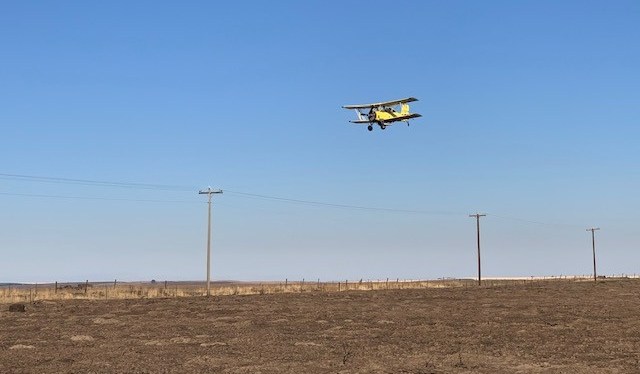
Fortunately, WDFW was poised to respond, leveraging funds in cooperation with the Bureau of Land Management (BLM) to quickly apply native grass seed mix to the charred Swanson Lakes landscape. Aerial seed drops covered about 930 acres on October 22nd, scattering two varieties of bluebunch wheatgrass, Idaho fescue, Sandberg bluegrass, and prairie dune grass across Swanson Lakes and a portion of adjacent BLM lands, said Mike Finch, WDFW Swanson Lakes Wildlife Area Assistant Manager.

Fall is not the ideal season to sow grasses, but the timing could not have been better. The WDFW and BLM made the seed drops in October to ensure native seeds were available to germinate on the exposed soil ahead of any invasive species seeds. Additionally, wet snow that fell October 23rd and 24th worked well to soak the seed into the soil surface, increasing the likelihood of establishment through good seed-to-soil contact. The WDFW plans to return with machinery in drier conditions to scratch the seeds slightly deeper into the soil surface.

Finch mentioned that Swanson Lakes was one of three areas receiving fall seed drops. The areas were prioritized for immediate reseeding due to their deeper soils, being more likely to establish and sustain healthy native grasses by allowing roots to grow down into moist soils for good summer survival. Understanding site conditions and prioritizing restoration efforts is important for project success and the best use of resources, particularly with the cost of native grass seed as high as $200 per acre, plus application time.

Native grass seed being dropped in Swanson Lakes Wildlife Area, October 22nd. Photo courtesy of Mike Finch, WDFW.

Native shrub-steppe communities are a critical part of the ecosystem in the arid west, providing food and shelter for a wide variety of wildlife. The sharp-tailed grouse, for example, is an iconic western prairie grouse species that thrives in shrub-steppe habitat. Precisely why maintaining quality native habitat in Swanson Lakes is of critical importance. The area was acquired by the Bonneville Power Administration, primarily as a wildlife mitigation project for Columbian sharp-tailed grouse, a state “threatened” species.

By leveraging funding and relationships with the BLM, and making smart decisions on the use of available resources, WDFW can sustain unique and important shrub-steppe habitat areas like Swanson Lakes to benefit wildlife and the public user well into the future.

Can Hunting Keep us Human?

Paula Young Lee poses the question in the High Country News. If this strikes you as a philosophical diatribe, you may be correct. But in an era where hunting is increasingly despised (read: misunderstood), the deeper meaning behind such ecosystem interaction at the human level of cognizance is indeed ponderous.

Hunting’s broader importance to human existence reconnects the severance between human life-history and the complex society we have developed. Humans operate under the disillusion that humans are superior to the natural ecosystem, having no association with the natural world or ecosystem function. But the hunter views things differently.

DSC_1124

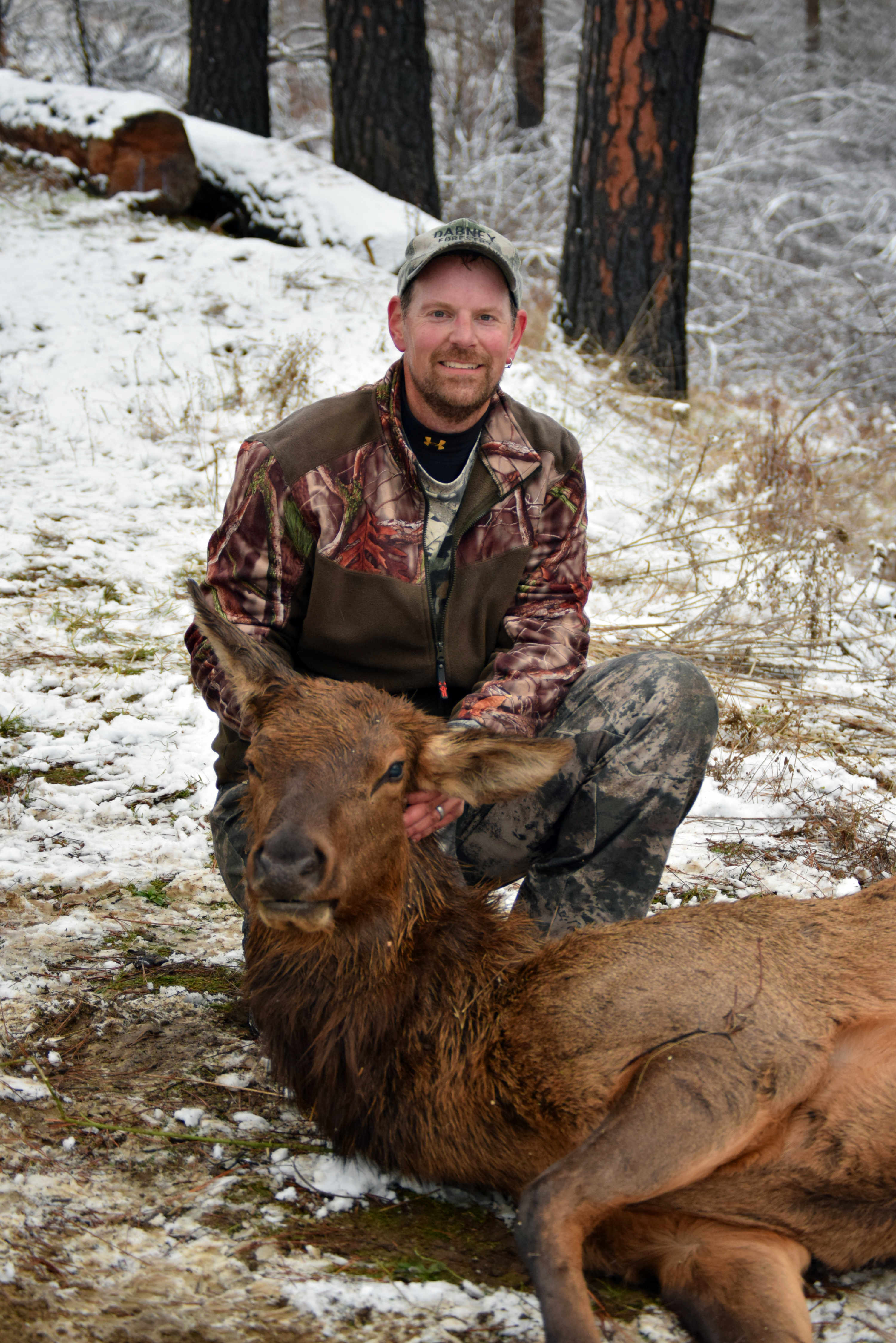
⇑⇑ Above: the author with a cow elk, his first, taken on the Idaho winter range, December 2018. Hard earned and well respected. The tags for this special draw hunt have since been stripped from the public and given to private landowners as depredation tags. ⇑⇑

“It may seem like sophistry to argue that hunting protects wildlife, but the act of hunting encompasses far more than shooting a wild animal, and it neither starts nor ends with a death. The hunt itself is part of a much larger continuum.”

Diving deeper into the meaning of the hunt, Lee discusses the spiritual connection between hunter and prey, and that the hunter views wild game as a blessed gift. Lee reinforces her point of the larger continuum through an economics analogy related to the gift of wild game.

DSC_0018a

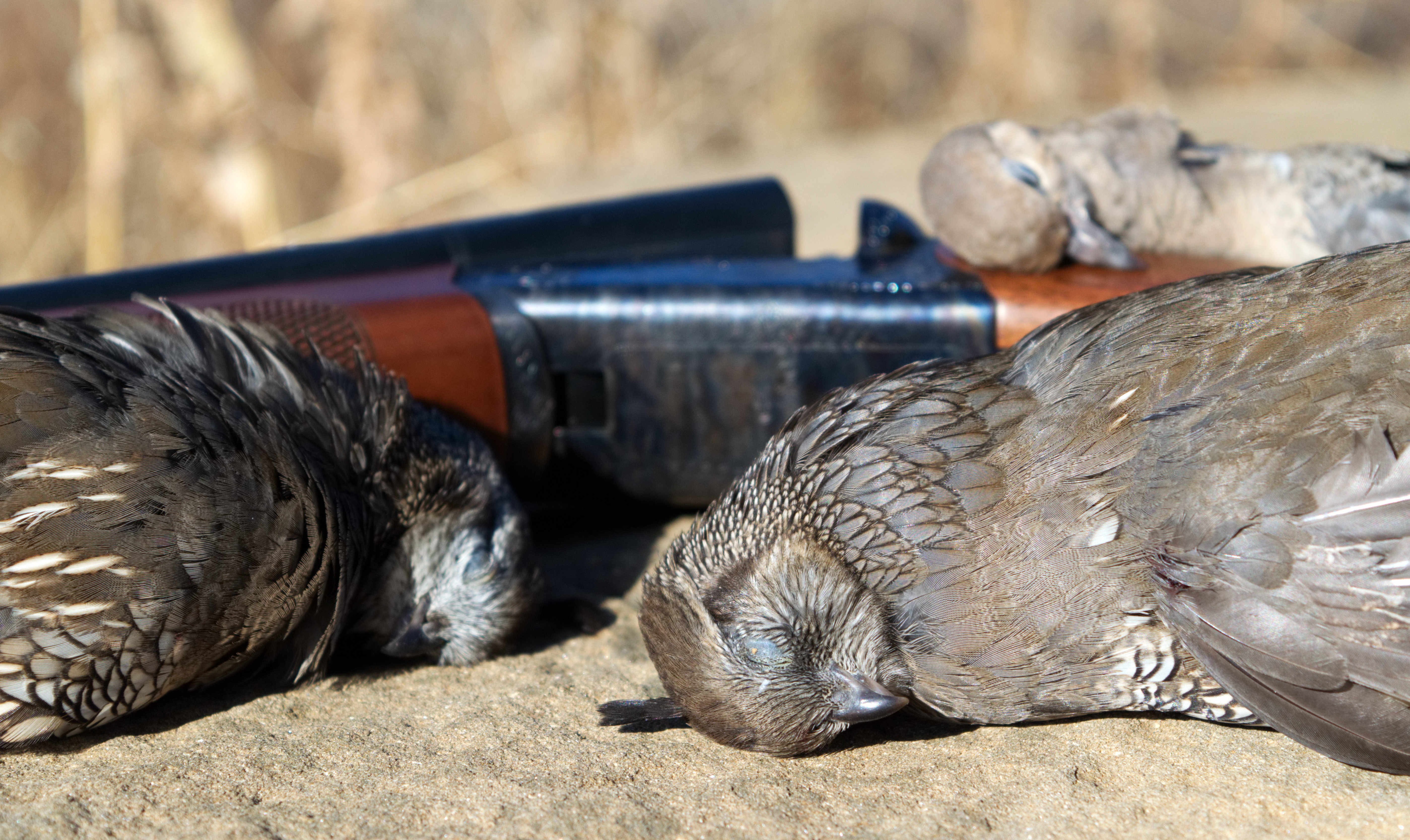
⇑⇑ Above: A successful valley quail hunt with two hens falling to a pointing dog and swift gun work. This interaction with the canine and upland bird plays a crucial role in spiritual rejuvenation for the hunter, who, in turn, gives back to conservation. ⇑⇑

“In a gift economy, the act of giving compels the person who receives the gift to reciprocate. A gift can be refused, but that refusal has consequences. Hence, ethical hunters reciprocate by protecting the wilderness, giving of themselves to ensure that the forest stays the forest….”

Hunting maintains our connection with and works to conserve our place in the ecosystem, and the ecosystem itself. The preservation of human nature.

Upland Stewardship Begins at Home

What’s the #1 threat to habitat on undeveloped public lands? If you guessed invasive plant species, you get a gold star for the day. Overall, habitat lost to civil development is a critical threat to fish and wildlife, putting tremendous importance on conservation and management of those precious public acres still intact.

Managing public land is important to provide habitat suitable for wildlife species and is accomplished through taxpayer and sportsman’s funds. For federal lands, this means congressional appropriations must be approved for specific geographic areas and funding limits.

While public lands, both state and federal, are at much lower risk of civil development, the economics of habitat management is a major driver in our ability to maintaining high quality habitat, and here is why.

Invasive species are incredibly competitive and successful at overtaking desired native species. With no natural predator controls (i.e. herbivory and parasitism) and an adaptive edge to the climates in which they occur, many species can create monocultures in short order. What’s more is that the increasing cost of invasive species control detracts from government ability to fund general habitat management and enhancement.

Picture2

Once established, eradicating an invasive plant is incredibly difficult and extremely costly, in the billions of dollars nationwide, annually. Our ability to control invasive species on public lands can change dramatically with political leadership. And when natural resources budgets are cut, our ability to effectively maintain habitat is hamstrung.

Early Detection and Rapid Response is the normal mode of operation for habitat managers, but budget cuts cause vulnerability in on-the-ground effectiveness. Labor cuts can reduce the number of employees and hours spent afield performing Early Detection monitoring. Supply cuts can reduce the available tools to implement Rapid Response once invasive species are detected, as well as reduce the overall time or acreage that biologists can treat.

High-quality habitat is not just nice to have for an easy, clean hunt. It’s a must for sustainable upland bird species and hunter opportunity. Its easy to assume that habitat management and controlling invasive species lies in the hands of qualified biologists, but make no mistake, quality habitat starts at home with you, the general public.

20191020_122336

⇑⇑ The seat cover in my Tundra harbors a number of invasive species ⇑⇑

As our talented canines careen across the grasslands searching for sharptails or cut through brush following a running grouse trail, their fur picks up invasive weed seeds that can be easily spread to otherwise weed free areas. Tailgate checks and post-hunt spa treatments (for those of us who own long-haired pups like setters and Munsterlanders)  are necessary to remove to potentially harmful grass awns and bur-like seeds.

Most importantly, uplanders that embark on rooster road trips would be remiss if they failed to clean the nooks and crannies of their bird hunting chariot prior to driving half way across the nation. A single germinated seed from a nasty invader like cheat grass (Bromus tectorum) can quickly threaten native species and impact habitat suitability.

Be sure to clean out the truck bed, pet crates and blankets, truck seats and seat covers, spray down floor mats and vacuum the crevasses that can harbor seeds.

20191020_121840

⇑⇑ Cleaning vests, kennels, truck beds, and interiors is critical ⇑⇑

If your truck cap has a carpet liner, inspect it with scrutiny. Your dog will shake in the truck bed, flinging weed seeds onto the ceiling and anywhere else they may attach, simply waiting to be offloaded in an otherwise clean area 1,000 miles from where they were picked up.

And the cleaning spree should not end with the truck and kennels. Our vests and clothing can trap a terrifying number of seeds. When was the last time you check your hunting vest pockets for seeds? Hundreds of grass seeds can gather in vest pockets as we traverse the prairies. Dog vests can capture a number of species as well, like bur chervil (Anthriscus caucalis), which wreaks havoc on native grasses and even competes with yellow starthistle (Centaurea solstitialis) in the arid west.

20191020_121913a

⇑⇑ A water bottle pocket of my hunting vest captures many seeds and plant debris ⇑⇑

Conservation and habitat management are influenced by each and every one of us. Its your duty as an uplander to exercise your stewardship abilities and battle the spread of invasive species. The future of our public natural resources and habitat depend on it.

Haying Best Management Practices for Wildlife

Farming and habitat practices to maintain healthy CRP and alfalfa stands provides significant nesting and brood rearing benefits to upland game birds, fawning areas for deer, and nesting and roosting habitat for wild turkey in the early spring and summer. Long, overhanging grasses provide nesting cover while broad-leaf plants like alfalfa and other native forbs provide insect forage for fledgling broods and hens. These stands draw and hold birds but have been called “ecological traps” in areas where haying regularly occurs.

The term ecological trap refers to a beneficial condition that attracts wildlife, but results in additive mortality, affecting the population overall. Quality CRP and alfalfa stands fit the scenario well where haying normally occurs during nesting season.

As haying equipment approaches, a hen pheasant may not vacate eggs or chicks, rather hunker down and use her camouflage for protection as a tractor passes by. This leaves birds vulnerable to the following mower which may be offset from the tractor. Likewise, small mammals and deer fawns use similar camouflage techniques and experience similar vulnerabilities to upland birds.

Best Management Practices

To minimize the potential hazardous effects of haying on wildlife, the Natural Resource Conservation Service has developed a few simple best management practices.

1) Defer haying. Apply and maintain at least two of the following management actions specifically for improving or protecting grassland functions for target wildlife species.

  • Do not cut hay on at least 1/3 of the hay acres each year. Idle strips or blocks must be at least 30 feet wide.
  • For at least 1/3 of the hay acreage, hay cutting must be either before and/or after the primary nesting or fawning seasons based on state established dates for the targeted species.
  • Increase forage heights after mowing to state specified minimum heights for the targeted species on all hayed acres.

2) For all haying during the nesting/fawning season implement at least two of the following to flush wildlife from hay fields during the mowing operation:

  • A flush bar attachment will be required on the mower (see figure below).
  • All mowing will be done during daylight hours.
  • Haying pattern:
    • Begin on one end of the field and work back and forth across the field, OR;
    • Begin in the center of the field and work outward.

Following these simple practices can greatly reduce unintentional wildlife mortality, further increasing the benefits of environmentally friendly farming.

flushing bar

Image from the Natural Resource Conservation Service.