The Proposed “Public Lands Rule” and What You Need to Know About It

Originally published at Harvesting Nature, August 11th, 2023.

            On July 5th, the public comment period closed on the Bureau of Land Management’s (BLM) proposed conservation and landscape health rule, or the “Public Lands Rule,” to make conservation a “land use” equivalent to all other land use activities like recreation and mineral extraction. Implementation of the proposed rule could be a game changer for conservation.

The BLM manages more than 245 million acres of public lands (approximately one-tenth of the country), the stewardship of which is guided by the Federal Land Policy and Management Act of 1976 (FLPMA), unless otherwise provided by law. The FLPMA provides the BLM the authority to manage public lands for resource and ecosystem conservation. The Public Lands Rule would “…provide an overarching framework for multiple BLM programs to promote ecosystem resilience on public lands.”

The Public Lands Rule would do the following:

  • Apply land health standards to all BLM-managed public lands and uses;
  • Clarify that conservation is a “use within” the Federal Lands Policy and Management Act’s (FLPMA) multiple-use framework;
  • Establish a framework to promote ecosystem resilience on public lands through the creation and deployment of conservation leases, which will allow third parties to engage in conservation and mitigation activities on BLM lands.

Each of the four points is important for enhancing and perpetuating ecosystem integrity on a vast proportion of public lands.

The application of land health standards would establish a baseline condition for public lands for which to apply effects analyses for proposed land use actions. Ensuring that proposed actions like grazing, mining, and timber harvest would maintain or improve the baseline condition consistent with conservation practices as a compatible land use would result in long-term ecosystem benefits.

Updating the Department of Interior’s land management regulations to enhance the BLM’s ability to designate Areas of Critical Environmental Concern (ACEC) will better protect and perpetuate sensitive habitats and cultural resources. The benefits of protecting sensitive and scarce habitats are clear, but sensitive cultural sites are not always known or as easy to protect beyond National Parks or Monuments, for example. Concerted efforts by the BLM to gain Tribal input for the establishment of ACECs beyond routine National Environmental Policy Act requirements have the potential to protect areas of cultural significance on a much broader scale and without an act of Congress.

“Conservation leases” present a novel idea for leasing areas specifically for habitat enhancement, ecosystem restoration, and compensatory mitigation for land development actions. Conservation as a land use and conservation leases are proposed to work in concert with other approved land uses or development but have the potential to establish boundaries for resource protections and allow for on- or off-site mitigation for potential habitat damage. 

The proposed Public Lands Rule as written is fairly robust, but the proposed language requires clarification.

Regarding conservation leases, the proposed language in Section 6102.4(a)(5) of the proposed Public Lands Rule aptly clarifies that “…the [conservation lease issuance] itself should not be interpreted to exclude public access to leased lands for casual use of such lands….” Plainly put, public recreation is permitted on lands under a conservation lease. However, this language requires two clarifications. The language should read “…the rule itself SHALL not be interpreted to exclude public access to leased lands for casual use of such lands….” The word “should” is dismissible and may lead to interpretations that would arbitrarily prohibit public access and recreation.

Additionally, “casual use” of public lands must be clearly defined to include appropriate low-impact recreation activities such as hiking, hunting, fishing, etcetera. Without a clear definition, interpretations of “casual use” may again arbitrarily prohibit certain types if not all public recreation on conservation leases.

To ensure the conservation lease language is appropriate for the final rule, the BLM requested The Wildlife Society (TWS) review and comment. The TWS Rangeland Wildlife Working Group led the review and provided six pages of suggested clarifications and overall support of the proposed Public Lands Rule.

For areas identified as ACECs, the proposed language would impose protections on these lands, yet the language is unclear when and how “protection” may be given to ACECs and what “protection” means. Some ACECs will be more culturally sensitive or pristine than others and should require greater restrictions on activities within those areas.

In conclusion, the proposed Public Lands Rule is a valuable effort with the potential to enhance and maintain ecosystem and cultural resource integrity in concert with other allowable land uses. The BLM will now consider the comments received and edit the proposed language where and how appropriate before publishing the final rule.

Although the public comment period has ended, all public land users should become familiar with the proposed Public Lands Rule and how it may affect public access and recreation. More information and a link to the Federal Register publication are available at Public Lands Rule | Bureau of Land Management (blm.gov).

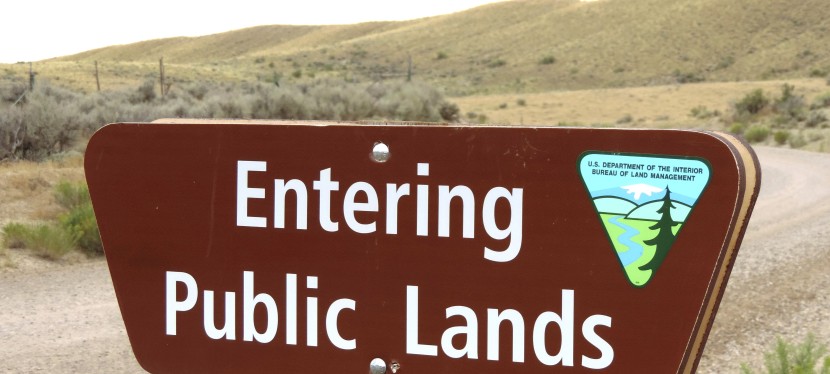
Feature Photo Credit: US Department of the Interior, Bureau of Land Management.

Upland Stewardship Begins at Home

What’s the #1 threat to habitat on undeveloped public lands? If you guessed invasive plant species, you get a gold star for the day. Overall, habitat lost to civil development is a critical threat to fish and wildlife, putting tremendous importance on conservation and management of those precious public acres still intact.

Managing public land is important to provide habitat suitable for wildlife species and is accomplished through taxpayer and sportsman’s funds. For federal lands, this means congressional appropriations must be approved for specific geographic areas and funding limits.

While public lands, both state and federal, are at much lower risk of civil development, the economics of habitat management is a major driver in our ability to maintaining high quality habitat, and here is why.

Invasive species are incredibly competitive and successful at overtaking desired native species. With no natural predator controls (i.e. herbivory and parasitism) and an adaptive edge to the climates in which they occur, many species can create monocultures in short order. What’s more is that the increasing cost of invasive species control detracts from government ability to fund general habitat management and enhancement.

Picture2

Once established, eradicating an invasive plant is incredibly difficult and extremely costly, in the billions of dollars nationwide, annually. Our ability to control invasive species on public lands can change dramatically with political leadership. And when natural resources budgets are cut, our ability to effectively maintain habitat is hamstrung.

Early Detection and Rapid Response is the normal mode of operation for habitat managers, but budget cuts cause vulnerability in on-the-ground effectiveness. Labor cuts can reduce the number of employees and hours spent afield performing Early Detection monitoring. Supply cuts can reduce the available tools to implement Rapid Response once invasive species are detected, as well as reduce the overall time or acreage that biologists can treat.

High-quality habitat is not just nice to have for an easy, clean hunt. It’s a must for sustainable upland bird species and hunter opportunity. Its easy to assume that habitat management and controlling invasive species lies in the hands of qualified biologists, but make no mistake, quality habitat starts at home with you, the general public.

20191020_122336

⇑⇑ The seat cover in my Tundra harbors a number of invasive species ⇑⇑

As our talented canines careen across the grasslands searching for sharptails or cut through brush following a running grouse trail, their fur picks up invasive weed seeds that can be easily spread to otherwise weed free areas. Tailgate checks and post-hunt spa treatments (for those of us who own long-haired pups like setters and Munsterlanders)  are necessary to remove to potentially harmful grass awns and bur-like seeds.

Most importantly, uplanders that embark on rooster road trips would be remiss if they failed to clean the nooks and crannies of their bird hunting chariot prior to driving half way across the nation. A single germinated seed from a nasty invader like cheat grass (Bromus tectorum) can quickly threaten native species and impact habitat suitability.

Be sure to clean out the truck bed, pet crates and blankets, truck seats and seat covers, spray down floor mats and vacuum the crevasses that can harbor seeds.

20191020_121840

⇑⇑ Cleaning vests, kennels, truck beds, and interiors is critical ⇑⇑

If your truck cap has a carpet liner, inspect it with scrutiny. Your dog will shake in the truck bed, flinging weed seeds onto the ceiling and anywhere else they may attach, simply waiting to be offloaded in an otherwise clean area 1,000 miles from where they were picked up.

And the cleaning spree should not end with the truck and kennels. Our vests and clothing can trap a terrifying number of seeds. When was the last time you check your hunting vest pockets for seeds? Hundreds of grass seeds can gather in vest pockets as we traverse the prairies. Dog vests can capture a number of species as well, like bur chervil (Anthriscus caucalis), which wreaks havoc on native grasses and even competes with yellow starthistle (Centaurea solstitialis) in the arid west.

20191020_121913a

⇑⇑ A water bottle pocket of my hunting vest captures many seeds and plant debris ⇑⇑

Conservation and habitat management are influenced by each and every one of us. Its your duty as an uplander to exercise your stewardship abilities and battle the spread of invasive species. The future of our public natural resources and habitat depend on it.

A Plug for Big-River Walleye

In the frothy toss of the dam tailrace, the little Smoker bobbed and dodged like a duck floating down a river rapid. Luckily, the dam was spilling only a minor volume, so conditions were still safe. The game plan was to drop a couple plugs behind the boat and troll across of the unique terrain that lay below the surface of the conflicting currents.

What to Look For

On the big river, walleye are generally structure-oriented in the sense that boulders, rock piles, troughs, and other terrain variations provide velocity breaks and concealment that fish can use to their advantage as forage passes by with the flow. Our target habitat was shelves and drop-offs in a depth range of 18-25 feet.

A plug for big river walleye (6)-1

Read the full post here, at Angler Pros.

Fly Fishing Essentials for Deep Summer Salmonids

Lake fishing for trout species can be dynamite almost any time of the year, but water temperature and heat can dictate when and how to fish for trout more than other species. When dry fly, or even nymph action slows during the dog days of summer, one fail-safe method is deep water streamer fishing. In my prior post, Flying Deep for Desert Cutthroat, I discuss deep water streamer tactics specifically for Lahontan cutthroat, but there are essential gear items every fly fisherman needs to beat the odds of a mid-summer salmonid shutdown.