Palouse Outdoors – Hunting Late-Season Snowshoe Hares

Originally Published in The Waitsburg Times, February 1st, 2024.

The end of the upland bird and waterfowl seasons in the early part of the calendar year comes with bittersweet closure, but as time ticks further beyond that last hunt, the urge to venture afield pulls harder, like an increasing magnetic force. Fortunately, small game seasons often run into March, bridging that early spring gap before the wild turkey opener. Early March can be a fine time to venture afield with bluebird days forecasting imminent spring weather, which is precisely why I seek the mixed timber stands when the March sun breaks through the Washington freezing fog.

Snowshoe hares are among the most abundant and widely distributed mammals in North America and are among the small game that can be hunted after other seasons close. They inhabit coniferous and boreal forests throughout the Pacific Northwest, New England, Alaska, Minnesota, Michigan, and Montana. However, hunting snowshoe hares comes with its challenges, like accessing high-elevation habitat. 
Six feet of snow piled atop the Forest Service gate that separated me and my friends Doug and Rob from our mountaintop destination. With snowshoes, it would have taken the rest of the day to make the hike, which is typically another thirty minutes by vehicle on a summer day. Walking to the rig behind me, I smirked through the window.

            “What do ya think? Chain up and give it hell?” I asked wryly. 

            “You first!” Doug replied with a nervous chuckle.

The wall of snow required the quick formulation of “Plan B,” which necessitated creativity. Also, Rob didn’t have snowshoes, so we would have to stay at a low elevation. We would leave the deep forest, circumvent a mountain range, and work up the adjacent drainage bottom, although I was skeptical of finding hares below 3,000 feet. 
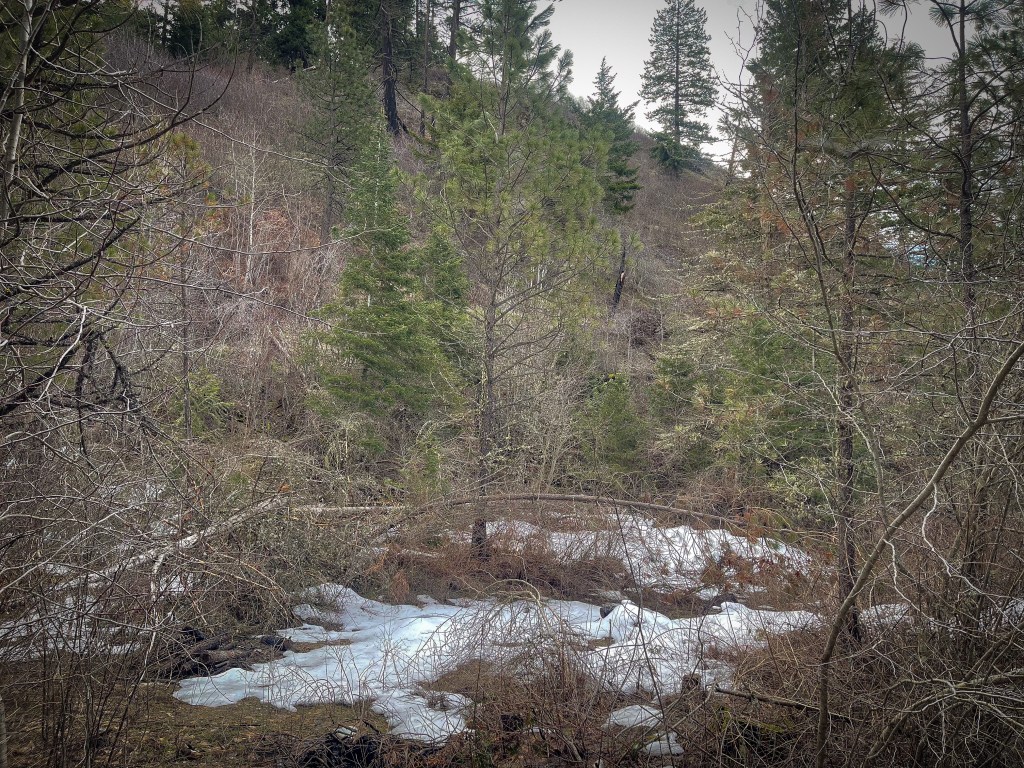
The snow had mostly melted in the creek bottom, save for the toe of the eastern slope, which held the right mix of ferns, fruiting shrubs, and blackberries, packed tight against a steep hillside shaded by eroded basalt bands.  

A gated road sliced through the narrow cover, making walking easy, but passing the one-hour mark with no sign of hares left me complacent. I slipped into the clutches of Mother Nature’s charm, hypnotized by golden sun rays streaming through dark timber. Starbursts of sunlight glistened through water droplets that hung delicately from seafoam-tinted fruticose lichens. Steam rose from thawing frost. The stunning details held my attention as Doug and Rob focused on the hunt.

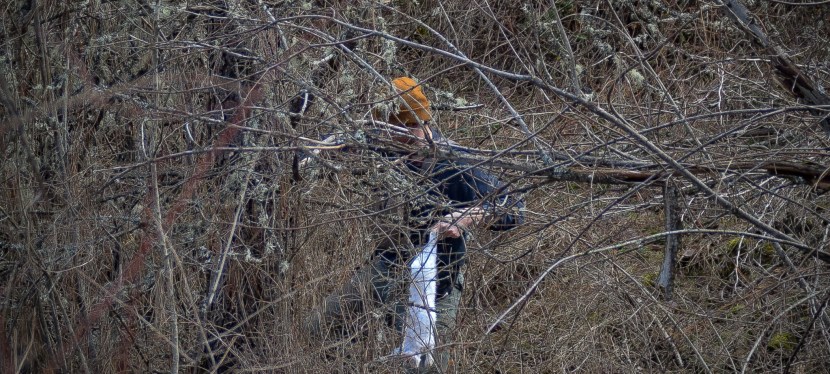
A short distance ahead, Rob walked a line through the thicket where raspberry, rose, and ferns created a dense ground cover. The faint metallic “click” of a gun safety roused my attention while a snow-white hare bounced across the trail directly between Doug and me, leaving us staring at one another in disbelief. 

Doug melted into the timber behind the hare while I back-tracked to find an opening in the greenery. A sudden bark from Doug’s Ithaca .410 single-shot echoed within the tight fir canopy, and he soon reappeared with a wide grin, carrying a beautiful young hare. 
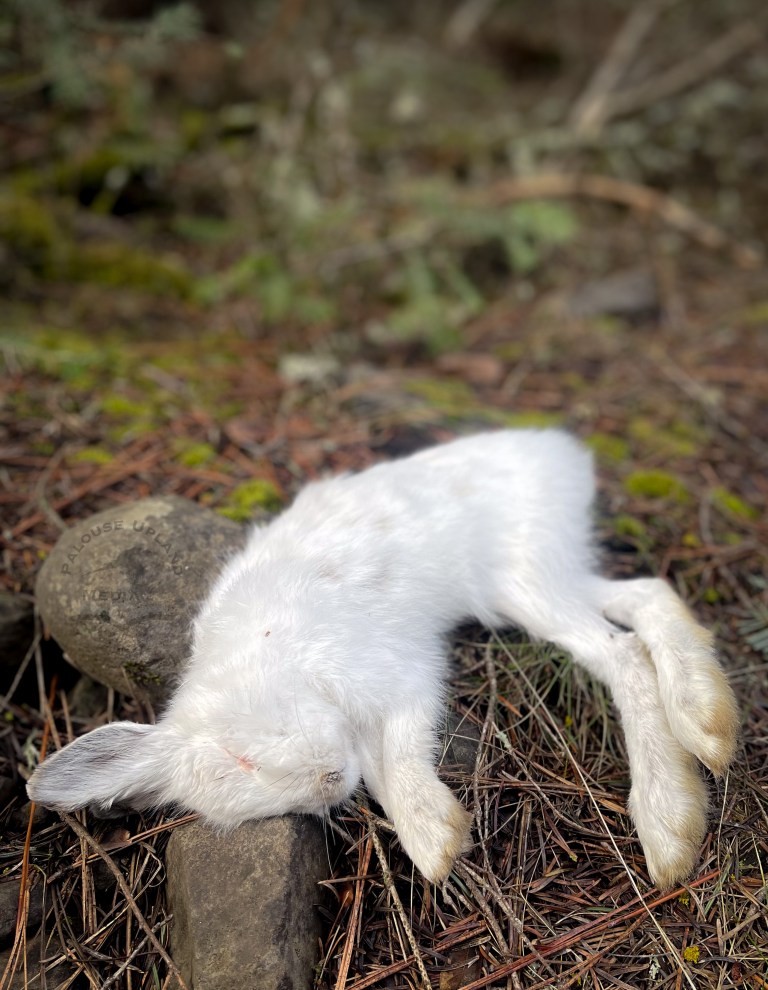
“It took me a moment to figure out why the snow was moving,” Rob said with a laugh as he emerged from the briars and ferns opposite Doug and me. Had the hare not run our way, it may have been Rob’s bunny.

We marveled over the silky softness of the hare’s flawless winter coat and poked fun at its comically large hind feet. A critter well equipped to thrive in deep snow and evade predators like Canada lynx, bobcats, and coyotes.  

Doug swapped places with Rob and moved quickly to the snowy toe of the slope. Moments later, the sudden discharge of his shotgun startled Rob and me. A second hare sat conspicuously beneath a fir just above head height on the slope as Doug approached—a reward for being at the right place and time. 

We called the hunt with two hares in the bag and shared a jovial hike out beneath the warming late-morning sun. That first hunt taught us that elevation is not a singular element in finding hares. The right habitat can be shrubby creek bottoms, given that hares eat twigs, buds, and bark in winter. A mix of deciduous and coniferous forest stands offers a good variety of food sources and cover. 

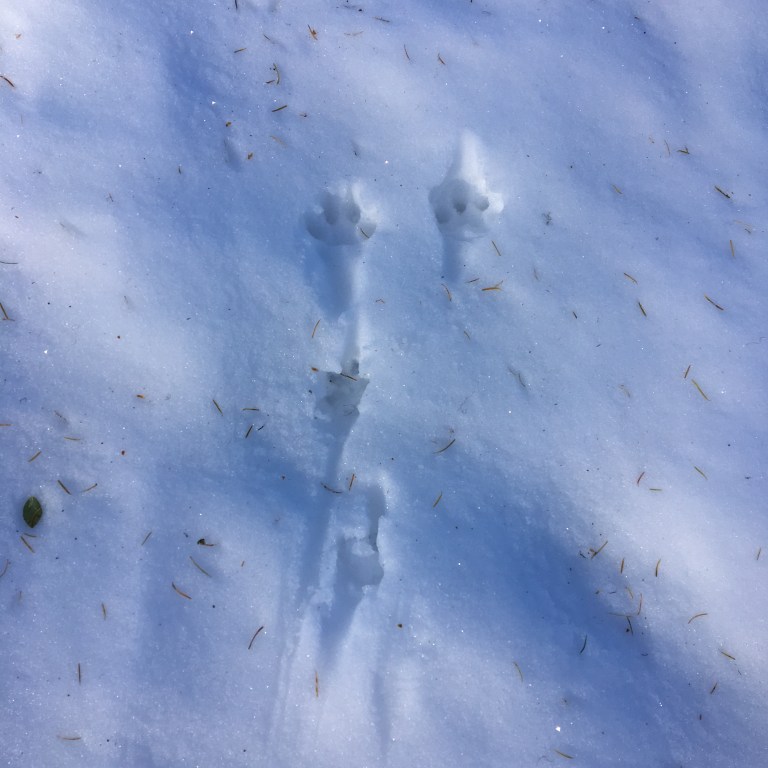
Look for “browse lines” where hares create trails in heavy snow. Always have a “Plan B,” as conditions and access can change yearly. And never forget your snowshoes.

Palouse Outdoors – Playing a Royal Flush

Originally Published in The Waitsburg Times, January 6th, 2025.

Some of the best moments of my life have occurred while following the flashing tail of a bird dog through the whipping grouse covers and amber plains. I’ve found the upland hunting community welcoming, and the tales I’ve shared have connected me with friends I would never have known otherwise. Pheasants Forever holds a subset of this community – like-minded conservationists passionate about nature, bird dogs, and the beautifully plumed game birds that fascinate us.

I’ve had the good fortune of experiencing a variety of hunts and dog breeds, each with unique styles, personalities, and quirks. Yet, I had never hunted with golden retrievers before the 2024 season. Fortunately, Randy, a fellow Pheasants Forever volunteer, recently invited me to walk with him and his brace of stunning strawberry blonde golden retrievers to push up pheasant.

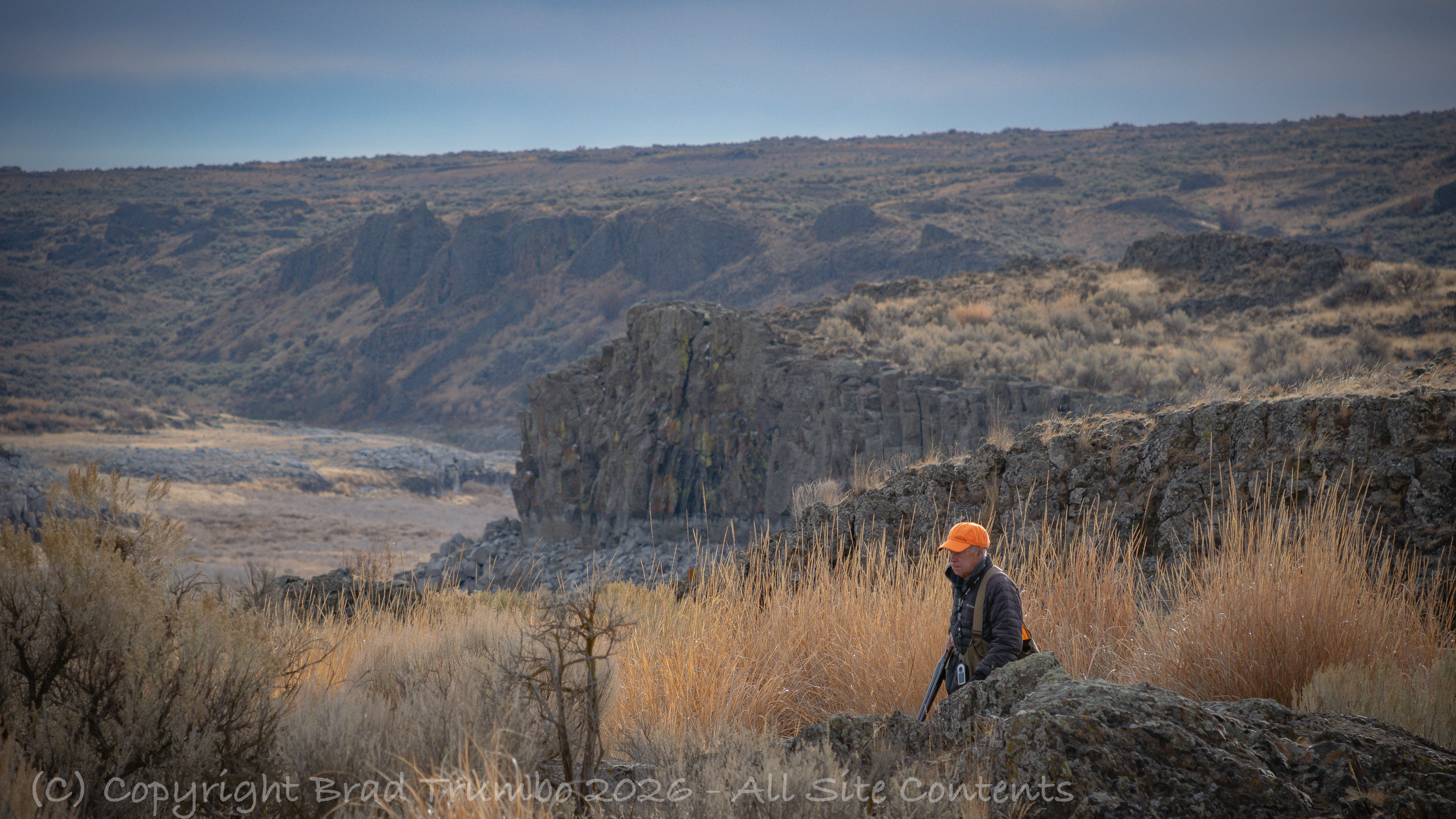
Randy’s casual appearance belies his wisdom and character as one of the most interesting people alive. He has traveled and hunted birds widely with his beloved golden retrievers. A 1970s throwback photo of Randy sitting with his dog and a handful of valley quail after a momentous day in Baja was highlighted in the 2024 Pheasants Forever Journal Upland Bird Super Issue, Volume 43(4). Randy has a story for every occasion, hunting or otherwise, but as I followed him and his bouncing pups into the field, our conversation narrowed to strictly business.

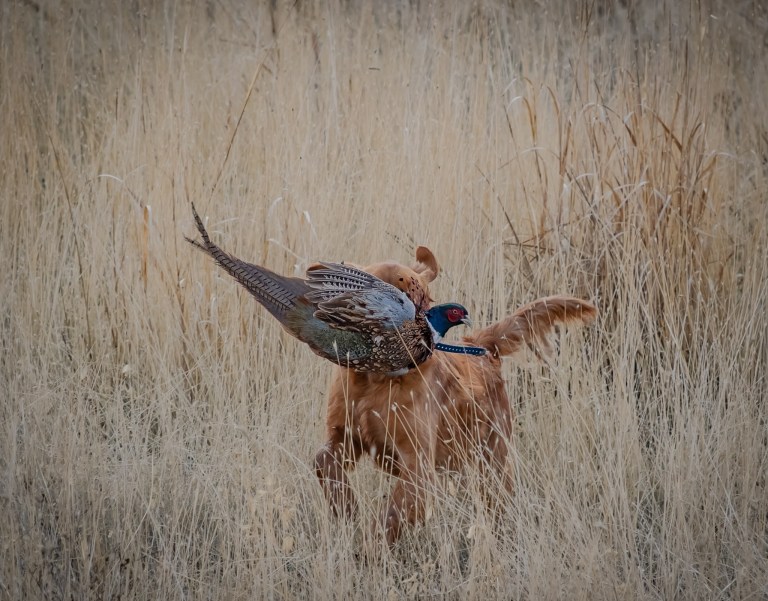
Young golden retriever, Scout, delivers a wily ring-neck rooster to hand.

“I’ve never hunted with flushers, save for a lab or two,” I said. 

“Really?” Randy questioned with surprise. “Well, you’re in for a treat!” Little did I know we would embark on a gentlemanly experience worthy of custom leather boots, twill wool garments, and ivy caps.

Flushing dogs are bred to do just that – find and flush birds. One crucial difference between flushing and pointing dogs like my setters is that flushers must work close to the hunter so the birds get up within shotgun range. Conversely, pointing dogs can range to whatever distance their handler is comfortable because they are bred and trained to stop when they find birds, allowing the hunter to approach and flush. These different dog behaviors also require the hunter to adapt their approach.

“You see the dogs getting ‘birdy’? Get up there fast!” Randy coached.

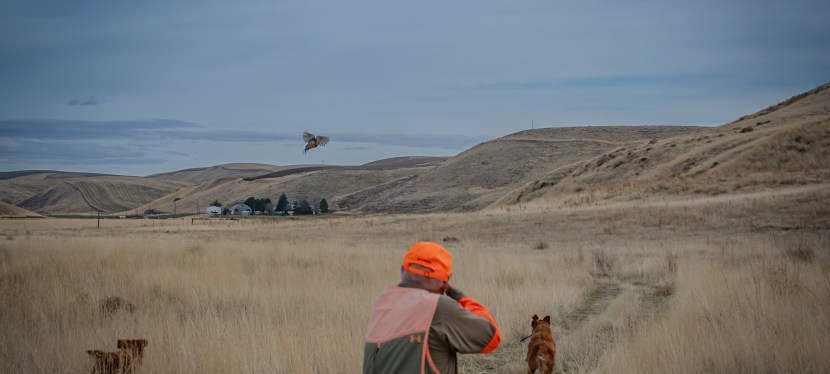
Making a beeline for the youngest dog, Scout, put me in the perfect position as a rooster pheasant broke from Scout’s pursuit. The rooster erupted directly ahead, climbing right-to-left and offering a clean swing. My 1951 C.F. Dumoulin side-by-side arrived at my shoulder with the bead perfectly aligned down range.

“Great shot!” Randy offered as Scout swiftly returned with the bird. 

“Thanks, Randy! My first rooster with the ole Dumoulin. And great dog work! I could get used to having my birds brought to hand. My setters have never cared to retrieve.”

Ten-year-old Tess settles at Randy’s feet with a prized rooster.

“Thank you! I’ll take the next bird,” Randy said with a chuckle as we moved on.

Soon after, Scout and his older companion, Tess, picked up the scent of another bird and began to push out. “Ssssssttt,” Randy quietly hissed, causing the dogs to hit the brakes and circle back toward us – an intelligent bit of training. Keeping quiet is essential to avoid spooking birds, particularly when approaching pheasants. This subtle sound instead of voice, whistle, or collar tone command can be the difference between a rooster flushing at 10 yards versus 100.

“You see how interested they look when they hit that scent? They ramp up to 100 miles per hour instantly, so you’ve got to be paying attention and moving quickly,” Randy advised as he scooted ahead, anticipating the flush. 

Randy carried a beautiful old Browning side-by-side, kept immaculate by his care and appreciation for quality and tradition. I observed Randy’s shot from behind, noting his relaxed technique and lead on the bird. The rooster tumbled, and Tess retrieved it in a textbook moment like a bread-and-butter sports play practiced 1,000 times over.

The hunt continued while Randy and I discussed birds and dogs and switched shooting opportunities with each new bird find. We strolled unhurried, carefree, appreciating every moment. It felt like a hunt for royalty, like we should have had a caddy to tote and reload the guns and serve the occasional sip of fine brandy or rich red wine in a classy sniffer.

By the hunt’s end, we each carried a passel of birds (Randy’s passel a bit heavier than mine) that would later become delicate meals shared with friends and family, sparking reflection on a noble hunt and Randy’s golden retrievers dealing a royal flush.

Classic side-by-sides like this 1951 C.F. Dumoulin 16-gauge are fun to carry, fitting of a classy hunt, and beautifully complemented by a brace of roosters.