Palouse Outdoors – Playing a Royal Flush

Originally Published in The Waitsburg Times, January 6th, 2025.

Some of the best moments of my life have occurred while following the flashing tail of a bird dog through the whipping grouse covers and amber plains. I’ve found the upland hunting community welcoming, and the tales I’ve shared have connected me with friends I would never have known otherwise. Pheasants Forever holds a subset of this community – like-minded conservationists passionate about nature, bird dogs, and the beautifully plumed game birds that fascinate us.

I’ve had the good fortune of experiencing a variety of hunts and dog breeds, each with unique styles, personalities, and quirks. Yet, I had never hunted with golden retrievers before the 2024 season. Fortunately, Randy, a fellow Pheasants Forever volunteer, recently invited me to walk with him and his brace of stunning strawberry blonde golden retrievers to push up pheasant.

Randy’s casual appearance belies his wisdom and character as one of the most interesting people alive. He has traveled and hunted birds widely with his beloved golden retrievers. A 1970s throwback photo of Randy sitting with his dog and a handful of valley quail after a momentous day in Baja was highlighted in the 2024 Pheasants Forever Journal Upland Bird Super Issue, Volume 43(4). Randy has a story for every occasion, hunting or otherwise, but as I followed him and his bouncing pups into the field, our conversation narrowed to strictly business.

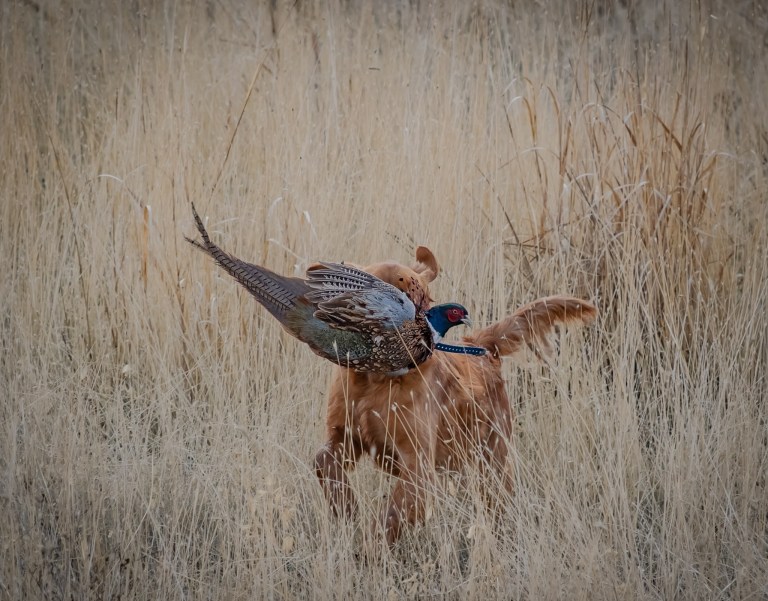
Young golden retriever, Scout, delivers a wily ring-neck rooster to hand.

“I’ve never hunted with flushers, save for a lab or two,” I said. 

“Really?” Randy questioned with surprise. “Well, you’re in for a treat!” Little did I know we would embark on a gentlemanly experience worthy of custom leather boots, twill wool garments, and ivy caps.

Flushing dogs are bred to do just that – find and flush birds. One crucial difference between flushing and pointing dogs like my setters is that flushers must work close to the hunter so the birds get up within shotgun range. Conversely, pointing dogs can range to whatever distance their handler is comfortable because they are bred and trained to stop when they find birds, allowing the hunter to approach and flush. These different dog behaviors also require the hunter to adapt their approach.

“You see the dogs getting ‘birdy’? Get up there fast!” Randy coached.

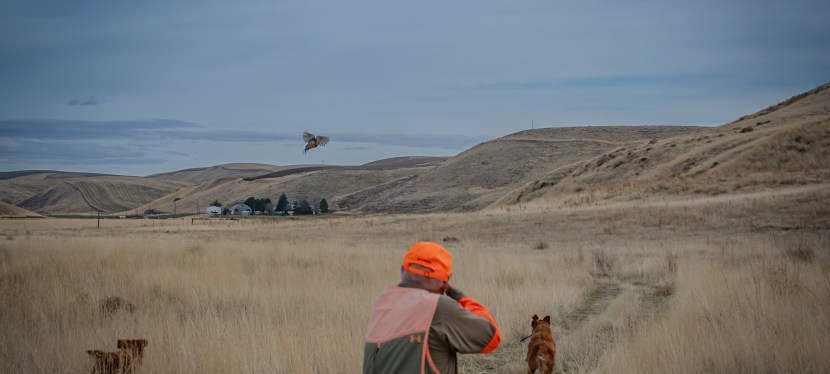
Making a beeline for the youngest dog, Scout, put me in the perfect position as a rooster pheasant broke from Scout’s pursuit. The rooster erupted directly ahead, climbing right-to-left and offering a clean swing. My 1951 C.F. Dumoulin side-by-side arrived at my shoulder with the bead perfectly aligned down range.

“Great shot!” Randy offered as Scout swiftly returned with the bird. 

“Thanks, Randy! My first rooster with the ole Dumoulin. And great dog work! I could get used to having my birds brought to hand. My setters have never cared to retrieve.”

Ten-year-old Tess settles at Randy’s feet with a prized rooster.

“Thank you! I’ll take the next bird,” Randy said with a chuckle as we moved on.

Soon after, Scout and his older companion, Tess, picked up the scent of another bird and began to push out. “Ssssssttt,” Randy quietly hissed, causing the dogs to hit the brakes and circle back toward us – an intelligent bit of training. Keeping quiet is essential to avoid spooking birds, particularly when approaching pheasants. This subtle sound instead of voice, whistle, or collar tone command can be the difference between a rooster flushing at 10 yards versus 100.

“You see how interested they look when they hit that scent? They ramp up to 100 miles per hour instantly, so you’ve got to be paying attention and moving quickly,” Randy advised as he scooted ahead, anticipating the flush. 

Randy carried a beautiful old Browning side-by-side, kept immaculate by his care and appreciation for quality and tradition. I observed Randy’s shot from behind, noting his relaxed technique and lead on the bird. The rooster tumbled, and Tess retrieved it in a textbook moment like a bread-and-butter sports play practiced 1,000 times over.

The hunt continued while Randy and I discussed birds and dogs and switched shooting opportunities with each new bird find. We strolled unhurried, carefree, appreciating every moment. It felt like a hunt for royalty, like we should have had a caddy to tote and reload the guns and serve the occasional sip of fine brandy or rich red wine in a classy sniffer.

By the hunt’s end, we each carried a passel of birds (Randy’s passel a bit heavier than mine) that would later become delicate meals shared with friends and family, sparking reflection on a noble hunt and Randy’s golden retrievers dealing a royal flush.

Classic side-by-sides like this 1951 C.F. Dumoulin 16-gauge are fun to carry, fitting of a classy hunt, and beautifully complemented by a brace of roosters.

Northwest Outdoor Writers Association Gathered in The Dalles, Oregon

The Northwest Outdoor Writers Association (NOWA) held its annual conference Friday, May 2nd through Sunday, May 4th, at the Columbia River Hotel in The Dalles, Oregon. For three days, some of the Northwest’s top outdoor writers, authors, photographers, videographers, and radio and podcast personalities gathered to discuss the future of their industry and craft.

The conference opened with a fine meal at the Portage Grill, followed by a keynote speech by author, poet, and publisher, Rick Steber, who exemplified excellence in storytelling. Rick is not only gifted in his ability to research people and history and share those stories in engaging detail, but the delivery of his many favorite interviews of historical figures (including voice impersonations) was both comical and fascinating.

Image of the twisting historic Oregon Route 30 taken from Rowen Crest with the Columbia River and the rugged Columbia Gorge in the background.

Trumbo captured this image while hiking at dawn on Rowen Crest just south of The Dalles, Oregon.

Over the following days, NOWA members sprinkled across the Columbia River Gorge to experience all The Dalles has to offer, such as the National Neon Sign Museum, hiking among the wildflowers and scrub oaks of the rugged river corridor, visiting ancient petroglyphs at Horsethief Lake, and fishing the spring Chinook salmon rodeo at Washington’s Drano Lake.

When not collecting memories, photographs, and fodder for future publications and videos, the outdoor media professionals gathered to share tips and tricks on improving one’s engagement and reach – facets of “Excellence in Craft”- and share business model ideas and successes. Excellence in Craft presentations included George Krumm, editor of Fish Alaska and Hunt Alaska magazines, who discussed how to land pitches and build relationships with editors. Brad Trumbo shared his rise in the outdoor writing and photography realm and engagement with his readers, thanks to his Llewellin setter bird dogs.

NOWA held its annual Excellence in Craft awards banquet Saturday, May 3rd, where 61 achievements were recognized, ranging from “Column of the Year” to the best outdoor photos, videos and humor pieces. The awards banquet offers an opportunity to see where talented outdoor content creators stand among their peers, provides “street cred” for marketing, and offers a fine payout for those who rank high in many categories. It’s a coveted experience for this highly talented group to share camaraderie with friendly competition.

This year’s Excellence in Craft award winners can be found here: https://nowaoutdoors.com/eic-winners-by-category/.

Black-chinned hummingbird hovering over a burgundy Columbine flower.

Trumbo’s image of a black-chinned hummingbird hovering over Columbine flowers took 1st place in NOWA’s Excellence in Craft “Fauna” photo category.

The weekend closed with NOWA President Troy Rodakowski presiding over Sunday morning’s membership and business meeting. During this meeting, Rodakowski assumed the position of NOWA’s Chairman of the Board of Directors as he passed the gavel to NOWA’s incoming President, Brad Trumbo. 

With the annual conference behind them, NOWA’s new year begins with anticipation of next year’s conference, which is already being planned. Additionally, Trumbo brings new ideas to NOWA’s structure and attempts to engage younger generations as the organization adapts to the evolution of outdoor media.

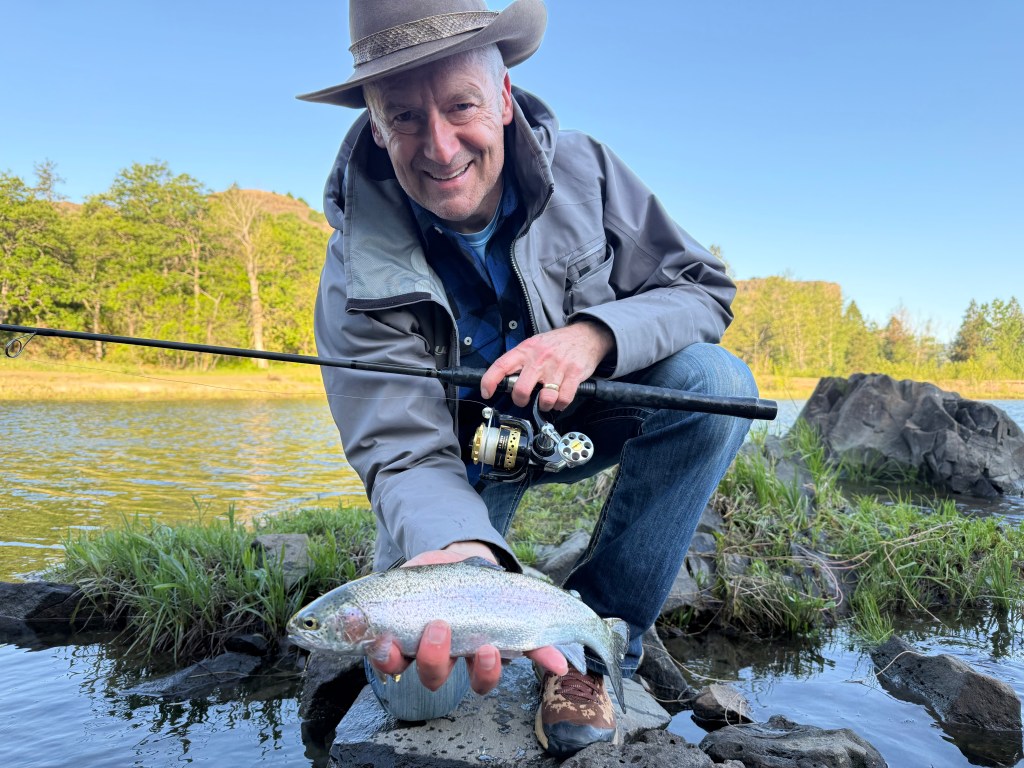
Gary Lewis, award winning author, freelance writer, podcaster, and host of the Frontier Unlimited TV show, found time for trout fishing before the Sunday morning meeting.

If you’re an outdoor content creator living in Oregon, Washington, Idaho, Montana, or BC Canada and want to learn from and contribute to this charismatic and savvy collection of media professionals, email NOWA’s Executive Director, Keith Szafranski, at photogsz@msn.com. Your creativity and energy will be welcomed by this prestigious cadre.

###

            The Northwest Outdoor Writers Association is a society of professional outdoor communicators dedicated to the pursuit of excellence in outdoor media. NOWA strives to further the improvement of professional communications skills and encourage their ethical employment. NOWA also provides a network of professional assistance and support, keeps members informed of news and information pertinent to outdoor activities and industries, and supports the conservation of natural and recreational resources. Visit https://nowaoutdoors.com/ and find us on Instagram @NOWAOutdoors.

Steppe Outside – Home Waters Flow Gentle on My Mind 

Published in the Walla Walla Union Bulletin November 9th, 2024

A mountain trout stream gently winds through the back of my mind. Its headwaters begin near the Oregon border and drop precipitously north. Picking up tributaries as it rolls, the creek reaches third-order status, where it begins building year-round trout habitat. Its twists and turns, log jams, and pools are all familiar. 

My parents would tell you that I was a fishing addict as a kid, which I cannot argue, but the fact that a trout creek flows into my stream of consciousness at the height of the upland bird season is telling. I’ve suffered as a “jack of all trades” my entire life, meaning I find fulfillment in nearly anything fish, wildlife, and outdoors related, especially now with a love for photography. As an adult, however, the closest thing I’ve experienced to addiction is upland bird hunting. 

This trout stream is near home and was my muse before my first setter pup arrived. We saw each other weekly, regardless of whether the fishing season was open. It’s close enough to be worth the trip but far enough to require commitment. Too far for killing a half-hour, but a morning, afternoon, even a whole day can be amply invested.

I cut my trout teeth on the blue lines descending from the George Washington National Forest and Shenandoah National Park. Eventually, one stream took priority – my home stream. The stream that I could see from my parents’ front room vista. It wasn’t the best or easiest fishing around, but it was close and offered a mile of worthy wild trout water. To say that I knew that water well would be an understatement. It was hard to leave it when I moved west, and even harder in 2020 when I caught my last Appalachian brook trout in those stair-step plunge pools. My beloved valley home overlooking the drainage sold a month later. 

The beauty of home waters is the intimacy one can establish with them. It is not entirely different from the intimacy between lovers, although the relationship appears one-sided on the surface. The angler walks the banks, noting the curves, the sweet spots and transition zones, the seasonal moods, where to tread lightly, and where to take charge. Meanwhile, the stream flows with the lifeblood that the mountain feeds it. It rearranges the furniture here and there and thrusts a hip this way or that following the spring freshet, but the angler who pays due diligence is rewarded with more than wild trout.

There’s an old saying that “an elephant never forgets.” I’ve found the same true for bird dogs and trout bums. Bird dogs catalog every bird they’ve ever found and will visit those spots whenever they hunt the same property. Identically, trout fishermen recall every rise and catalog the log jam, flow seam, backwater, or grasses overhanging the run where the hookup occurred. This plays into the intimacy a trout angler develops with their home waters. These are the sweet spots that are revisited time and again. After a few years of fishing their home waters, a trout bum can identify the pools and runs by the sound of the water pouring over rocks and wood.

October is arguably one of the best months for mountain stream fishing—the heat of summer breaks, giving way to seasonal change. The riparian corridor is decorated in autumn gold. Cooler water invigorates the speckled gems fining in the tail-outs and prompts giant October caddis to flutter clumsily over the creek, offering a royal meal as they dip in to lay eggs. I rarely missed an October weekend on the stream in what feels like an alternate life. Now, the opposite is true. 

It had been two Octobers since my last autumn visit. With unusual heat putting the brakes on upland bird hunting plans, my mind scrolled through the many productive uses of time. The notion of fishing the home waters trickled in and caught fire like pouring gasoline on a flame. The only decision was where to start, but the decision was already made. A preferred reach continually lingers upon one’s subconscious, awaiting the opportunity to surface.

My waders swished, and sweat soaked the brim of a blaze orange ball cap as I approached a lesser-fished stretch of water that’s difficult to navigate and has relatively little fishy habitat compared to other reaches. Three specific pools in this reach speak to my flavor of fly presentation when the water is low, and this autumn has been unusually dry. Casts would be short, and line control would be critical.

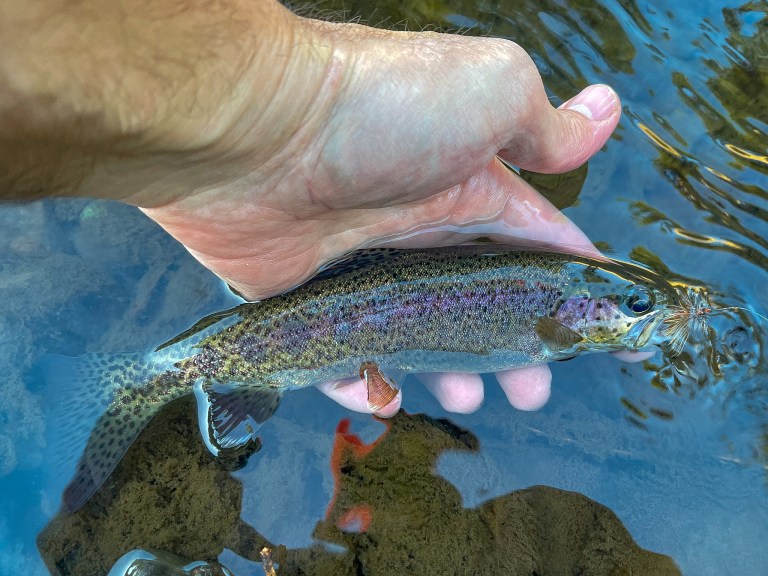
A thirteen-foot tenkara rod with an equal length of fly line represents an effective, simplistic, centuries-old Japanese fly-fishing method developed for mountain streams. Using the grasses, trees, and woody debris to creep within ten feet of a beautiful log jam pool, I gently flopped an absurdly-sized “stimulator” fly into the still waters beside the flow plunging over the logs. Within seconds, a ten-inch rainbow pounced on the moth-sized fly.

The feisty rainbow came to hand, and like every other from this river, the deep purple of the lateral line and olive-shaped parr marks beneath a dusting of black speckles presented a masterful work of art. I studied the fish briefly, admiring its features and glistening silver, gold, and olive scales, each individually defined. Then, freeing the fish from the fluffy fly, it darted back into the shadow of the log.

Trout are a marvel of nature regardless of the time of year, but mountain stream trout glow with a particular radiance in fall, as if reflecting the seasonal color change of the riparian flora. They are muscular from a spring of high water and spawning, and a summer of eating hoppers, caddis, and stoneflies. Their rise is deliberate, calculated, and executed with precision and efficiency to avoid expending energy unnecessarily.

Rainbows have risen to a fly in this pool for years, but the pool wasn’t always present. Before stream restoration efforts, this reach was characterized by shallow riffles and slightly deeper runs with little wood or boulder cover and no pools. Juvenile Chinook salmon and tiny rainbows rose to any small fly along the flow seams, but bigger fish were few and far between. Fortunately, constructed log jams and the 2020 flood cooperated to provide more quality habitat throughout the mainstem.

Having fished mountain trout streams across nearly a dozen states and 3,000 miles in several directions, I can offer that good water is good water, regardless of where you fish. Sometimes, that’s easy to describe. Other times, the popular cliché “when you know, you know,” is all there is to be said. Fly placement is somewhat universal, born of experience reading water and, occasionally, dumb luck. Deciding which to thank for a trout rise is hard, but experience pays on home waters. 

“I bet that fish spooked the entire pool,” I thought, confident that no other fish would bite after blowing up the thirty-six-square-foot pocket of skinny flow. “Well, what the hell. I’m here,” I thought, flopping the now waterlogged fly into a tucked-away spot slightly closer to the shore where I stood.

Using the rod’s length to keep the line high and the fly afloat, I bounced the fly atop the water like an October caddis laying its eggs. To my surprise, another similar-sized rainbow rose for the fly. It’s possible that another seasoned angler could find equivalent success on a new waterbody in a scenario like that. Still, I take comfort in telling myself that an unlikely second fish rose because I know how to fish “my stream.” 

 The following pools fished the same, and I even discovered a new side channel pocket that has scoured over the past several years to form a beautiful bend pool. I had seen that side channel before but ignored it for bigger water. The pocket is exceptionally tight, with no casting room. I merely dangled the fly from a high stick posture about ten feet away, tempting a rainbow to emerge from nearly underfoot to inhale the fly. 

“This will never work. It’s too close,” I thought as I laid the fly on the water’s surface. Being wrong isn’t always bad.

My visit was brief. Just long enough to land a half-dozen gorgeous rainbows. Glenn Campbell’s “Gentle on My Mind” aptly played in my subconscious in time with the tumbling water. 

In his most recent and final book, “Dumb Luck and the Kindness of Strangers,” renowned fly-fishing author John Gierach explicates on his home waters, as in many of his twenty-one previous volumes.

“On rare days, it’s something as vague as a quality of light or certain stillness in the air that seems to make the water vibrate with possibility, but I think that’s less mystical than it sounds. It’s just that some of the things you know about your home water operate beneath the level of full consciousness and only reveal themselves disguised as intuition.”

Gierach’s experience came from intimately knowing his home waters, and his gift for sharing that intimacy through a conversational read inspired generations of fly anglers, myself included. There’s something to be said about the feeling one gets when standing streamside, influenced by the sun, temperature, breeze, cloud cover, and the carefree notion of having already succeeded in the endeavor without yet wetting a fly.

Catching fish in the home waters is not the point but is generally accepted as a scientific law. “If” is not a question, nor is the fish the reward. Wild turkey hens shepherd their chicks through the upland riparian edges among violet lupine in spring, and birdsong envelopes the stream. Ruffed grouse drum, valley quail call from the blackberry tangles, and black bears gorge on the sweet, dark berries. Salmon flies and October caddis predict the seasons, and a number sixteen Adams is always welcomed. Somewhere between the roar of the rushing waters and a pointed focus on landing the fly in “the spot on the spot,” one’s true self appears, completely at ease, in a world secluded from reality—a state of being achieved only on the home waters. 

While I don’t spend nearly the time on my stream compared to a decade ago, our relationship is steadfast. I’ve learned her language. She patiently awaits, her waters forever flowing gentle on my mind.

Footnote – John Gierach died on October 3rd, 2024, at age 77. An average man with an appreciation for the average angling experience and hot coffee, he possessed an extraordinary ability with words and inspiration. This story presents a style slightly different than Trumbo’s norm. A tip of the hat to Gierach for developing friendships with his readers by writing as if he were engaged in conversation.

Research Identifies Measures to Reduce Wind Energy-related Bird and Bat Fatalities

Published July 7th 2023 at Harvesting Nature

Wind energy production facilities have been condemned for impacts to bird and bat species, but recent research suggests that minimizing impacts while maintaining power production efficiency may be feasible.

Wind energy production facilities are increasingly common worldwide, resulting from efforts to shift to renewable energy sources – a trend that will likely continue in the US. In 2022, President Biden invoked the Defense Production Act to allow the U.S. to “take ownership of its clean energy independence[1].”

The purpose for calling upon this decades-old act is to provide the US Department of Energy the authority to “help strengthen domestic solar, heat pump, and grid manufacturing industries while fortifying America’s economic security and creating good-paying jobs, and lowering utility costs along the way.” Invocation of the Defense Production Act is anticipated to “boost American production of the critical technologies necessary to lower energy costs, support the clean energy economy, and strengthen national security.”

In 2021, Princeton University estimated that the US would need to develop 19-96 gigawatts of wind energy production each year to reach “net-zero” greenhouse gas emissions by 2050[2]. And, like most energy production sources, wind turbines are known to impact wildlife, namely a proportion of birds and bats that encounter them. Therefore, the May/June 2023 issue of The Wildlife Professional provides a timely summary of potential measures to reduce bird and bat mortality at wind turbines2.  

Organizations like the US Fish and Wildlife Service have developed guidelines for wind turbine operations to minimize impacts on birds and bats through a process called “curtailment.” For example, bats are more active around wind turbines operating at slower speeds, so a curtailment measure would be to set a higher windspeed threshold (i.e. “cut-in speed”) for which the wind turbine would begin to operate. Research has shown that cut-in windspeeds between 11-15 miles per hour reduce bat fatalities by up to 63 percent[3], and curtailment to over 16 miles per hour reduces fatalities by over 80 percent for some species[4]. Curtailment has also been found to reduce eagle fatalities on par with bats.

A 60 to 80 percent reduction in bat and eagle mortality seems to support implementing curtailment measures, but curtailment reduces power production efficiency for facilities that some would argue are inefficient even without operating restrictions. For this reason, additional actions are being evaluated.

A global positioning system (GPS)-triggered “geo-fence” is being implemented with California condors. When a tagged condor enters the defined perimeter of a wind facility, the tag detection triggers immediate curtailment measures and avoids wind turbines operating under curtailment when no birds are present. This is an effective method of reducing condor fatalities, but tagging individuals is not a feasible solution for songbirds and bats. Deterrent strategies may be more effective.

Deterrents that have been studied reduce bird and bat mortality without impacting power production and include sound, high-contrast lighting, and painted turbine blades to avoid the appearance of blurring together at high speed. Only auditory deterrents are effective for bats, and each species’ use of echolocation differs, making one-size-fits-all deterrents less effective.

No single fatality reduction measure has proven effective for all species; however, a combination of deterrents and curtailment may be tailored to facilities, and research is ongoing to identify additional measures to reduce bird and bat fatalities while allowing efficient wind energy production.


[1] President Biden Invokes Defense Production Act | Department of Energy

[2] Felton, S. 2023. Change in the Air: Technological Solutions can Reduce Bird and Bat Collisions at Wind Facilities. The Wildlife Professional 17(3):38-40.

[3] A review of the effectiveness of operational curtailment for reducing bat fatalities at terrestrial wind farms in North America | PLOS ONE

[4] A smart curtailment approach for reducing bat fatalities and curtailment time at wind energy facilities – PubMed (nih.gov)

Birds, Books, Setters, and Upland Hunting

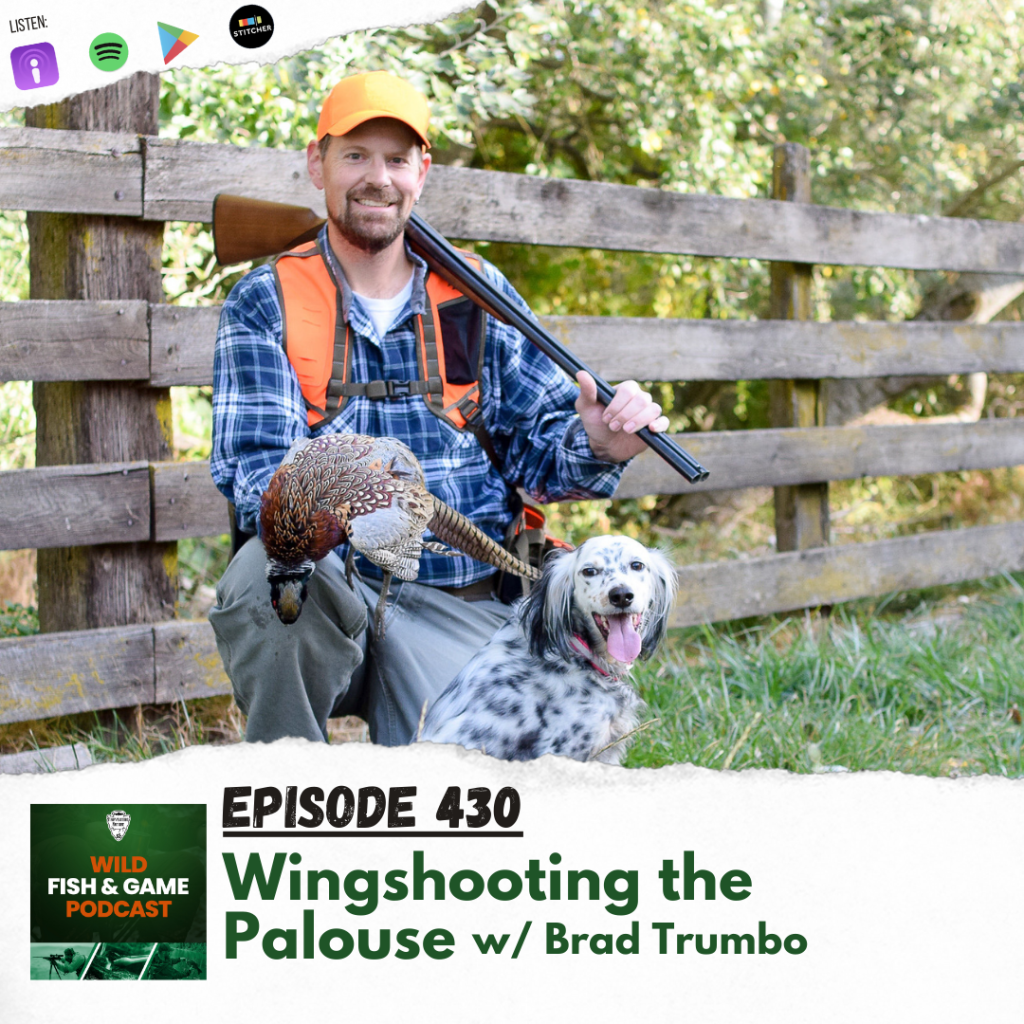
I’ve had the great pleasure to chat with the Crew at Harvesting Nature about Wingshooting the Palouse, and I believe you will enjoy the conversation. Give it a listen on the Wild Fish and Game Podcast.

Wingshooting the Palouse is available at Amazon.com.