

Published in the Walla Walla Union Bulletin November 9th, 2024
A mountain trout stream gently winds through the back of my mind. Its headwaters begin near the Oregon border and drop precipitously north. Picking up tributaries as it rolls, the creek reaches third-order status, where it begins building year-round trout habitat. Its twists and turns, log jams, and pools are all familiar.
My parents would tell you that I was a fishing addict as a kid, which I cannot argue, but the fact that a trout creek flows into my stream of consciousness at the height of the upland bird season is telling. I’ve suffered as a “jack of all trades” my entire life, meaning I find fulfillment in nearly anything fish, wildlife, and outdoors related, especially now with a love for photography. As an adult, however, the closest thing I’ve experienced to addiction is upland bird hunting.
This trout stream is near home and was my muse before my first setter pup arrived. We saw each other weekly, regardless of whether the fishing season was open. It’s close enough to be worth the trip but far enough to require commitment. Too far for killing a half-hour, but a morning, afternoon, even a whole day can be amply invested.

I cut my trout teeth on the blue lines descending from the George Washington National Forest and Shenandoah National Park. Eventually, one stream took priority – my home stream. The stream that I could see from my parents’ front room vista. It wasn’t the best or easiest fishing around, but it was close and offered a mile of worthy wild trout water. To say that I knew that water well would be an understatement. It was hard to leave it when I moved west, and even harder in 2020 when I caught my last Appalachian brook trout in those stair-step plunge pools. My beloved valley home overlooking the drainage sold a month later.
The beauty of home waters is the intimacy one can establish with them. It is not entirely different from the intimacy between lovers, although the relationship appears one-sided on the surface. The angler walks the banks, noting the curves, the sweet spots and transition zones, the seasonal moods, where to tread lightly, and where to take charge. Meanwhile, the stream flows with the lifeblood that the mountain feeds it. It rearranges the furniture here and there and thrusts a hip this way or that following the spring freshet, but the angler who pays due diligence is rewarded with more than wild trout.
There’s an old saying that “an elephant never forgets.” I’ve found the same true for bird dogs and trout bums. Bird dogs catalog every bird they’ve ever found and will visit those spots whenever they hunt the same property. Identically, trout fishermen recall every rise and catalog the log jam, flow seam, backwater, or grasses overhanging the run where the hookup occurred. This plays into the intimacy a trout angler develops with their home waters. These are the sweet spots that are revisited time and again. After a few years of fishing their home waters, a trout bum can identify the pools and runs by the sound of the water pouring over rocks and wood.
October is arguably one of the best months for mountain stream fishing—the heat of summer breaks, giving way to seasonal change. The riparian corridor is decorated in autumn gold. Cooler water invigorates the speckled gems fining in the tail-outs and prompts giant October caddis to flutter clumsily over the creek, offering a royal meal as they dip in to lay eggs. I rarely missed an October weekend on the stream in what feels like an alternate life. Now, the opposite is true.
It had been two Octobers since my last autumn visit. With unusual heat putting the brakes on upland bird hunting plans, my mind scrolled through the many productive uses of time. The notion of fishing the home waters trickled in and caught fire like pouring gasoline on a flame. The only decision was where to start, but the decision was already made. A preferred reach continually lingers upon one’s subconscious, awaiting the opportunity to surface.
My waders swished, and sweat soaked the brim of a blaze orange ball cap as I approached a lesser-fished stretch of water that’s difficult to navigate and has relatively little fishy habitat compared to other reaches. Three specific pools in this reach speak to my flavor of fly presentation when the water is low, and this autumn has been unusually dry. Casts would be short, and line control would be critical.
A thirteen-foot tenkara rod with an equal length of fly line represents an effective, simplistic, centuries-old Japanese fly-fishing method developed for mountain streams. Using the grasses, trees, and woody debris to creep within ten feet of a beautiful log jam pool, I gently flopped an absurdly-sized “stimulator” fly into the still waters beside the flow plunging over the logs. Within seconds, a ten-inch rainbow pounced on the moth-sized fly.
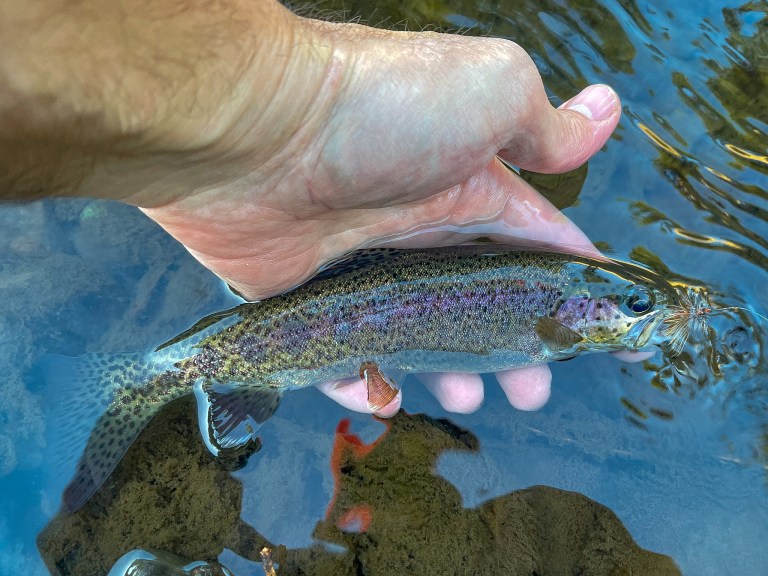
The feisty rainbow came to hand, and like every other from this river, the deep purple of the lateral line and olive-shaped parr marks beneath a dusting of black speckles presented a masterful work of art. I studied the fish briefly, admiring its features and glistening silver, gold, and olive scales, each individually defined. Then, freeing the fish from the fluffy fly, it darted back into the shadow of the log.
Trout are a marvel of nature regardless of the time of year, but mountain stream trout glow with a particular radiance in fall, as if reflecting the seasonal color change of the riparian flora. They are muscular from a spring of high water and spawning, and a summer of eating hoppers, caddis, and stoneflies. Their rise is deliberate, calculated, and executed with precision and efficiency to avoid expending energy unnecessarily.
Rainbows have risen to a fly in this pool for years, but the pool wasn’t always present. Before stream restoration efforts, this reach was characterized by shallow riffles and slightly deeper runs with little wood or boulder cover and no pools. Juvenile Chinook salmon and tiny rainbows rose to any small fly along the flow seams, but bigger fish were few and far between. Fortunately, constructed log jams and the 2020 flood cooperated to provide more quality habitat throughout the mainstem.
Having fished mountain trout streams across nearly a dozen states and 3,000 miles in several directions, I can offer that good water is good water, regardless of where you fish. Sometimes, that’s easy to describe. Other times, the popular cliché “when you know, you know,” is all there is to be said. Fly placement is somewhat universal, born of experience reading water and, occasionally, dumb luck. Deciding which to thank for a trout rise is hard, but experience pays on home waters.
“I bet that fish spooked the entire pool,” I thought, confident that no other fish would bite after blowing up the thirty-six-square-foot pocket of skinny flow. “Well, what the hell. I’m here,” I thought, flopping the now waterlogged fly into a tucked-away spot slightly closer to the shore where I stood.
Using the rod’s length to keep the line high and the fly afloat, I bounced the fly atop the water like an October caddis laying its eggs. To my surprise, another similar-sized rainbow rose for the fly. It’s possible that another seasoned angler could find equivalent success on a new waterbody in a scenario like that. Still, I take comfort in telling myself that an unlikely second fish rose because I know how to fish “my stream.”
The following pools fished the same, and I even discovered a new side channel pocket that has scoured over the past several years to form a beautiful bend pool. I had seen that side channel before but ignored it for bigger water. The pocket is exceptionally tight, with no casting room. I merely dangled the fly from a high stick posture about ten feet away, tempting a rainbow to emerge from nearly underfoot to inhale the fly.
“This will never work. It’s too close,” I thought as I laid the fly on the water’s surface. Being wrong isn’t always bad.
My visit was brief. Just long enough to land a half-dozen gorgeous rainbows. Glenn Campbell’s “Gentle on My Mind” aptly played in my subconscious in time with the tumbling water.

In his most recent and final book, “Dumb Luck and the Kindness of Strangers,” renowned fly-fishing author John Gierach explicates on his home waters, as in many of his twenty-one previous volumes.
“On rare days, it’s something as vague as a quality of light or certain stillness in the air that seems to make the water vibrate with possibility, but I think that’s less mystical than it sounds. It’s just that some of the things you know about your home water operate beneath the level of full consciousness and only reveal themselves disguised as intuition.”
Gierach’s experience came from intimately knowing his home waters, and his gift for sharing that intimacy through a conversational read inspired generations of fly anglers, myself included. There’s something to be said about the feeling one gets when standing streamside, influenced by the sun, temperature, breeze, cloud cover, and the carefree notion of having already succeeded in the endeavor without yet wetting a fly.
Catching fish in the home waters is not the point but is generally accepted as a scientific law. “If” is not a question, nor is the fish the reward. Wild turkey hens shepherd their chicks through the upland riparian edges among violet lupine in spring, and birdsong envelopes the stream. Ruffed grouse drum, valley quail call from the blackberry tangles, and black bears gorge on the sweet, dark berries. Salmon flies and October caddis predict the seasons, and a number sixteen Adams is always welcomed. Somewhere between the roar of the rushing waters and a pointed focus on landing the fly in “the spot on the spot,” one’s true self appears, completely at ease, in a world secluded from reality—a state of being achieved only on the home waters.
While I don’t spend nearly the time on my stream compared to a decade ago, our relationship is steadfast. I’ve learned her language. She patiently awaits, her waters forever flowing gentle on my mind.
Footnote – John Gierach died on October 3rd, 2024, at age 77. An average man with an appreciation for the average angling experience and hot coffee, he possessed an extraordinary ability with words and inspiration. This story presents a style slightly different than Trumbo’s norm. A tip of the hat to Gierach for developing friendships with his readers by writing as if he were engaged in conversation.


 Palouse Upland Media