Palouse Outdoors – Playing a Royal Flush

Originally Published in The Waitsburg Times, January 6th, 2025.

Some of the best moments of my life have occurred while following the flashing tail of a bird dog through the whipping grouse covers and amber plains. I’ve found the upland hunting community welcoming, and the tales I’ve shared have connected me with friends I would never have known otherwise. Pheasants Forever holds a subset of this community – like-minded conservationists passionate about nature, bird dogs, and the beautifully plumed game birds that fascinate us.

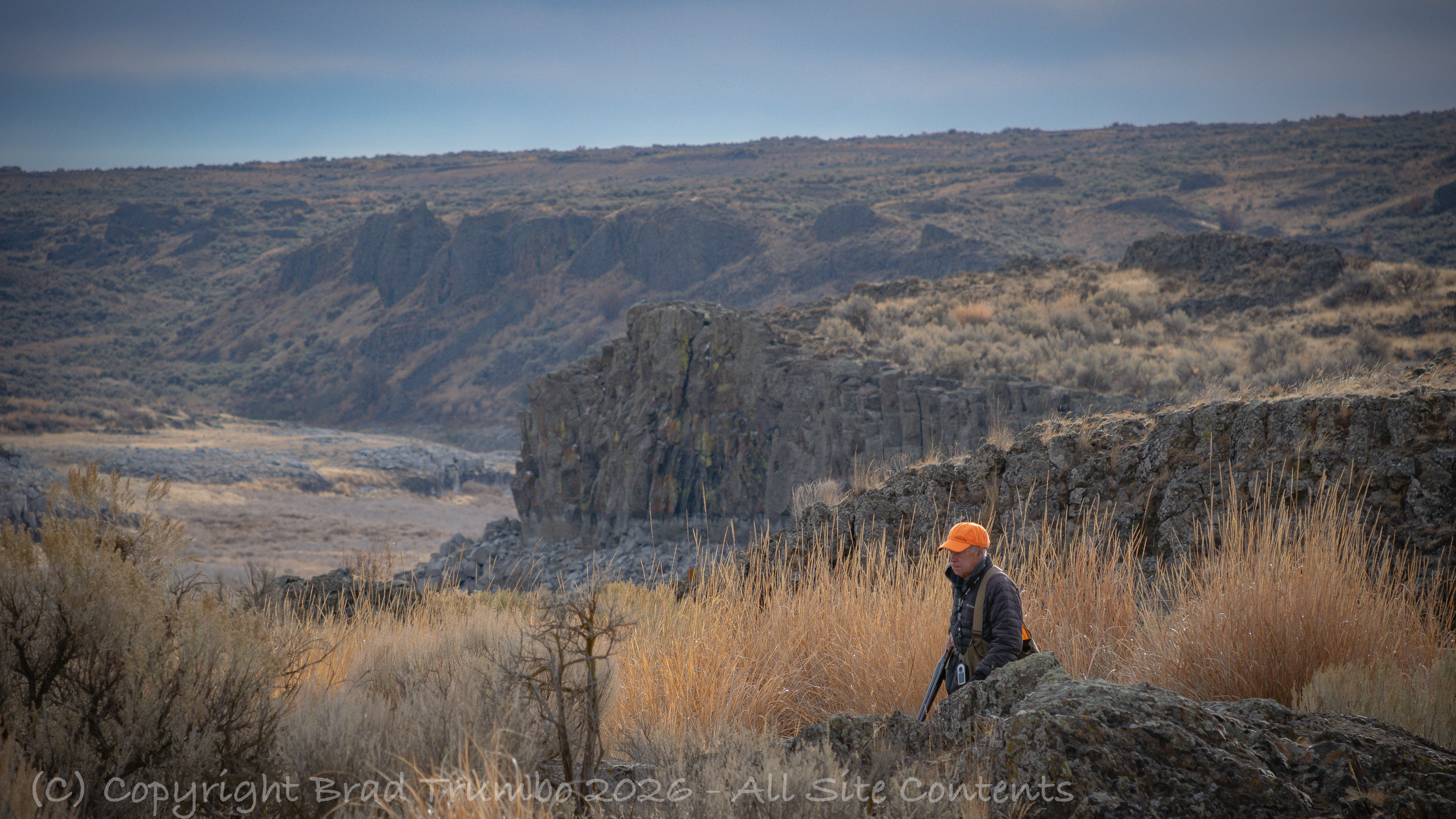
I’ve had the good fortune of experiencing a variety of hunts and dog breeds, each with unique styles, personalities, and quirks. Yet, I had never hunted with golden retrievers before the 2024 season. Fortunately, Randy, a fellow Pheasants Forever volunteer, recently invited me to walk with him and his brace of stunning strawberry blonde golden retrievers to push up pheasant.

Randy’s casual appearance belies his wisdom and character as one of the most interesting people alive. He has traveled and hunted birds widely with his beloved golden retrievers. A 1970s throwback photo of Randy sitting with his dog and a handful of valley quail after a momentous day in Baja was highlighted in the 2024 Pheasants Forever Journal Upland Bird Super Issue, Volume 43(4). Randy has a story for every occasion, hunting or otherwise, but as I followed him and his bouncing pups into the field, our conversation narrowed to strictly business.
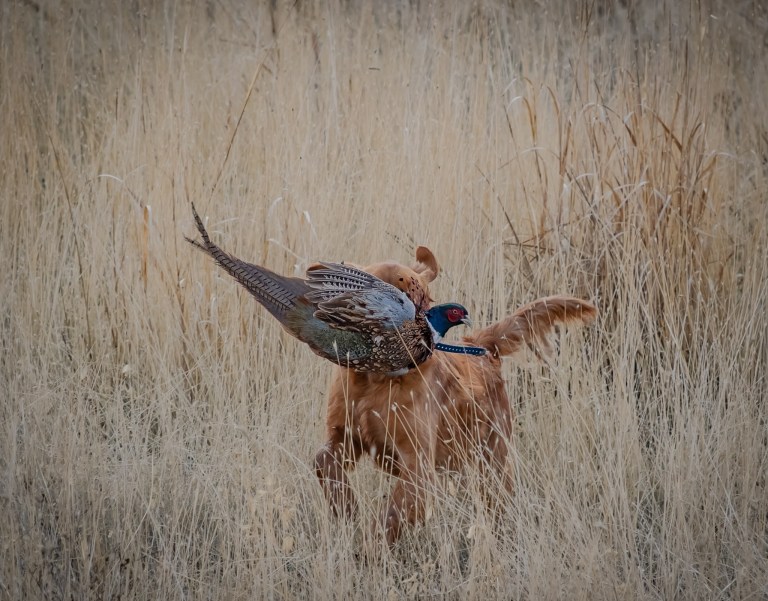
Young golden retriever, Scout, delivers a wily ring-neck rooster to hand.

“I’ve never hunted with flushers, save for a lab or two,” I said. 

“Really?” Randy questioned with surprise. “Well, you’re in for a treat!” Little did I know we would embark on a gentlemanly experience worthy of custom leather boots, twill wool garments, and ivy caps.

Flushing dogs are bred to do just that – find and flush birds. One crucial difference between flushing and pointing dogs like my setters is that flushers must work close to the hunter so the birds get up within shotgun range. Conversely, pointing dogs can range to whatever distance their handler is comfortable because they are bred and trained to stop when they find birds, allowing the hunter to approach and flush. These different dog behaviors also require the hunter to adapt their approach.

“You see the dogs getting ‘birdy’? Get up there fast!” Randy coached.

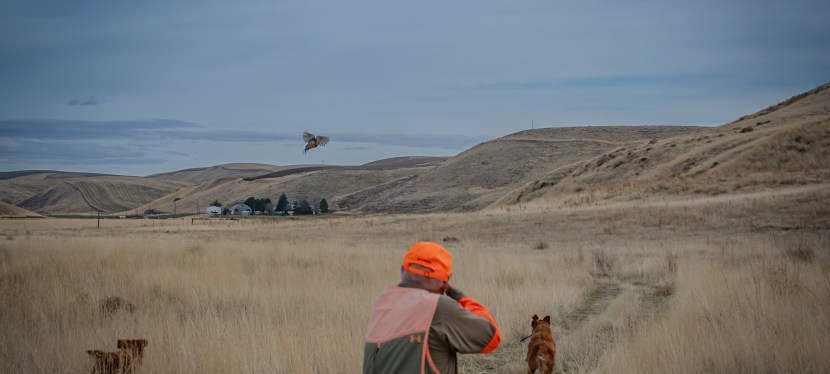
Making a beeline for the youngest dog, Scout, put me in the perfect position as a rooster pheasant broke from Scout’s pursuit. The rooster erupted directly ahead, climbing right-to-left and offering a clean swing. My 1951 C.F. Dumoulin side-by-side arrived at my shoulder with the bead perfectly aligned down range.

“Great shot!” Randy offered as Scout swiftly returned with the bird. 

“Thanks, Randy! My first rooster with the ole Dumoulin. And great dog work! I could get used to having my birds brought to hand. My setters have never cared to retrieve.”

Ten-year-old Tess settles at Randy’s feet with a prized rooster.

“Thank you! I’ll take the next bird,” Randy said with a chuckle as we moved on.

Soon after, Scout and his older companion, Tess, picked up the scent of another bird and began to push out. “Ssssssttt,” Randy quietly hissed, causing the dogs to hit the brakes and circle back toward us – an intelligent bit of training. Keeping quiet is essential to avoid spooking birds, particularly when approaching pheasants. This subtle sound instead of voice, whistle, or collar tone command can be the difference between a rooster flushing at 10 yards versus 100.

“You see how interested they look when they hit that scent? They ramp up to 100 miles per hour instantly, so you’ve got to be paying attention and moving quickly,” Randy advised as he scooted ahead, anticipating the flush. 

Randy carried a beautiful old Browning side-by-side, kept immaculate by his care and appreciation for quality and tradition. I observed Randy’s shot from behind, noting his relaxed technique and lead on the bird. The rooster tumbled, and Tess retrieved it in a textbook moment like a bread-and-butter sports play practiced 1,000 times over.

The hunt continued while Randy and I discussed birds and dogs and switched shooting opportunities with each new bird find. We strolled unhurried, carefree, appreciating every moment. It felt like a hunt for royalty, like we should have had a caddy to tote and reload the guns and serve the occasional sip of fine brandy or rich red wine in a classy sniffer.

By the hunt’s end, we each carried a passel of birds (Randy’s passel a bit heavier than mine) that would later become delicate meals shared with friends and family, sparking reflection on a noble hunt and Randy’s golden retrievers dealing a royal flush.

Classic side-by-sides like this 1951 C.F. Dumoulin 16-gauge are fun to carry, fitting of a classy hunt, and beautifully complemented by a brace of roosters.
The Proposed “Public Lands Rule” and What You Need to Know About It

Originally published at Harvesting Nature, August 11th, 2023.

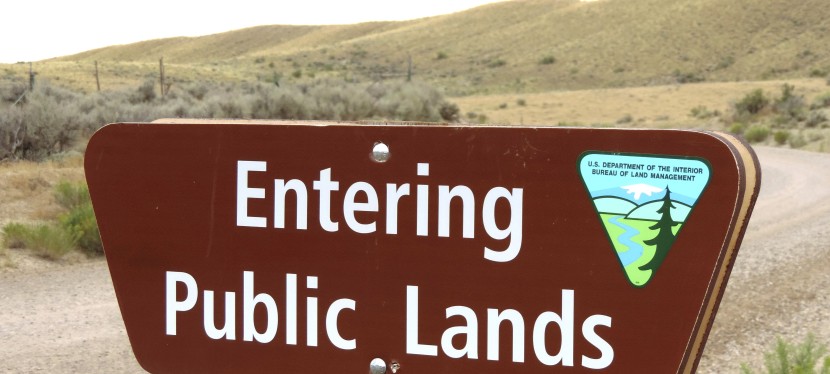
            On July 5th, the public comment period closed on the Bureau of Land Management’s (BLM) proposed conservation and landscape health rule, or the “Public Lands Rule,” to make conservation a “land use” equivalent to all other land use activities like recreation and mineral extraction. Implementation of the proposed rule could be a game changer for conservation.

The BLM manages more than 245 million acres of public lands (approximately one-tenth of the country), the stewardship of which is guided by the Federal Land Policy and Management Act of 1976 (FLPMA), unless otherwise provided by law. The FLPMA provides the BLM the authority to manage public lands for resource and ecosystem conservation. The Public Lands Rule would “…provide an overarching framework for multiple BLM programs to promote ecosystem resilience on public lands.”

The Public Lands Rule would do the following:

  • Apply land health standards to all BLM-managed public lands and uses;
  • Clarify that conservation is a “use within” the Federal Lands Policy and Management Act’s (FLPMA) multiple-use framework;
  • Establish a framework to promote ecosystem resilience on public lands through the creation and deployment of conservation leases, which will allow third parties to engage in conservation and mitigation activities on BLM lands.

Each of the four points is important for enhancing and perpetuating ecosystem integrity on a vast proportion of public lands.

The application of land health standards would establish a baseline condition for public lands for which to apply effects analyses for proposed land use actions. Ensuring that proposed actions like grazing, mining, and timber harvest would maintain or improve the baseline condition consistent with conservation practices as a compatible land use would result in long-term ecosystem benefits.

Updating the Department of Interior’s land management regulations to enhance the BLM’s ability to designate Areas of Critical Environmental Concern (ACEC) will better protect and perpetuate sensitive habitats and cultural resources. The benefits of protecting sensitive and scarce habitats are clear, but sensitive cultural sites are not always known or as easy to protect beyond National Parks or Monuments, for example. Concerted efforts by the BLM to gain Tribal input for the establishment of ACECs beyond routine National Environmental Policy Act requirements have the potential to protect areas of cultural significance on a much broader scale and without an act of Congress.

“Conservation leases” present a novel idea for leasing areas specifically for habitat enhancement, ecosystem restoration, and compensatory mitigation for land development actions. Conservation as a land use and conservation leases are proposed to work in concert with other approved land uses or development but have the potential to establish boundaries for resource protections and allow for on- or off-site mitigation for potential habitat damage. 

The proposed Public Lands Rule as written is fairly robust, but the proposed language requires clarification.

Regarding conservation leases, the proposed language in Section 6102.4(a)(5) of the proposed Public Lands Rule aptly clarifies that “…the [conservation lease issuance] itself should not be interpreted to exclude public access to leased lands for casual use of such lands….” Plainly put, public recreation is permitted on lands under a conservation lease. However, this language requires two clarifications. The language should read “…the rule itself SHALL not be interpreted to exclude public access to leased lands for casual use of such lands….” The word “should” is dismissible and may lead to interpretations that would arbitrarily prohibit public access and recreation.

Additionally, “casual use” of public lands must be clearly defined to include appropriate low-impact recreation activities such as hiking, hunting, fishing, etcetera. Without a clear definition, interpretations of “casual use” may again arbitrarily prohibit certain types if not all public recreation on conservation leases.

To ensure the conservation lease language is appropriate for the final rule, the BLM requested The Wildlife Society (TWS) review and comment. The TWS Rangeland Wildlife Working Group led the review and provided six pages of suggested clarifications and overall support of the proposed Public Lands Rule.

For areas identified as ACECs, the proposed language would impose protections on these lands, yet the language is unclear when and how “protection” may be given to ACECs and what “protection” means. Some ACECs will be more culturally sensitive or pristine than others and should require greater restrictions on activities within those areas.

In conclusion, the proposed Public Lands Rule is a valuable effort with the potential to enhance and maintain ecosystem and cultural resource integrity in concert with other allowable land uses. The BLM will now consider the comments received and edit the proposed language where and how appropriate before publishing the final rule.

Although the public comment period has ended, all public land users should become familiar with the proposed Public Lands Rule and how it may affect public access and recreation. More information and a link to the Federal Register publication are available at Public Lands Rule | Bureau of Land Management (blm.gov).

Feature Photo Credit: US Department of the Interior, Bureau of Land Management.