The Proposed “Public Lands Rule” and What You Need to Know About It

Originally published at Harvesting Nature, August 11th, 2023.

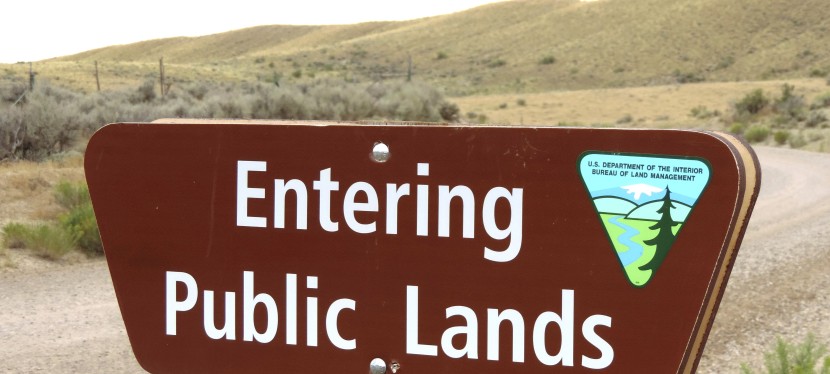
            On July 5th, the public comment period closed on the Bureau of Land Management’s (BLM) proposed conservation and landscape health rule, or the “Public Lands Rule,” to make conservation a “land use” equivalent to all other land use activities like recreation and mineral extraction. Implementation of the proposed rule could be a game changer for conservation.

The BLM manages more than 245 million acres of public lands (approximately one-tenth of the country), the stewardship of which is guided by the Federal Land Policy and Management Act of 1976 (FLPMA), unless otherwise provided by law. The FLPMA provides the BLM the authority to manage public lands for resource and ecosystem conservation. The Public Lands Rule would “…provide an overarching framework for multiple BLM programs to promote ecosystem resilience on public lands.”

The Public Lands Rule would do the following:

  • Apply land health standards to all BLM-managed public lands and uses;
  • Clarify that conservation is a “use within” the Federal Lands Policy and Management Act’s (FLPMA) multiple-use framework;
  • Establish a framework to promote ecosystem resilience on public lands through the creation and deployment of conservation leases, which will allow third parties to engage in conservation and mitigation activities on BLM lands.

Each of the four points is important for enhancing and perpetuating ecosystem integrity on a vast proportion of public lands.

The application of land health standards would establish a baseline condition for public lands for which to apply effects analyses for proposed land use actions. Ensuring that proposed actions like grazing, mining, and timber harvest would maintain or improve the baseline condition consistent with conservation practices as a compatible land use would result in long-term ecosystem benefits.

Updating the Department of Interior’s land management regulations to enhance the BLM’s ability to designate Areas of Critical Environmental Concern (ACEC) will better protect and perpetuate sensitive habitats and cultural resources. The benefits of protecting sensitive and scarce habitats are clear, but sensitive cultural sites are not always known or as easy to protect beyond National Parks or Monuments, for example. Concerted efforts by the BLM to gain Tribal input for the establishment of ACECs beyond routine National Environmental Policy Act requirements have the potential to protect areas of cultural significance on a much broader scale and without an act of Congress.

“Conservation leases” present a novel idea for leasing areas specifically for habitat enhancement, ecosystem restoration, and compensatory mitigation for land development actions. Conservation as a land use and conservation leases are proposed to work in concert with other approved land uses or development but have the potential to establish boundaries for resource protections and allow for on- or off-site mitigation for potential habitat damage. 

The proposed Public Lands Rule as written is fairly robust, but the proposed language requires clarification.

Regarding conservation leases, the proposed language in Section 6102.4(a)(5) of the proposed Public Lands Rule aptly clarifies that “…the [conservation lease issuance] itself should not be interpreted to exclude public access to leased lands for casual use of such lands….” Plainly put, public recreation is permitted on lands under a conservation lease. However, this language requires two clarifications. The language should read “…the rule itself SHALL not be interpreted to exclude public access to leased lands for casual use of such lands….” The word “should” is dismissible and may lead to interpretations that would arbitrarily prohibit public access and recreation.

Additionally, “casual use” of public lands must be clearly defined to include appropriate low-impact recreation activities such as hiking, hunting, fishing, etcetera. Without a clear definition, interpretations of “casual use” may again arbitrarily prohibit certain types if not all public recreation on conservation leases.

To ensure the conservation lease language is appropriate for the final rule, the BLM requested The Wildlife Society (TWS) review and comment. The TWS Rangeland Wildlife Working Group led the review and provided six pages of suggested clarifications and overall support of the proposed Public Lands Rule.

For areas identified as ACECs, the proposed language would impose protections on these lands, yet the language is unclear when and how “protection” may be given to ACECs and what “protection” means. Some ACECs will be more culturally sensitive or pristine than others and should require greater restrictions on activities within those areas.

In conclusion, the proposed Public Lands Rule is a valuable effort with the potential to enhance and maintain ecosystem and cultural resource integrity in concert with other allowable land uses. The BLM will now consider the comments received and edit the proposed language where and how appropriate before publishing the final rule.

Although the public comment period has ended, all public land users should become familiar with the proposed Public Lands Rule and how it may affect public access and recreation. More information and a link to the Federal Register publication are available at Public Lands Rule | Bureau of Land Management (blm.gov).

Feature Photo Credit: US Department of the Interior, Bureau of Land Management.

Arizona’s Apache Trout could be the First Gamefish De-listed from the Endangered Species Act

On August 10th, 2023, the US Fish and Wildlife Service (USFWS) issued a press release announcing the proposed de-listing of Arizona’s state fish, the Apache trout[1]. The Apache trout and Gila trout are the only two trout species native to the state.

According to the USFWS[2], the Apache trout is native exclusively to the streams in and around the White Mountains in the eastern part of the state. Historically, they were found only in the headwaters of the White, Black, and Little Colorado Rivers above 5,900 feet elevation in east-central Arizona[3].

The Apache trout was originally considered the same species as the Gila trout, which was listed under the Endangered Species Preservation Act in 1967. The Apache trout was first described as a unique species in 1972, and one year later, it gained protection under the Endangered Species Act of 19731.

Competition from non-native brook and brown trout and hybridization with non-native rainbow and cutthroat trout threaten Apache trout populations.

The 2009 Apache Trout Recovery Plan identified a goal of 30 pure (non-hybridized) Apache trout populations being necessary for species recovery. The plan also noted 27 populations existing within their historical range in Arizona’s Gila, Apache, and Greenlee counties, and the Fort Apache Indian Reservation and Apache-Sitgreaves National Forest[4].

The USFWS 2021 Apache trout species status assessment[5] identified the recovery goal of 30 pure populations had been met, which prompted the USFWS Endangered Species Act de-listing proposal.

Apache trout recovery is owed to 50 years of collaborative conservation work among state, federal, and nonprofit partners removing introduced trout species and preventing their reestablishment in Apache trout habitats. If de-listed, the Apache trout would add to the list of 91 species that have recovered under the protections of the Endangered Species Act.

Active management would continue to prevent future reintroductions of non-native trout species and hybridization. Additionally, the Endangered Species Act requires the USFWS to implement a post-delisting monitoring plan for a minimum of five years to ensure the species remains stable.

The USFWS de-listing proposal1 is open for public comment through October 9th. Information on how to submit comments is available at www.regulations.gov  by searching docket number FWS-R2-ES-2022-0115.


[1] Apache Trout De-listing Proposal – Federal Register – Regulations.gov

[2] Proposed Delisting of Apache Trout | U.S. Fish & Wildlife Service (fws.gov)

[3] Apache Trout Recovery – Arizona Game & Fish Department (azgfd.com)

[4] Apache Trout (Oncorhynchus apache) – Species Profile (usgs.gov)

[5] USFWS 2021 Apache Trout Species Status Assessment (fws.gov)

Feature Photo Credit: US Fish and Wildlife Service

Research Identifies Measures to Reduce Wind Energy-related Bird and Bat Fatalities

Published July 7th 2023 at Harvesting Nature

Wind energy production facilities have been condemned for impacts to bird and bat species, but recent research suggests that minimizing impacts while maintaining power production efficiency may be feasible.

Wind energy production facilities are increasingly common worldwide, resulting from efforts to shift to renewable energy sources – a trend that will likely continue in the US. In 2022, President Biden invoked the Defense Production Act to allow the U.S. to “take ownership of its clean energy independence[1].”

The purpose for calling upon this decades-old act is to provide the US Department of Energy the authority to “help strengthen domestic solar, heat pump, and grid manufacturing industries while fortifying America’s economic security and creating good-paying jobs, and lowering utility costs along the way.” Invocation of the Defense Production Act is anticipated to “boost American production of the critical technologies necessary to lower energy costs, support the clean energy economy, and strengthen national security.”

In 2021, Princeton University estimated that the US would need to develop 19-96 gigawatts of wind energy production each year to reach “net-zero” greenhouse gas emissions by 2050[2]. And, like most energy production sources, wind turbines are known to impact wildlife, namely a proportion of birds and bats that encounter them. Therefore, the May/June 2023 issue of The Wildlife Professional provides a timely summary of potential measures to reduce bird and bat mortality at wind turbines2.  

Organizations like the US Fish and Wildlife Service have developed guidelines for wind turbine operations to minimize impacts on birds and bats through a process called “curtailment.” For example, bats are more active around wind turbines operating at slower speeds, so a curtailment measure would be to set a higher windspeed threshold (i.e. “cut-in speed”) for which the wind turbine would begin to operate. Research has shown that cut-in windspeeds between 11-15 miles per hour reduce bat fatalities by up to 63 percent[3], and curtailment to over 16 miles per hour reduces fatalities by over 80 percent for some species[4]. Curtailment has also been found to reduce eagle fatalities on par with bats.

A 60 to 80 percent reduction in bat and eagle mortality seems to support implementing curtailment measures, but curtailment reduces power production efficiency for facilities that some would argue are inefficient even without operating restrictions. For this reason, additional actions are being evaluated.

A global positioning system (GPS)-triggered “geo-fence” is being implemented with California condors. When a tagged condor enters the defined perimeter of a wind facility, the tag detection triggers immediate curtailment measures and avoids wind turbines operating under curtailment when no birds are present. This is an effective method of reducing condor fatalities, but tagging individuals is not a feasible solution for songbirds and bats. Deterrent strategies may be more effective.

Deterrents that have been studied reduce bird and bat mortality without impacting power production and include sound, high-contrast lighting, and painted turbine blades to avoid the appearance of blurring together at high speed. Only auditory deterrents are effective for bats, and each species’ use of echolocation differs, making one-size-fits-all deterrents less effective.

No single fatality reduction measure has proven effective for all species; however, a combination of deterrents and curtailment may be tailored to facilities, and research is ongoing to identify additional measures to reduce bird and bat fatalities while allowing efficient wind energy production.


[1] President Biden Invokes Defense Production Act | Department of Energy

[2] Felton, S. 2023. Change in the Air: Technological Solutions can Reduce Bird and Bat Collisions at Wind Facilities. The Wildlife Professional 17(3):38-40.

[3] A review of the effectiveness of operational curtailment for reducing bat fatalities at terrestrial wind farms in North America | PLOS ONE

[4] A smart curtailment approach for reducing bat fatalities and curtailment time at wind energy facilities – PubMed (nih.gov)

Rewinding the Kissimmee River

Published May 19th, 2023 at Harvesting Nature.

When country music artist, John Anderson, released his hit song Seminole Wind in 1992, his fans fell in love with it. Music is about storytelling, and Seminole Wind speaks of the Everglades’ history and ecological and cultural collapse.

“They made their plans and they drained the land. Now the glades are going dry.”

Anyone who has heard the song remembers these powerful lyrics. However, the true context was lost on folks that were unaware of the ecological damage that had been done “…in the name of flood control.” The Kissimmee River provides a cut-and-dried case study.

The Kissimmee River once snaked 103 miles south from its Lake Kissimmee headwaters to Lake Okeechobee. The river’s floodplain was a two-mile-wide wetland inundated by seasonal rainfall. This wetland corridor provided prime habitat for at least 38 species of waterbirds and 39 fishes. The life history of these species depended upon the wetlands1.

The “flood pulse concept” is an ecological process involving seasonal flooding and inundation of the lands surrounding a waterbody. Flooding delivers sediment and nutrients to the land, opens spawning habitat for fishes, and creates breeding and feeding opportunities for wildlife. Seasonal flooding also replenishes the water table and shallow aquifers.

As development spread through Central Florida in the mid-1900s, the Kissimmee River’s seasonal flooding became problematic for Florida’s economic growth. The state approached the US Army Corps of Engineers (USACE) with a request for assistance in draining the land for development2

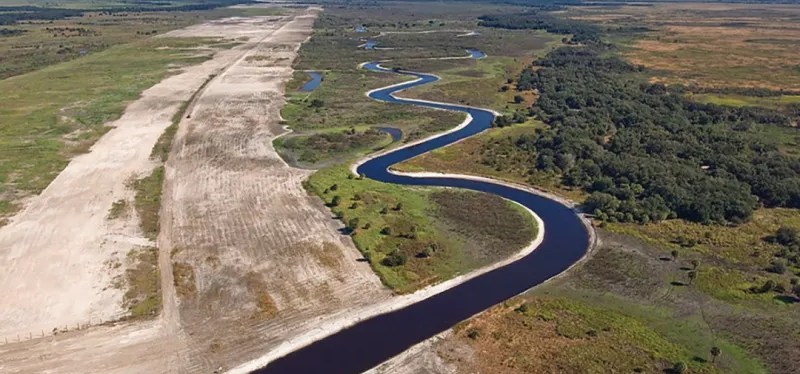
Between 1962 and 1971, USACE channeled the Kissimmee River, creating a 30-foot deep, 300-foot wide, 56-mile-long drainage canal. This project drained approximately 50,000 acres of the Kissimmee’s floodplain wetlands3 and effectively ended the seasonal flood pulse. Within a few years, waterfowl populations dropped by 90 percent, bald eagle numbers by 70 percent, and some fish, bird, and mammal species vanished entirely2. Ironically, the canal system drained too well.

The formerly channelized Kissimmee River – photo by the South Florida Water Management District

“It messed up our water management infrastructure. Now, we drain so much water that when it’s dry, we don’t have enough water for our human needs. We over-drained, and so now we’re trying to rebuild the system where we’re going to catch water instead of wasting it when it’s wet”, said Paul Gray, Everglades Science Center Coordinator of Audubon Florida.

Beginning in the 1990s, USACE and its partners began cooperating to restore the Kissimmee River ecosystem. Coincidentally, Congress authorized the restoration in 1992 as Seminole Wind played through millions of FM radios and televisions.

More than 20 years and over $1 billion later, the restoration of approximately 44 miles of the Kissimmee River and 25,000 acres and 40 square miles of wetlands have been re-established and rehydrated1,2. The restored floodplain and wetlands now support at least 159 bird species3.

Re-winding a river is something rare and nearly impossible to accomplish, particularly at the scale of the Kissimmee River. Fortunately, in our modern world of “engineering with nature” and “nature-based solutions” to infrastructure problems, science and technology can cooperate with the environment to balance needs and functionality. The Kissimmee River restoration is the largest functioning restoration of its kind worldwide – something the USACE and Floridians can be proud of.

[1] Kissimmee River Project – Largest Restoration Initiative of its Kind – Complete After Nearly 30 Years | Audubon Florida

[2] The Kissimmee River has been brought back to life—and wildlife is thriving (nationalgeographic.com)

[3] Kissimmee River Project restores about 40% of river’s twists | South Central Florida Life

Feature Image Credit: US Army Corps of engineers, Jacksonville District