Steppe Outside – The Search for Washington’s Dancing Grouse

Published May 18th, 2024, in the Walla Walla Union Bulletin

Rain hammered upon the camper roof throughout the night, robbing me of the restful sleep I envisioned when planning a trip to the north-central scablands. Spring in the scablands is purely magical, and I often find myself float-fishing for trout on the many good fishing lakes. This trip was something different, however.

Rousing groggily to the 4:00 a.m. alarm meant my sleepless night would soon be rewarded with a cold, wet sit in the dark. Surrounded by Columbian sharp-tailed grouse habitat, I was about to embark on my first-ever lek survey to assist the Washington Department of Fish and Wildlife (WDFW) in monitoring one of this species’ seven fragile populations in Washington State.

We’ve all heard the adage that Columbia River salmon once returned so abundant that one could “walk across their backs.” Well, the story is similar for the Columbian sharp-tailed grouse. When the west was settled, sharp-tailed grouse numbered in the millions. Eastern Washington was largely shrub-steppe habitat and supported hundreds of thousands of the subspecies “Columbian” sharp-tailed grouse. They were commonplace. But, like the passenger pigeon, no one considered they would ever face extinction.

A tragedy of being human is that we often fail to notice a gradual decline in something so familiar until we’ve slipped past the point of recovery. The bird’s initial decline was noted as early as the 1950s, and as the vast Washington shrub-steppe disappeared an acre at a time, the Columbian sharp-tailed grouse followed.

The temperature plummeted with the falling rain, which soon turned to heavy snow. The veil of large white flakes impaired visibility on the greasy gravel road, not to mention the waves of muddy water splashing over the windshield from large puddles.

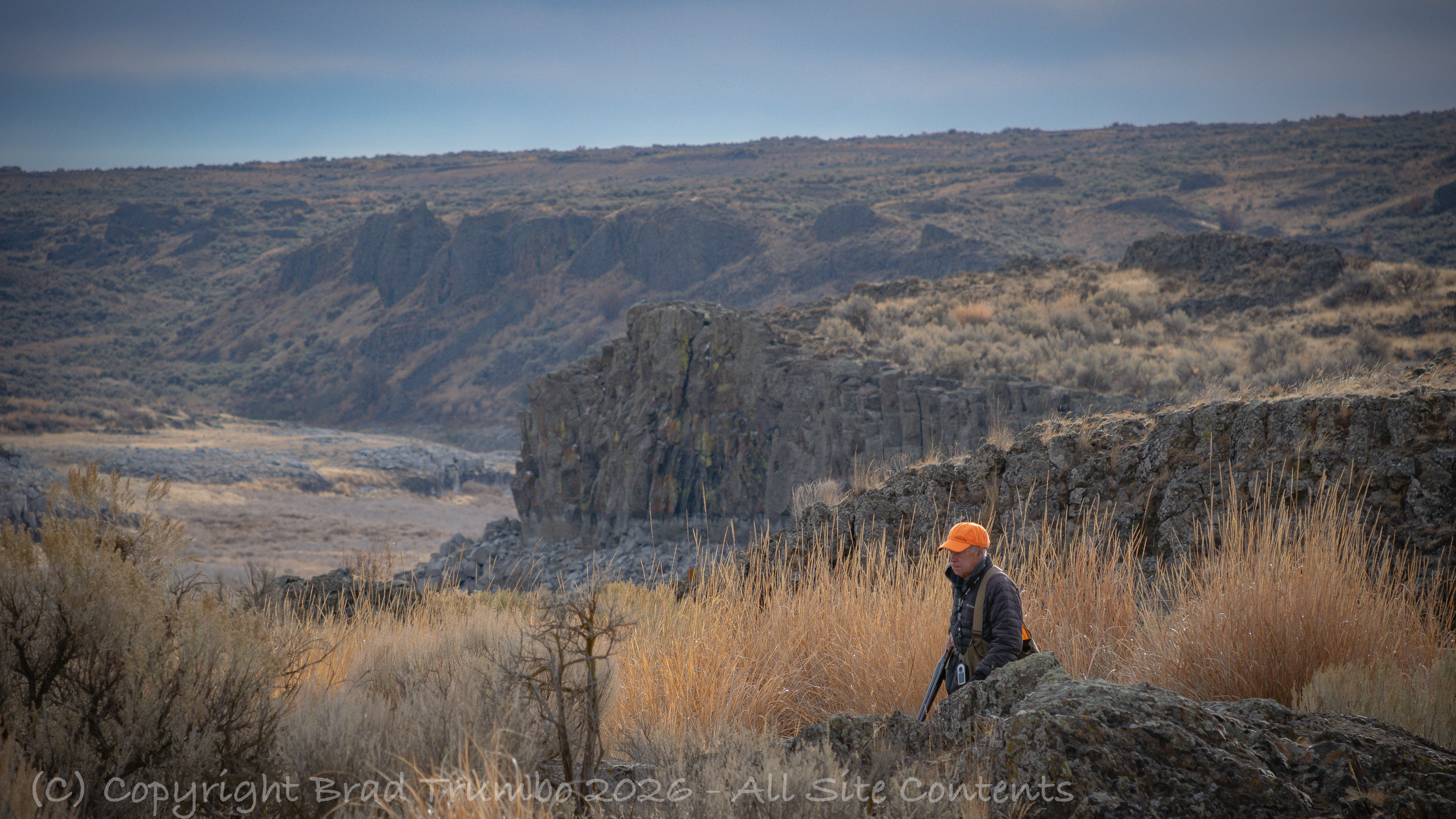
Thirty minutes later, Malika, George, and I sat in the snow overlooking a several-hundred-acre basin supporting a handful of historic and active sharp-tail “leks”. North American grasslands grouse – sharp-tails, sage grouse, and prairie chickens – use these traditional habitat areas year after year where males perform courtship rituals and compete for mates. The word “lek” combines the idea of “mating” (from the Swedish “lek”) and the notion of a “place” (from the Swedish “ställe”). In Swedish, “lekställe” directly translates to “mating ground”[1].

Sharp-tail males flash their “superciliary combs,” or sunflower-yellow eyebrows, and their “drum nape,” which are violet-colored air sacs on either side of their neck, while bowing with their tails high and wings extended, looking like a plane dropping onto the runway. They shuffle and tap their feet swiftly and click their two namesake pointed tailfeathers as they dance. Their tailfeathers clicking sounds like an old film reel movie playing as the birds spin about. In areas with strong sharp-tail populations, grasses on the lek can become beaten down from weeks of morning dancing, “hooting, clucking, and gobbling” rituals.

While I knew we overlooked an active lek, sharp-tails would only dance in my head this morning. We eagerly awaited dawn, listening for any hint of these mythical birds while snowflakes noisily pattered our synthetic jacket hoods. I had seen sharp-tails by the dozen in Montana and the Dakotas, but to see Columbian sharp-tails on their native Washington soil was a spectacle I longed to behold.

Survey protocol was to walk the lek about 45 minutes after sunrise. By then, any birds on an active lek would at least be heard if not seen, and the lek activity would be waning for the day. Flushing the birds provides more accurate counts and allows surveyors to search for scat and feathers; the feathers can be used for genetic testing. Due to the snow and no sign or sound of the birds, we left the lek without bothering to walk it as no feathers or scat would have been visible.

Back at camp, we all returned to our respective mobile shelters and wiled away the day, watching the snow fall, reading, and preparing for another cold morning.

The next morning dawned frigid cold, crystal clear, and with a million shimmering stars. Malika and I went alone to the same lek as before and again awaited dawn while a chorus of wildlife warmed their voices. 

“If I were a grouse, I would be dancing on a morning like this,” I said as we plopped down in the dark with our ears tuned to the sharp-tail channel.

Canada geese, mallards, and a hundred other waterfowl competed with a pack of coyotes in every compass direction for the award of “most obnoxious morning song,” but something different drifted in from our left. The low, two-pitched cluck from what sounded like a single bird somewhere in the grasses was a new sound for both of us.

“I think that’s a sharp-tail,” Malika whispered.

“So do I,” I replied while shifting to scan the lek with my binoculars.

We never spotted the birds from where we sat, but around 7:00 a.m., we strolled down onto the lek in search of scat and feathers. The sun glistened upon the frost-encrusted bunchgrasses in the 27-degree stillness. We walked more than 100 yards of what appeared to be prime lek without a speck of sign, but as Malika turned to make a pass back, the slap of upland bird wings grabbed my ears. My head snapped right so fast that I nearly pulled a neck muscle. The tell-tale flushing “chuckle” of a sharp-tailed grouse was so exciting that I yelled, “Sharp-tailed grouse!” while pointing at the fleeing bird. Moments later, a second bird lifted off, chuckling as it raced toward the horizon.

We finished walking the lek with no further sign of birds, but the sun shining warmly upon our shoulders fortified our sense of triumph. Malika was a 20-year-old college undergrad with a fresh notion of becoming a wildlife biologist. Before that weekend, she had no clue what a sharp-tailed grouse was, much less any awareness of the bird’s struggle for existence in Washington State. The experience was unique for us in different ways, although seeing a sharp-tail in Washington was a first for us both.

For Malika, it was a cool “sciency” encounter with an upland bird. For me, it was like stumbling upon delicate frost flowers or catching a glimpse of UFO-shaped lenticular clouds. These natural phenomena exist, but they are rare enough that it’s unlikely to experience them.

That chuckling sharp-tail flush echoed through my mind on the drive home. Just seven remnant populations of Columbian sharp-tailed grouse remain in Douglas, Lincoln, and Okanogan Counties. The total Washington population is fewer than 1,000 birds, and the largest individual population remains on the Colville Reservation. Columbian sharp-tails occupy approximately three percent of their historic Washington range, making habitat loss events like the September 7th, 2020, Whiney Fire that torched over 127,000 acres a significant threat. That’s a large enough area to wipe out one of the remaining populations completely.

The Colville Tribes are deeply invested in Columbian sharp-tailed grouse conservation efforts, working alongside the WDFW, Bonneville Power Administration, and local Public Utility Districts in the upper Columbia River. According to the WDFW, the Colville Tribes began assisting with translocation efforts as far back as 1999 (possibly before) by providing birds from the Reservation to be released at the WDFW 9,000-acre Scotch Creek Wildlife Area in Okanogan County. The BPA paid for the Scotch Creek land acquisition with mitigation funds for the operation and electricity sales from Chief Joseph and Grand Coulee Dams.

The Columbian sharp-tailed grouse is classified as “endangered” in Washington and protected from hunting. With ongoing efforts by the Colville Tribes, WDFW, and non-profits, Washington’s sharp-tailed grouse can hang on, but how long is unknown.


[1] Lek – Words For Things You Didn’t Know Have Names, Vol. 3 | Merriam-Webster

Cover Photo by the US Fish and Wildlife Service
The Proposed “Public Lands Rule” and What You Need to Know About It

Originally published at Harvesting Nature, August 11th, 2023.

            On July 5th, the public comment period closed on the Bureau of Land Management’s (BLM) proposed conservation and landscape health rule, or the “Public Lands Rule,” to make conservation a “land use” equivalent to all other land use activities like recreation and mineral extraction. Implementation of the proposed rule could be a game changer for conservation.

The BLM manages more than 245 million acres of public lands (approximately one-tenth of the country), the stewardship of which is guided by the Federal Land Policy and Management Act of 1976 (FLPMA), unless otherwise provided by law. The FLPMA provides the BLM the authority to manage public lands for resource and ecosystem conservation. The Public Lands Rule would “…provide an overarching framework for multiple BLM programs to promote ecosystem resilience on public lands.”

The Public Lands Rule would do the following:

  • Apply land health standards to all BLM-managed public lands and uses;
  • Clarify that conservation is a “use within” the Federal Lands Policy and Management Act’s (FLPMA) multiple-use framework;
  • Establish a framework to promote ecosystem resilience on public lands through the creation and deployment of conservation leases, which will allow third parties to engage in conservation and mitigation activities on BLM lands.

Each of the four points is important for enhancing and perpetuating ecosystem integrity on a vast proportion of public lands.

The application of land health standards would establish a baseline condition for public lands for which to apply effects analyses for proposed land use actions. Ensuring that proposed actions like grazing, mining, and timber harvest would maintain or improve the baseline condition consistent with conservation practices as a compatible land use would result in long-term ecosystem benefits.

Updating the Department of Interior’s land management regulations to enhance the BLM’s ability to designate Areas of Critical Environmental Concern (ACEC) will better protect and perpetuate sensitive habitats and cultural resources. The benefits of protecting sensitive and scarce habitats are clear, but sensitive cultural sites are not always known or as easy to protect beyond National Parks or Monuments, for example. Concerted efforts by the BLM to gain Tribal input for the establishment of ACECs beyond routine National Environmental Policy Act requirements have the potential to protect areas of cultural significance on a much broader scale and without an act of Congress.

“Conservation leases” present a novel idea for leasing areas specifically for habitat enhancement, ecosystem restoration, and compensatory mitigation for land development actions. Conservation as a land use and conservation leases are proposed to work in concert with other approved land uses or development but have the potential to establish boundaries for resource protections and allow for on- or off-site mitigation for potential habitat damage. 

The proposed Public Lands Rule as written is fairly robust, but the proposed language requires clarification.

Regarding conservation leases, the proposed language in Section 6102.4(a)(5) of the proposed Public Lands Rule aptly clarifies that “…the [conservation lease issuance] itself should not be interpreted to exclude public access to leased lands for casual use of such lands….” Plainly put, public recreation is permitted on lands under a conservation lease. However, this language requires two clarifications. The language should read “…the rule itself SHALL not be interpreted to exclude public access to leased lands for casual use of such lands….” The word “should” is dismissible and may lead to interpretations that would arbitrarily prohibit public access and recreation.

Additionally, “casual use” of public lands must be clearly defined to include appropriate low-impact recreation activities such as hiking, hunting, fishing, etcetera. Without a clear definition, interpretations of “casual use” may again arbitrarily prohibit certain types if not all public recreation on conservation leases.

To ensure the conservation lease language is appropriate for the final rule, the BLM requested The Wildlife Society (TWS) review and comment. The TWS Rangeland Wildlife Working Group led the review and provided six pages of suggested clarifications and overall support of the proposed Public Lands Rule.

For areas identified as ACECs, the proposed language would impose protections on these lands, yet the language is unclear when and how “protection” may be given to ACECs and what “protection” means. Some ACECs will be more culturally sensitive or pristine than others and should require greater restrictions on activities within those areas.

In conclusion, the proposed Public Lands Rule is a valuable effort with the potential to enhance and maintain ecosystem and cultural resource integrity in concert with other allowable land uses. The BLM will now consider the comments received and edit the proposed language where and how appropriate before publishing the final rule.

Although the public comment period has ended, all public land users should become familiar with the proposed Public Lands Rule and how it may affect public access and recreation. More information and a link to the Federal Register publication are available at Public Lands Rule | Bureau of Land Management (blm.gov).

Feature Photo Credit: US Department of the Interior, Bureau of Land Management.

Sage Grouse Translocation Reverses Population Decline

Published at Harvesting Nature, November 26th, 2021.

Think you’ve heard it all when it comes to greater sage grouse conservation? Think again. When an icon of the sagebrush ecosystem becomes imperiled, conservation dollars flow to the far corners of habitat and population research to find solutions to species sustainability and persistence.

Mary Meyerpeter and colleagues with the US Geological Survey and Idaho State University are currently studying translocation to stabilize or even grow two declining sage grouse populations on opposite fringes of their North American distribution. The “Bi-State” population on the California-Nevada border was selected as a small, isolated group facing low hatch success and overall decline. A North Dakota population was selected after a suffering a severe West Nile Virus outbreak, reduced the population.  

Wildlife translocation has been a tool in the scientific toolbox longer than the words “science” and “research” have been in existence, and with this tool comes many benefits to imperiled populations. Declining genetic diversity and abundance of reproductive individuals are two challenges recipient populations typically face that may be overcome by translocation. Precisely what Meyerpeter et al. had in mind, coupled with estimating the population-level effects of introducing new individuals to the imperiled populations, and removing individuals from the donor populations.    

From 2017 through 2019, the Bi-State population received 68 adults and 125 chicks from a nearby source population, while the North Dakota population received 137 adults and 66 chicks from an interior Wyoming population. The populations were monitored across the translocation period and continue to be monitored.

Photo by the US Fish and Wildlife Service
Preliminary study results suggest that translocation efforts have been successful for the recipient populations. The Bi-State population increased 160 percent with egg hatch success increasing from 31 percent to 86 percent. Similarly, the North Dakota population increased 188 percent compared to pre-translocation estimates.

The Bi-State donor population declined 31 percent following translocations, which may have been attributed to that population also being relatively small, among other potential factors. The Wyoming donor population showed no change.

Translocation results are considered preliminary until a monitoring period of up to five years has documented population responses, but the results appear promising. Additionally, successful translocation coupled with habitat restoration can perpetuate the species and play a role in range expansion into historic habitats.

Tree Removal Benefits Greater Sage Grouse Population Growth

Tree Removal Benefits Greater Sage Grouse Population Growth – Harvesting Nature

Woody plant expansion into shrub and grasslands poses a significant ecosystem issue for multiple uses. In the Great Basin of North America, pinyon–juniper expansion into the sagebrush biome is threatening the greater sage grouse, a sagebrush obligate species, as well as pronghorn, mule deer, and livestock grazing due a major shift in the vegetation community and associated ecosystem components.

According to Brianna Randall of the Sage Grouse Initiative (SGI), “More than one million acres of sagebrush grazing lands in the Great Basin have turned into pinyon-juniper forests in the past two decades alone.”

This is problematic for sage grouse because they avoid landscapes with trees, likely because trees provide raptor perching and nesting habitat. Additionally, trees crowd out and take precious water from perennial grasses, forbs, and other plants that a variety of wildlife rely on, and can effectively reduce habitat carrying capacity and suitability, causing species to relocate.

Protecting and restoring the sagebrush ecosystem is at the forefront of the Natural Recourse Conservation Service (NRCS) mission. Through the NRCS Working Lands for Wildlife program, the SGI was born and includes partnerships with other land management agencies, universities, and landowners. As a collective, these entities work to enhance the sagebrush ecosystem for cooperative wildlife and agricultural uses.

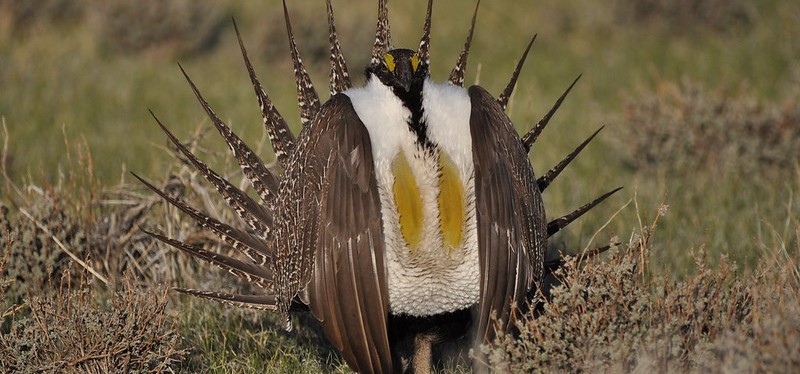
Sage grouse on the lek. (Photo credit USFWS)

Since approximately 2011, a pinyon–juniper removal effort has been underway in the Warner Mountains in south-central Oregon. Concurrently, researchers GPS-tracked 417 hen sage grouse over a 109,000-acre “treatment” area with active tree removal.

Study results published in June (Olsen et al. 2021) show that within the treatment area, sage grouse population growth rates increased approximately 12 percent within five years of tree removal compared to a population within an adjacent 82,000-acre “control” or area with no tree removal. Similarly, a 2017 SGI report identified that 29 percent of tracked hen sage grouse in Oregon returned to restored nesting habitats within four years post-restoration. Encouraging results for the future of sage grouse and the sagebrush ecosystem.

The rarity in seeing such positive population results from habitat management was summarized appropriately by Olsen et al. (2021).

“Examples of positive, population-level responses to habitat management are exceptionally rare for terrestrial vertebrates, and this study provides promising evidence of active management that can be implemented to aid recovery of an imperiled species and biome.”  

References

Olsen, AC., JP Severson, LD Maestas, DE Naugle, JT Smith, JD Tack, KH Yates, and CA Hagen. 2021. Reversing tree expansion in sagebrush steppe yields population-level benefit for imperiled grouse. Ecosphere https://doi.org/10.1002/ecs2.3551.

Sage Grouse Initiative. 2017. Conifer Removal Boosts Sage Grouse Success. Science to Solutions Series Number 12. Conifer Removal Boosts Sage Grouse Success – Sage Grouse Initiative