Northwest Outdoor Writers Association Gathered in The Dalles, Oregon

The Northwest Outdoor Writers Association (NOWA) held its annual conference Friday, May 2nd through Sunday, May 4th, at the Columbia River Hotel in The Dalles, Oregon. For three days, some of the Northwest’s top outdoor writers, authors, photographers, videographers, and radio and podcast personalities gathered to discuss the future of their industry and craft.

The conference opened with a fine meal at the Portage Grill, followed by a keynote speech by author, poet, and publisher, Rick Steber, who exemplified excellence in storytelling. Rick is not only gifted in his ability to research people and history and share those stories in engaging detail, but the delivery of his many favorite interviews of historical figures (including voice impersonations) was both comical and fascinating.

Image of the twisting historic Oregon Route 30 taken from Rowen Crest with the Columbia River and the rugged Columbia Gorge in the background.

Trumbo captured this image while hiking at dawn on Rowen Crest just south of The Dalles, Oregon.

Over the following days, NOWA members sprinkled across the Columbia River Gorge to experience all The Dalles has to offer, such as the National Neon Sign Museum, hiking among the wildflowers and scrub oaks of the rugged river corridor, visiting ancient petroglyphs at Horsethief Lake, and fishing the spring Chinook salmon rodeo at Washington’s Drano Lake.

When not collecting memories, photographs, and fodder for future publications and videos, the outdoor media professionals gathered to share tips and tricks on improving one’s engagement and reach – facets of “Excellence in Craft”- and share business model ideas and successes. Excellence in Craft presentations included George Krumm, editor of Fish Alaska and Hunt Alaska magazines, who discussed how to land pitches and build relationships with editors. Brad Trumbo shared his rise in the outdoor writing and photography realm and engagement with his readers, thanks to his Llewellin setter bird dogs.

NOWA held its annual Excellence in Craft awards banquet Saturday, May 3rd, where 61 achievements were recognized, ranging from “Column of the Year” to the best outdoor photos, videos and humor pieces. The awards banquet offers an opportunity to see where talented outdoor content creators stand among their peers, provides “street cred” for marketing, and offers a fine payout for those who rank high in many categories. It’s a coveted experience for this highly talented group to share camaraderie with friendly competition.

This year’s Excellence in Craft award winners can be found here: https://nowaoutdoors.com/eic-winners-by-category/.

Black-chinned hummingbird hovering over a burgundy Columbine flower.

Trumbo’s image of a black-chinned hummingbird hovering over Columbine flowers took 1st place in NOWA’s Excellence in Craft “Fauna” photo category.

The weekend closed with NOWA President Troy Rodakowski presiding over Sunday morning’s membership and business meeting. During this meeting, Rodakowski assumed the position of NOWA’s Chairman of the Board of Directors as he passed the gavel to NOWA’s incoming President, Brad Trumbo. 

With the annual conference behind them, NOWA’s new year begins with anticipation of next year’s conference, which is already being planned. Additionally, Trumbo brings new ideas to NOWA’s structure and attempts to engage younger generations as the organization adapts to the evolution of outdoor media.
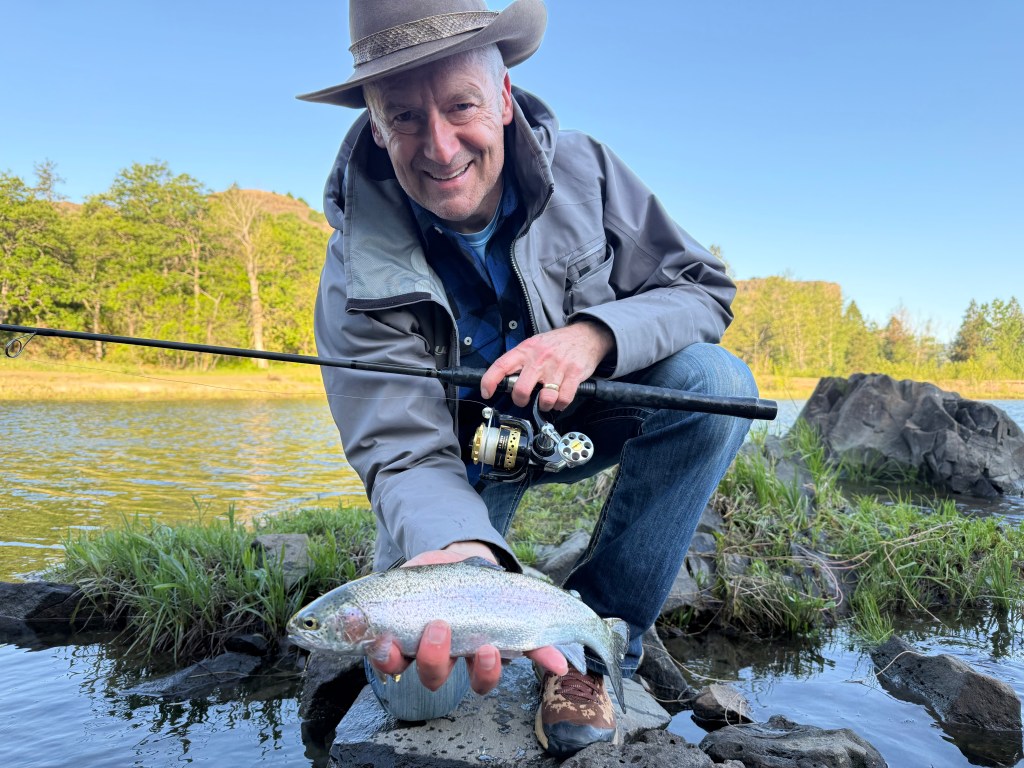
Gary Lewis, award winning author, freelance writer, podcaster, and host of the Frontier Unlimited TV show, found time for trout fishing before the Sunday morning meeting.

If you’re an outdoor content creator living in Oregon, Washington, Idaho, Montana, or BC Canada and want to learn from and contribute to this charismatic and savvy collection of media professionals, email NOWA’s Executive Director, Keith Szafranski, at photogsz@msn.com. Your creativity and energy will be welcomed by this prestigious cadre.

###

            The Northwest Outdoor Writers Association is a society of professional outdoor communicators dedicated to the pursuit of excellence in outdoor media. NOWA strives to further the improvement of professional communications skills and encourage their ethical employment. NOWA also provides a network of professional assistance and support, keeps members informed of news and information pertinent to outdoor activities and industries, and supports the conservation of natural and recreational resources. Visit https://nowaoutdoors.com/ and find us on Instagram @NOWAOutdoors.

Upland Stewardship Begins at Home

What’s the #1 threat to habitat on undeveloped public lands? If you guessed invasive plant species, you get a gold star for the day. Overall, habitat lost to civil development is a critical threat to fish and wildlife, putting tremendous importance on conservation and management of those precious public acres still intact.

Managing public land is important to provide habitat suitable for wildlife species and is accomplished through taxpayer and sportsman’s funds. For federal lands, this means congressional appropriations must be approved for specific geographic areas and funding limits.

While public lands, both state and federal, are at much lower risk of civil development, the economics of habitat management is a major driver in our ability to maintaining high quality habitat, and here is why.

Invasive species are incredibly competitive and successful at overtaking desired native species. With no natural predator controls (i.e. herbivory and parasitism) and an adaptive edge to the climates in which they occur, many species can create monocultures in short order. What’s more is that the increasing cost of invasive species control detracts from government ability to fund general habitat management and enhancement.

Picture2

Once established, eradicating an invasive plant is incredibly difficult and extremely costly, in the billions of dollars nationwide, annually. Our ability to control invasive species on public lands can change dramatically with political leadership. And when natural resources budgets are cut, our ability to effectively maintain habitat is hamstrung.

Early Detection and Rapid Response is the normal mode of operation for habitat managers, but budget cuts cause vulnerability in on-the-ground effectiveness. Labor cuts can reduce the number of employees and hours spent afield performing Early Detection monitoring. Supply cuts can reduce the available tools to implement Rapid Response once invasive species are detected, as well as reduce the overall time or acreage that biologists can treat.

High-quality habitat is not just nice to have for an easy, clean hunt. It’s a must for sustainable upland bird species and hunter opportunity. Its easy to assume that habitat management and controlling invasive species lies in the hands of qualified biologists, but make no mistake, quality habitat starts at home with you, the general public.

20191020_122336

⇑⇑ The seat cover in my Tundra harbors a number of invasive species ⇑⇑

As our talented canines careen across the grasslands searching for sharptails or cut through brush following a running grouse trail, their fur picks up invasive weed seeds that can be easily spread to otherwise weed free areas. Tailgate checks and post-hunt spa treatments (for those of us who own long-haired pups like setters and Munsterlanders)  are necessary to remove to potentially harmful grass awns and bur-like seeds.

Most importantly, uplanders that embark on rooster road trips would be remiss if they failed to clean the nooks and crannies of their bird hunting chariot prior to driving half way across the nation. A single germinated seed from a nasty invader like cheat grass (Bromus tectorum) can quickly threaten native species and impact habitat suitability.

Be sure to clean out the truck bed, pet crates and blankets, truck seats and seat covers, spray down floor mats and vacuum the crevasses that can harbor seeds.

20191020_121840

⇑⇑ Cleaning vests, kennels, truck beds, and interiors is critical ⇑⇑

If your truck cap has a carpet liner, inspect it with scrutiny. Your dog will shake in the truck bed, flinging weed seeds onto the ceiling and anywhere else they may attach, simply waiting to be offloaded in an otherwise clean area 1,000 miles from where they were picked up.

And the cleaning spree should not end with the truck and kennels. Our vests and clothing can trap a terrifying number of seeds. When was the last time you check your hunting vest pockets for seeds? Hundreds of grass seeds can gather in vest pockets as we traverse the prairies. Dog vests can capture a number of species as well, like bur chervil (Anthriscus caucalis), which wreaks havoc on native grasses and even competes with yellow starthistle (Centaurea solstitialis) in the arid west.

20191020_121913a

⇑⇑ A water bottle pocket of my hunting vest captures many seeds and plant debris ⇑⇑

Conservation and habitat management are influenced by each and every one of us. Its your duty as an uplander to exercise your stewardship abilities and battle the spread of invasive species. The future of our public natural resources and habitat depend on it.