Northwest Outdoor Writers Association Gathered in The Dalles, Oregon

The Northwest Outdoor Writers Association (NOWA) held its annual conference Friday, May 2nd through Sunday, May 4th, at the Columbia River Hotel in The Dalles, Oregon. For three days, some of the Northwest’s top outdoor writers, authors, photographers, videographers, and radio and podcast personalities gathered to discuss the future of their industry and craft.

The conference opened with a fine meal at the Portage Grill, followed by a keynote speech by author, poet, and publisher, Rick Steber, who exemplified excellence in storytelling. Rick is not only gifted in his ability to research people and history and share those stories in engaging detail, but the delivery of his many favorite interviews of historical figures (including voice impersonations) was both comical and fascinating.

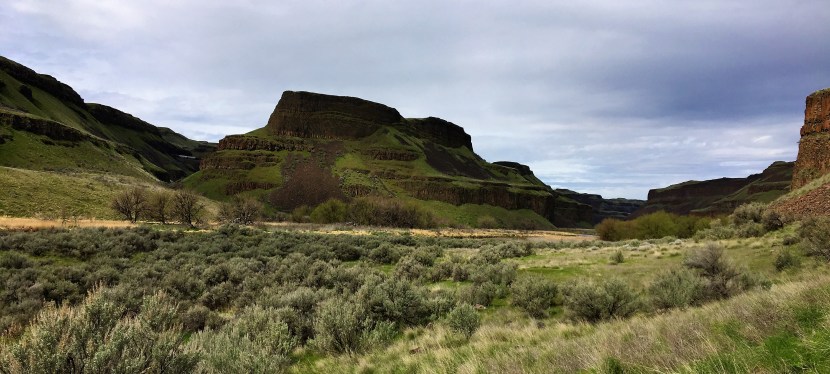
Image of the twisting historic Oregon Route 30 taken from Rowen Crest with the Columbia River and the rugged Columbia Gorge in the background.

Trumbo captured this image while hiking at dawn on Rowen Crest just south of The Dalles, Oregon.

Over the following days, NOWA members sprinkled across the Columbia River Gorge to experience all The Dalles has to offer, such as the National Neon Sign Museum, hiking among the wildflowers and scrub oaks of the rugged river corridor, visiting ancient petroglyphs at Horsethief Lake, and fishing the spring Chinook salmon rodeo at Washington’s Drano Lake.

When not collecting memories, photographs, and fodder for future publications and videos, the outdoor media professionals gathered to share tips and tricks on improving one’s engagement and reach – facets of “Excellence in Craft”- and share business model ideas and successes. Excellence in Craft presentations included George Krumm, editor of Fish Alaska and Hunt Alaska magazines, who discussed how to land pitches and build relationships with editors. Brad Trumbo shared his rise in the outdoor writing and photography realm and engagement with his readers, thanks to his Llewellin setter bird dogs.

NOWA held its annual Excellence in Craft awards banquet Saturday, May 3rd, where 61 achievements were recognized, ranging from “Column of the Year” to the best outdoor photos, videos and humor pieces. The awards banquet offers an opportunity to see where talented outdoor content creators stand among their peers, provides “street cred” for marketing, and offers a fine payout for those who rank high in many categories. It’s a coveted experience for this highly talented group to share camaraderie with friendly competition.

This year’s Excellence in Craft award winners can be found here: https://nowaoutdoors.com/eic-winners-by-category/.

Black-chinned hummingbird hovering over a burgundy Columbine flower.

Trumbo’s image of a black-chinned hummingbird hovering over Columbine flowers took 1st place in NOWA’s Excellence in Craft “Fauna” photo category.

The weekend closed with NOWA President Troy Rodakowski presiding over Sunday morning’s membership and business meeting. During this meeting, Rodakowski assumed the position of NOWA’s Chairman of the Board of Directors as he passed the gavel to NOWA’s incoming President, Brad Trumbo. 

With the annual conference behind them, NOWA’s new year begins with anticipation of next year’s conference, which is already being planned. Additionally, Trumbo brings new ideas to NOWA’s structure and attempts to engage younger generations as the organization adapts to the evolution of outdoor media.

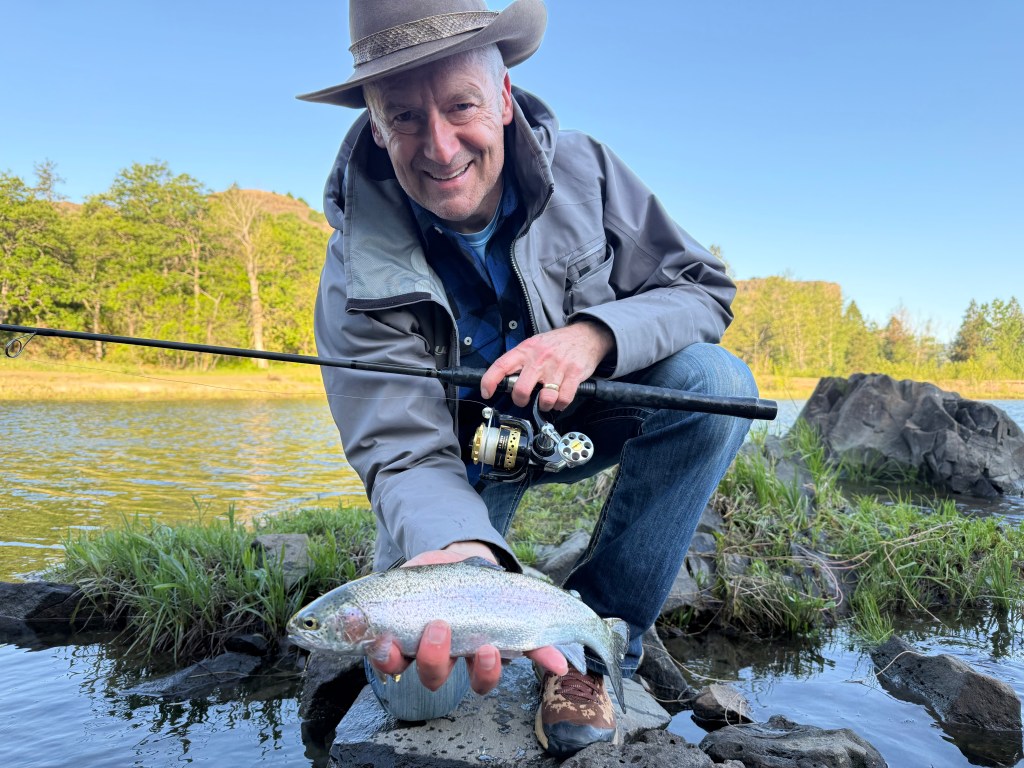
Gary Lewis, award winning author, freelance writer, podcaster, and host of the Frontier Unlimited TV show, found time for trout fishing before the Sunday morning meeting.

If you’re an outdoor content creator living in Oregon, Washington, Idaho, Montana, or BC Canada and want to learn from and contribute to this charismatic and savvy collection of media professionals, email NOWA’s Executive Director, Keith Szafranski, at photogsz@msn.com. Your creativity and energy will be welcomed by this prestigious cadre.

###

            The Northwest Outdoor Writers Association is a society of professional outdoor communicators dedicated to the pursuit of excellence in outdoor media. NOWA strives to further the improvement of professional communications skills and encourage their ethical employment. NOWA also provides a network of professional assistance and support, keeps members informed of news and information pertinent to outdoor activities and industries, and supports the conservation of natural and recreational resources. Visit https://nowaoutdoors.com/ and find us on Instagram @NOWAOutdoors.

Steppe Outside – Home Waters Flow Gentle on My Mind 

Published in the Walla Walla Union Bulletin November 9th, 2024

A mountain trout stream gently winds through the back of my mind. Its headwaters begin near the Oregon border and drop precipitously north. Picking up tributaries as it rolls, the creek reaches third-order status, where it begins building year-round trout habitat. Its twists and turns, log jams, and pools are all familiar. 

My parents would tell you that I was a fishing addict as a kid, which I cannot argue, but the fact that a trout creek flows into my stream of consciousness at the height of the upland bird season is telling. I’ve suffered as a “jack of all trades” my entire life, meaning I find fulfillment in nearly anything fish, wildlife, and outdoors related, especially now with a love for photography. As an adult, however, the closest thing I’ve experienced to addiction is upland bird hunting. 

This trout stream is near home and was my muse before my first setter pup arrived. We saw each other weekly, regardless of whether the fishing season was open. It’s close enough to be worth the trip but far enough to require commitment. Too far for killing a half-hour, but a morning, afternoon, even a whole day can be amply invested.

I cut my trout teeth on the blue lines descending from the George Washington National Forest and Shenandoah National Park. Eventually, one stream took priority – my home stream. The stream that I could see from my parents’ front room vista. It wasn’t the best or easiest fishing around, but it was close and offered a mile of worthy wild trout water. To say that I knew that water well would be an understatement. It was hard to leave it when I moved west, and even harder in 2020 when I caught my last Appalachian brook trout in those stair-step plunge pools. My beloved valley home overlooking the drainage sold a month later. 

The beauty of home waters is the intimacy one can establish with them. It is not entirely different from the intimacy between lovers, although the relationship appears one-sided on the surface. The angler walks the banks, noting the curves, the sweet spots and transition zones, the seasonal moods, where to tread lightly, and where to take charge. Meanwhile, the stream flows with the lifeblood that the mountain feeds it. It rearranges the furniture here and there and thrusts a hip this way or that following the spring freshet, but the angler who pays due diligence is rewarded with more than wild trout.

There’s an old saying that “an elephant never forgets.” I’ve found the same true for bird dogs and trout bums. Bird dogs catalog every bird they’ve ever found and will visit those spots whenever they hunt the same property. Identically, trout fishermen recall every rise and catalog the log jam, flow seam, backwater, or grasses overhanging the run where the hookup occurred. This plays into the intimacy a trout angler develops with their home waters. These are the sweet spots that are revisited time and again. After a few years of fishing their home waters, a trout bum can identify the pools and runs by the sound of the water pouring over rocks and wood.

October is arguably one of the best months for mountain stream fishing—the heat of summer breaks, giving way to seasonal change. The riparian corridor is decorated in autumn gold. Cooler water invigorates the speckled gems fining in the tail-outs and prompts giant October caddis to flutter clumsily over the creek, offering a royal meal as they dip in to lay eggs. I rarely missed an October weekend on the stream in what feels like an alternate life. Now, the opposite is true. 

It had been two Octobers since my last autumn visit. With unusual heat putting the brakes on upland bird hunting plans, my mind scrolled through the many productive uses of time. The notion of fishing the home waters trickled in and caught fire like pouring gasoline on a flame. The only decision was where to start, but the decision was already made. A preferred reach continually lingers upon one’s subconscious, awaiting the opportunity to surface.

My waders swished, and sweat soaked the brim of a blaze orange ball cap as I approached a lesser-fished stretch of water that’s difficult to navigate and has relatively little fishy habitat compared to other reaches. Three specific pools in this reach speak to my flavor of fly presentation when the water is low, and this autumn has been unusually dry. Casts would be short, and line control would be critical.

A thirteen-foot tenkara rod with an equal length of fly line represents an effective, simplistic, centuries-old Japanese fly-fishing method developed for mountain streams. Using the grasses, trees, and woody debris to creep within ten feet of a beautiful log jam pool, I gently flopped an absurdly-sized “stimulator” fly into the still waters beside the flow plunging over the logs. Within seconds, a ten-inch rainbow pounced on the moth-sized fly.

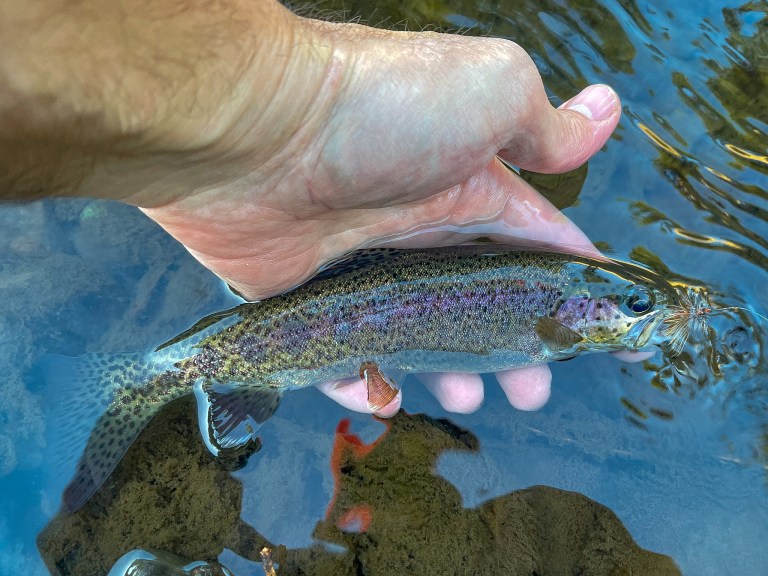
The feisty rainbow came to hand, and like every other from this river, the deep purple of the lateral line and olive-shaped parr marks beneath a dusting of black speckles presented a masterful work of art. I studied the fish briefly, admiring its features and glistening silver, gold, and olive scales, each individually defined. Then, freeing the fish from the fluffy fly, it darted back into the shadow of the log.

Trout are a marvel of nature regardless of the time of year, but mountain stream trout glow with a particular radiance in fall, as if reflecting the seasonal color change of the riparian flora. They are muscular from a spring of high water and spawning, and a summer of eating hoppers, caddis, and stoneflies. Their rise is deliberate, calculated, and executed with precision and efficiency to avoid expending energy unnecessarily.

Rainbows have risen to a fly in this pool for years, but the pool wasn’t always present. Before stream restoration efforts, this reach was characterized by shallow riffles and slightly deeper runs with little wood or boulder cover and no pools. Juvenile Chinook salmon and tiny rainbows rose to any small fly along the flow seams, but bigger fish were few and far between. Fortunately, constructed log jams and the 2020 flood cooperated to provide more quality habitat throughout the mainstem.

Having fished mountain trout streams across nearly a dozen states and 3,000 miles in several directions, I can offer that good water is good water, regardless of where you fish. Sometimes, that’s easy to describe. Other times, the popular cliché “when you know, you know,” is all there is to be said. Fly placement is somewhat universal, born of experience reading water and, occasionally, dumb luck. Deciding which to thank for a trout rise is hard, but experience pays on home waters. 

“I bet that fish spooked the entire pool,” I thought, confident that no other fish would bite after blowing up the thirty-six-square-foot pocket of skinny flow. “Well, what the hell. I’m here,” I thought, flopping the now waterlogged fly into a tucked-away spot slightly closer to the shore where I stood.

Using the rod’s length to keep the line high and the fly afloat, I bounced the fly atop the water like an October caddis laying its eggs. To my surprise, another similar-sized rainbow rose for the fly. It’s possible that another seasoned angler could find equivalent success on a new waterbody in a scenario like that. Still, I take comfort in telling myself that an unlikely second fish rose because I know how to fish “my stream.” 

 The following pools fished the same, and I even discovered a new side channel pocket that has scoured over the past several years to form a beautiful bend pool. I had seen that side channel before but ignored it for bigger water. The pocket is exceptionally tight, with no casting room. I merely dangled the fly from a high stick posture about ten feet away, tempting a rainbow to emerge from nearly underfoot to inhale the fly. 

“This will never work. It’s too close,” I thought as I laid the fly on the water’s surface. Being wrong isn’t always bad.

My visit was brief. Just long enough to land a half-dozen gorgeous rainbows. Glenn Campbell’s “Gentle on My Mind” aptly played in my subconscious in time with the tumbling water. 

In his most recent and final book, “Dumb Luck and the Kindness of Strangers,” renowned fly-fishing author John Gierach explicates on his home waters, as in many of his twenty-one previous volumes.

“On rare days, it’s something as vague as a quality of light or certain stillness in the air that seems to make the water vibrate with possibility, but I think that’s less mystical than it sounds. It’s just that some of the things you know about your home water operate beneath the level of full consciousness and only reveal themselves disguised as intuition.”

Gierach’s experience came from intimately knowing his home waters, and his gift for sharing that intimacy through a conversational read inspired generations of fly anglers, myself included. There’s something to be said about the feeling one gets when standing streamside, influenced by the sun, temperature, breeze, cloud cover, and the carefree notion of having already succeeded in the endeavor without yet wetting a fly.

Catching fish in the home waters is not the point but is generally accepted as a scientific law. “If” is not a question, nor is the fish the reward. Wild turkey hens shepherd their chicks through the upland riparian edges among violet lupine in spring, and birdsong envelopes the stream. Ruffed grouse drum, valley quail call from the blackberry tangles, and black bears gorge on the sweet, dark berries. Salmon flies and October caddis predict the seasons, and a number sixteen Adams is always welcomed. Somewhere between the roar of the rushing waters and a pointed focus on landing the fly in “the spot on the spot,” one’s true self appears, completely at ease, in a world secluded from reality—a state of being achieved only on the home waters. 

While I don’t spend nearly the time on my stream compared to a decade ago, our relationship is steadfast. I’ve learned her language. She patiently awaits, her waters forever flowing gentle on my mind.

Footnote – John Gierach died on October 3rd, 2024, at age 77. An average man with an appreciation for the average angling experience and hot coffee, he possessed an extraordinary ability with words and inspiration. This story presents a style slightly different than Trumbo’s norm. A tip of the hat to Gierach for developing friendships with his readers by writing as if he were engaged in conversation.

Steppe Outside – The Search for Washington’s Dancing Grouse

Published May 18th, 2024, in the Walla Walla Union Bulletin

Rain hammered upon the camper roof throughout the night, robbing me of the restful sleep I envisioned when planning a trip to the north-central scablands. Spring in the scablands is purely magical, and I often find myself float-fishing for trout on the many good fishing lakes. This trip was something different, however.

Rousing groggily to the 4:00 a.m. alarm meant my sleepless night would soon be rewarded with a cold, wet sit in the dark. Surrounded by Columbian sharp-tailed grouse habitat, I was about to embark on my first-ever lek survey to assist the Washington Department of Fish and Wildlife (WDFW) in monitoring one of this species’ seven fragile populations in Washington State.

We’ve all heard the adage that Columbia River salmon once returned so abundant that one could “walk across their backs.” Well, the story is similar for the Columbian sharp-tailed grouse. When the west was settled, sharp-tailed grouse numbered in the millions. Eastern Washington was largely shrub-steppe habitat and supported hundreds of thousands of the subspecies “Columbian” sharp-tailed grouse. They were commonplace. But, like the passenger pigeon, no one considered they would ever face extinction.

A tragedy of being human is that we often fail to notice a gradual decline in something so familiar until we’ve slipped past the point of recovery. The bird’s initial decline was noted as early as the 1950s, and as the vast Washington shrub-steppe disappeared an acre at a time, the Columbian sharp-tailed grouse followed.

The temperature plummeted with the falling rain, which soon turned to heavy snow. The veil of large white flakes impaired visibility on the greasy gravel road, not to mention the waves of muddy water splashing over the windshield from large puddles.

Thirty minutes later, Malika, George, and I sat in the snow overlooking a several-hundred-acre basin supporting a handful of historic and active sharp-tail “leks”. North American grasslands grouse – sharp-tails, sage grouse, and prairie chickens – use these traditional habitat areas year after year where males perform courtship rituals and compete for mates. The word “lek” combines the idea of “mating” (from the Swedish “lek”) and the notion of a “place” (from the Swedish “ställe”). In Swedish, “lekställe” directly translates to “mating ground”[1].

Sharp-tail males flash their “superciliary combs,” or sunflower-yellow eyebrows, and their “drum nape,” which are violet-colored air sacs on either side of their neck, while bowing with their tails high and wings extended, looking like a plane dropping onto the runway. They shuffle and tap their feet swiftly and click their two namesake pointed tailfeathers as they dance. Their tailfeathers clicking sounds like an old film reel movie playing as the birds spin about. In areas with strong sharp-tail populations, grasses on the lek can become beaten down from weeks of morning dancing, “hooting, clucking, and gobbling” rituals.

While I knew we overlooked an active lek, sharp-tails would only dance in my head this morning. We eagerly awaited dawn, listening for any hint of these mythical birds while snowflakes noisily pattered our synthetic jacket hoods. I had seen sharp-tails by the dozen in Montana and the Dakotas, but to see Columbian sharp-tails on their native Washington soil was a spectacle I longed to behold.

Survey protocol was to walk the lek about 45 minutes after sunrise. By then, any birds on an active lek would at least be heard if not seen, and the lek activity would be waning for the day. Flushing the birds provides more accurate counts and allows surveyors to search for scat and feathers; the feathers can be used for genetic testing. Due to the snow and no sign or sound of the birds, we left the lek without bothering to walk it as no feathers or scat would have been visible.

Back at camp, we all returned to our respective mobile shelters and wiled away the day, watching the snow fall, reading, and preparing for another cold morning.

The next morning dawned frigid cold, crystal clear, and with a million shimmering stars. Malika and I went alone to the same lek as before and again awaited dawn while a chorus of wildlife warmed their voices. 

“If I were a grouse, I would be dancing on a morning like this,” I said as we plopped down in the dark with our ears tuned to the sharp-tail channel.

Canada geese, mallards, and a hundred other waterfowl competed with a pack of coyotes in every compass direction for the award of “most obnoxious morning song,” but something different drifted in from our left. The low, two-pitched cluck from what sounded like a single bird somewhere in the grasses was a new sound for both of us.

“I think that’s a sharp-tail,” Malika whispered.

“So do I,” I replied while shifting to scan the lek with my binoculars.

We never spotted the birds from where we sat, but around 7:00 a.m., we strolled down onto the lek in search of scat and feathers. The sun glistened upon the frost-encrusted bunchgrasses in the 27-degree stillness. We walked more than 100 yards of what appeared to be prime lek without a speck of sign, but as Malika turned to make a pass back, the slap of upland bird wings grabbed my ears. My head snapped right so fast that I nearly pulled a neck muscle. The tell-tale flushing “chuckle” of a sharp-tailed grouse was so exciting that I yelled, “Sharp-tailed grouse!” while pointing at the fleeing bird. Moments later, a second bird lifted off, chuckling as it raced toward the horizon.

We finished walking the lek with no further sign of birds, but the sun shining warmly upon our shoulders fortified our sense of triumph. Malika was a 20-year-old college undergrad with a fresh notion of becoming a wildlife biologist. Before that weekend, she had no clue what a sharp-tailed grouse was, much less any awareness of the bird’s struggle for existence in Washington State. The experience was unique for us in different ways, although seeing a sharp-tail in Washington was a first for us both.

For Malika, it was a cool “sciency” encounter with an upland bird. For me, it was like stumbling upon delicate frost flowers or catching a glimpse of UFO-shaped lenticular clouds. These natural phenomena exist, but they are rare enough that it’s unlikely to experience them.

That chuckling sharp-tail flush echoed through my mind on the drive home. Just seven remnant populations of Columbian sharp-tailed grouse remain in Douglas, Lincoln, and Okanogan Counties. The total Washington population is fewer than 1,000 birds, and the largest individual population remains on the Colville Reservation. Columbian sharp-tails occupy approximately three percent of their historic Washington range, making habitat loss events like the September 7th, 2020, Whiney Fire that torched over 127,000 acres a significant threat. That’s a large enough area to wipe out one of the remaining populations completely.

The Colville Tribes are deeply invested in Columbian sharp-tailed grouse conservation efforts, working alongside the WDFW, Bonneville Power Administration, and local Public Utility Districts in the upper Columbia River. According to the WDFW, the Colville Tribes began assisting with translocation efforts as far back as 1999 (possibly before) by providing birds from the Reservation to be released at the WDFW 9,000-acre Scotch Creek Wildlife Area in Okanogan County. The BPA paid for the Scotch Creek land acquisition with mitigation funds for the operation and electricity sales from Chief Joseph and Grand Coulee Dams.

The Columbian sharp-tailed grouse is classified as “endangered” in Washington and protected from hunting. With ongoing efforts by the Colville Tribes, WDFW, and non-profits, Washington’s sharp-tailed grouse can hang on, but how long is unknown.


[1] Lek – Words For Things You Didn’t Know Have Names, Vol. 3 | Merriam-Webster

Cover Photo by the US Fish and Wildlife Service

Palouse Outdoors – Stay Safe Outdoors with a Satellite Communication System

Published April 4th, 2024, in The Waitsburg Times

Hunting, fishing, and hiking always seemed vanilla to me when it comes to the potential for injury and death. That could be one reason that a passion for the outdoors hit me when I was a child. My brothers chided me for being a “sissy,” and the best escape from the ridicule was avoidance somewhere beneath the trees on the neighboring woodlots.

I began tree-stand hunting for white-tailed deer in my late teens and quickly realized the dangers of the activity. I took the proper precautions with ropes and harnesses and always let someone know when and where I was headed and returning. Aside from that, trail running and mountain biking alone in the Appalachians never appeared dangerous, partially because testing the limits of gravity or intelligence for a thrill never appealed to me. When I moved west and began wilderness hiking and hunting routinely, I realized the dangers in the backcountry, even for the careful and prepared outdoors enthusiast. Middle age likely played a role as well.

Elk and mule deer country is steep, rugged, slippery, and riddled with deadfalls. Add 60-plus pounds of quarters and backstraps to your pack and start back to camp exhausted and sometimes in the dark, and you have a recipe for trips and falls that can lead to impalement on pine branch stubs, torn ligaments and cartilage in knees and shoulders, broken limbs and ribs, and possible tumbles over cliff faces. Navigating all this alone is absurd, yet we’ve all done it and will do it again. All to secure food, experience the beauty and solace of the wilderness, and bestow honor upon the wild life we took to feed our families and memory bank by pursuing them on their terms.

Fortunately, today’s technology offers life safety for average and extreme outdoor enthusiasts via affordable, reliable, and easy-to-use satellite communications devices.

Above are screenshots of the Garmin inReach Messenger device status panel (left), an example of the text message interface (middle), and a weather forecast for a given location (right). This device is user-friendly and works through your smartphone via Bluetooth without a data connection.

Since 2011, Garmin Corporation, among others, has been producing satellite communicators that can summon emergency medical and rescue services through the touch of the “SOS” button using your global position system location coordinates. Should you experience a fall, get lost, or have Mother Nature throw a curveball, location information is transferred through a satellite network to “Garmin Response” in Montgomery, Texas. According to Garmin, “all SOS monitoring, communication, and emergency response coordination are handled at this location.”

A global emergency response system capable of reaching remote locations and saving lives. Sounds great, right? But how does it work?

“Garmin Response maintains a global database of local first responders and emergency services. As soon as an SOS activation is received, the Garmin Response team pulls up the precise location of the SOS alert, a corresponding list of emergency response organizations for that area, and a map overlay of agency jurisdictions. The Garmin Response team contacts the local organization and works with them to dispatch resources to the incident site as necessary[1].”

 In 2023, Garmin coordinated emergency responses for over 10,000 SOS calls made from Garmin devices around the globe. While the number of Garmin subscribers is unknown, a breakdown of activities for which an SOS was transmitted suggests that hiking/backpacking makes up approximately 40 percent. Nearly 20 percent of transmissions are from automobile, motorcycle, and boating accidents. Hunting makes up only about five percent of SOS transmissions.

Overall, more than 70 percent of SOS transmissions could have been made from remote wilderness area situations. Physical injuries caused most SOS transmittals, while medical emergencies, being stranded or stuck (data include offroad vehicle activities), and being physically lost were the other most common emergencies.

“Responses…from New Zealand to Norway to Argentina to Canada were coordinated for plane crashes, grizzly bear encounters, sinking sailboats, skiers in avalanches, stranded divers, injured climbers, and many more1.” 

Over the past few years, getting older, fatter, achier, and spending most of my time outdoors alone were nagging at the back of my mind to get a satellite communicator. I finally pulled the trigger when a remote work trip came up shortly after my wife had major surgery. I settled on the Garmin inReach Messenger because it allows text messaging with friends and family via the Iridium satellite network. During my time in the Idaho mountains, I checked my wife’s health status routinely and could receive immediate notice from her in an emergency.

Whether you’re into extreme mountain sports or leisurely hikes, carrying a satellite communicator makes good sense. With the door to summer recreation opening quickly, now is the time to prepare for your safety while escaping civilization, particularly when going solo. Hopefully, you’ll never need to summon a wilderness rescue, but come wildfire, grizzly attack, or loss of common sense due to hypothermia or elk hunting exertion-induced delirium, carrying a satellite communicator provides a lifeline when faced with the unexpected.

Packing my Garmin inReach Messenger is no different than grabbing my hunting and fishing license – it goes everywhere outdoors with me.


[1] 2023 Garmin inReach® SOS Year in Review

New Legislation Aims to Boost Walk-in Private Lands Access

Originally published at Harvesting Nature, July 7th, 2023.

Among the top “barriers to entry” for hunters is the basic need for a place to go. In the western US, large tracts of public land managed by the Bureau of Land Management, US Forest Service, and states and tribes are available to the public, but this is not the case everywhere. For example, Illinois is one of the top five most populous states but is comprised of 96 percent private lands[1]. Therefore, public access to private lands plays a critical role in hunter opportunities nationwide.

Outdoor recreation is big business, contributing $778 billion to the US economy every year1, and firearms and ammunition sales have contributed over $16 billion in conservation funds through the Pittman-Robertson Act[2]. Ensuring the American public is afforded hunting opportunities supports a cornerstone of the North American Model of Wildlife Conservation, which is why incentivizing public access to private lands was introduced into the Farm Bill as “Open Fields” back in 2008.

In 2018, the Farm Bill authorized what is now called the Voluntary Public Access and Habitat Incentive Program (VPA-HIP), which provides grants to states and tribes to implement walk-in access programs. Congress stepped up its investment in VPA-HIP, providing $50 million via the 2018 Farm Bill1.

In September 2019, the Natural Resource Conservation Service (NRCS) announced VPA-HIP funding opportunities to state and tribal governments. States and tribes were eligible to receive up to $3 million in federal dollars to be leveraged with partner funds for the expansion of recreational access on private lands. In March 2020, the NRCS announced nearly $49 million in VPA-HIP awards1.

What makes VPA-HIP incentives more attractive is that they can be realized in addition to other Farm Bill programs like wetlands enrolled in the Agricultural Conservation Easement Program and the Conservation Reserve Program. Furthermore, the VPA-HIP program allows the states to assume legal liability for the public accessing enrolled lands. But the VPA-HIP program benefits may soon increase dramatically.

In April, new legislation called the Voluntary Public Access Improvement Act of 2023 was introduced by Senators Steve Daines, Michael Bennet, and Roger Marshall to strengthen VPA-HIP by tripling its funding from $50 million to $150 million over the next five years[3]. This increased investment was among the recommendations made by the Theodore Roosevelt Conservation Partnership’s Agriculture and Wildlife Working Group i10 its “Hunter and Angler Priorities for the 2023 Farm Bill” report that was released earlier this year3,[4].

To date, the VPA-HIP program has opened nearly one million private acres to public hunting, fishing, and outdoor recreation. View the Theodore Roosevelt Conservation Partnership’s “Accessible Private Lands3” report for details, and imagine what tripling the program’s funding could do for hunter and angler opportunity.


[1] REI-VPA-HIP-Report_FINAL-11-3-2020.pdf (trcp.org)

[2] Firearm Industry Surpasses $16 Billion in Pittman-Robertson Excise Tax Contributions for Conservation • NSSF

[3] https://www.trcp.org/2023/04/03/new-legislation-help-increase-walk-access-program-acres/

[4] AWWG-2023-FB-Platform_2-15-23.pdf (trcp.org)

The Proposed “Public Lands Rule” and What You Need to Know About It

Originally published at Harvesting Nature, August 11th, 2023.

            On July 5th, the public comment period closed on the Bureau of Land Management’s (BLM) proposed conservation and landscape health rule, or the “Public Lands Rule,” to make conservation a “land use” equivalent to all other land use activities like recreation and mineral extraction. Implementation of the proposed rule could be a game changer for conservation.

The BLM manages more than 245 million acres of public lands (approximately one-tenth of the country), the stewardship of which is guided by the Federal Land Policy and Management Act of 1976 (FLPMA), unless otherwise provided by law. The FLPMA provides the BLM the authority to manage public lands for resource and ecosystem conservation. The Public Lands Rule would “…provide an overarching framework for multiple BLM programs to promote ecosystem resilience on public lands.”

The Public Lands Rule would do the following:

  • Apply land health standards to all BLM-managed public lands and uses;
  • Clarify that conservation is a “use within” the Federal Lands Policy and Management Act’s (FLPMA) multiple-use framework;
  • Establish a framework to promote ecosystem resilience on public lands through the creation and deployment of conservation leases, which will allow third parties to engage in conservation and mitigation activities on BLM lands.

Each of the four points is important for enhancing and perpetuating ecosystem integrity on a vast proportion of public lands.

The application of land health standards would establish a baseline condition for public lands for which to apply effects analyses for proposed land use actions. Ensuring that proposed actions like grazing, mining, and timber harvest would maintain or improve the baseline condition consistent with conservation practices as a compatible land use would result in long-term ecosystem benefits.

Updating the Department of Interior’s land management regulations to enhance the BLM’s ability to designate Areas of Critical Environmental Concern (ACEC) will better protect and perpetuate sensitive habitats and cultural resources. The benefits of protecting sensitive and scarce habitats are clear, but sensitive cultural sites are not always known or as easy to protect beyond National Parks or Monuments, for example. Concerted efforts by the BLM to gain Tribal input for the establishment of ACECs beyond routine National Environmental Policy Act requirements have the potential to protect areas of cultural significance on a much broader scale and without an act of Congress.

“Conservation leases” present a novel idea for leasing areas specifically for habitat enhancement, ecosystem restoration, and compensatory mitigation for land development actions. Conservation as a land use and conservation leases are proposed to work in concert with other approved land uses or development but have the potential to establish boundaries for resource protections and allow for on- or off-site mitigation for potential habitat damage. 

The proposed Public Lands Rule as written is fairly robust, but the proposed language requires clarification.

Regarding conservation leases, the proposed language in Section 6102.4(a)(5) of the proposed Public Lands Rule aptly clarifies that “…the [conservation lease issuance] itself should not be interpreted to exclude public access to leased lands for casual use of such lands….” Plainly put, public recreation is permitted on lands under a conservation lease. However, this language requires two clarifications. The language should read “…the rule itself SHALL not be interpreted to exclude public access to leased lands for casual use of such lands….” The word “should” is dismissible and may lead to interpretations that would arbitrarily prohibit public access and recreation.

Additionally, “casual use” of public lands must be clearly defined to include appropriate low-impact recreation activities such as hiking, hunting, fishing, etcetera. Without a clear definition, interpretations of “casual use” may again arbitrarily prohibit certain types if not all public recreation on conservation leases.

To ensure the conservation lease language is appropriate for the final rule, the BLM requested The Wildlife Society (TWS) review and comment. The TWS Rangeland Wildlife Working Group led the review and provided six pages of suggested clarifications and overall support of the proposed Public Lands Rule.

For areas identified as ACECs, the proposed language would impose protections on these lands, yet the language is unclear when and how “protection” may be given to ACECs and what “protection” means. Some ACECs will be more culturally sensitive or pristine than others and should require greater restrictions on activities within those areas.

In conclusion, the proposed Public Lands Rule is a valuable effort with the potential to enhance and maintain ecosystem and cultural resource integrity in concert with other allowable land uses. The BLM will now consider the comments received and edit the proposed language where and how appropriate before publishing the final rule.

Although the public comment period has ended, all public land users should become familiar with the proposed Public Lands Rule and how it may affect public access and recreation. More information and a link to the Federal Register publication are available at Public Lands Rule | Bureau of Land Management (blm.gov).

Feature Photo Credit: US Department of the Interior, Bureau of Land Management.

Arizona’s Apache Trout could be the First Gamefish De-listed from the Endangered Species Act

On August 10th, 2023, the US Fish and Wildlife Service (USFWS) issued a press release announcing the proposed de-listing of Arizona’s state fish, the Apache trout[1]. The Apache trout and Gila trout are the only two trout species native to the state.

According to the USFWS[2], the Apache trout is native exclusively to the streams in and around the White Mountains in the eastern part of the state. Historically, they were found only in the headwaters of the White, Black, and Little Colorado Rivers above 5,900 feet elevation in east-central Arizona[3].

The Apache trout was originally considered the same species as the Gila trout, which was listed under the Endangered Species Preservation Act in 1967. The Apache trout was first described as a unique species in 1972, and one year later, it gained protection under the Endangered Species Act of 19731.

Competition from non-native brook and brown trout and hybridization with non-native rainbow and cutthroat trout threaten Apache trout populations.

The 2009 Apache Trout Recovery Plan identified a goal of 30 pure (non-hybridized) Apache trout populations being necessary for species recovery. The plan also noted 27 populations existing within their historical range in Arizona’s Gila, Apache, and Greenlee counties, and the Fort Apache Indian Reservation and Apache-Sitgreaves National Forest[4].

The USFWS 2021 Apache trout species status assessment[5] identified the recovery goal of 30 pure populations had been met, which prompted the USFWS Endangered Species Act de-listing proposal.

Apache trout recovery is owed to 50 years of collaborative conservation work among state, federal, and nonprofit partners removing introduced trout species and preventing their reestablishment in Apache trout habitats. If de-listed, the Apache trout would add to the list of 91 species that have recovered under the protections of the Endangered Species Act.

Active management would continue to prevent future reintroductions of non-native trout species and hybridization. Additionally, the Endangered Species Act requires the USFWS to implement a post-delisting monitoring plan for a minimum of five years to ensure the species remains stable.

The USFWS de-listing proposal1 is open for public comment through October 9th. Information on how to submit comments is available at www.regulations.gov  by searching docket number FWS-R2-ES-2022-0115.


[1] Apache Trout De-listing Proposal – Federal Register – Regulations.gov

[2] Proposed Delisting of Apache Trout | U.S. Fish & Wildlife Service (fws.gov)

[3] Apache Trout Recovery – Arizona Game & Fish Department (azgfd.com)

[4] Apache Trout (Oncorhynchus apache) – Species Profile (usgs.gov)

[5] USFWS 2021 Apache Trout Species Status Assessment (fws.gov)

Feature Photo Credit: US Fish and Wildlife Service

Research Identifies Measures to Reduce Wind Energy-related Bird and Bat Fatalities

Published July 7th 2023 at Harvesting Nature

Wind energy production facilities have been condemned for impacts to bird and bat species, but recent research suggests that minimizing impacts while maintaining power production efficiency may be feasible.

Wind energy production facilities are increasingly common worldwide, resulting from efforts to shift to renewable energy sources – a trend that will likely continue in the US. In 2022, President Biden invoked the Defense Production Act to allow the U.S. to “take ownership of its clean energy independence[1].”

The purpose for calling upon this decades-old act is to provide the US Department of Energy the authority to “help strengthen domestic solar, heat pump, and grid manufacturing industries while fortifying America’s economic security and creating good-paying jobs, and lowering utility costs along the way.” Invocation of the Defense Production Act is anticipated to “boost American production of the critical technologies necessary to lower energy costs, support the clean energy economy, and strengthen national security.”

In 2021, Princeton University estimated that the US would need to develop 19-96 gigawatts of wind energy production each year to reach “net-zero” greenhouse gas emissions by 2050[2]. And, like most energy production sources, wind turbines are known to impact wildlife, namely a proportion of birds and bats that encounter them. Therefore, the May/June 2023 issue of The Wildlife Professional provides a timely summary of potential measures to reduce bird and bat mortality at wind turbines2.  

Organizations like the US Fish and Wildlife Service have developed guidelines for wind turbine operations to minimize impacts on birds and bats through a process called “curtailment.” For example, bats are more active around wind turbines operating at slower speeds, so a curtailment measure would be to set a higher windspeed threshold (i.e. “cut-in speed”) for which the wind turbine would begin to operate. Research has shown that cut-in windspeeds between 11-15 miles per hour reduce bat fatalities by up to 63 percent[3], and curtailment to over 16 miles per hour reduces fatalities by over 80 percent for some species[4]. Curtailment has also been found to reduce eagle fatalities on par with bats.

A 60 to 80 percent reduction in bat and eagle mortality seems to support implementing curtailment measures, but curtailment reduces power production efficiency for facilities that some would argue are inefficient even without operating restrictions. For this reason, additional actions are being evaluated.

A global positioning system (GPS)-triggered “geo-fence” is being implemented with California condors. When a tagged condor enters the defined perimeter of a wind facility, the tag detection triggers immediate curtailment measures and avoids wind turbines operating under curtailment when no birds are present. This is an effective method of reducing condor fatalities, but tagging individuals is not a feasible solution for songbirds and bats. Deterrent strategies may be more effective.

Deterrents that have been studied reduce bird and bat mortality without impacting power production and include sound, high-contrast lighting, and painted turbine blades to avoid the appearance of blurring together at high speed. Only auditory deterrents are effective for bats, and each species’ use of echolocation differs, making one-size-fits-all deterrents less effective.

No single fatality reduction measure has proven effective for all species; however, a combination of deterrents and curtailment may be tailored to facilities, and research is ongoing to identify additional measures to reduce bird and bat fatalities while allowing efficient wind energy production.


[1] President Biden Invokes Defense Production Act | Department of Energy

[2] Felton, S. 2023. Change in the Air: Technological Solutions can Reduce Bird and Bat Collisions at Wind Facilities. The Wildlife Professional 17(3):38-40.

[3] A review of the effectiveness of operational curtailment for reducing bat fatalities at terrestrial wind farms in North America | PLOS ONE

[4] A smart curtailment approach for reducing bat fatalities and curtailment time at wind energy facilities – PubMed (nih.gov)

Western Monarch Butterflies see an Inspiring Rebound

Published at Harvesting Nature, February 10th, 2022.

In April 2021, I wrote a piece for Harvesting Nature on what appeared to be the imminent extinction of the western Monarch butterfly population. Only about 2,000 butterflies arrived on their southern California winter range in 2020 where approximately five million once clouded the skies and trees. When a population sees decline of this magnitude, coming back from the brink is rare, particularly in one breeding season, but it seems there is more to the story on the western monarch butterfly.

The 2021 Thanksgiving monarch count saw an unprecedented number of citizen scientists eager to help collect important population data. Across 283 count sites, the western monarch population estimate was over 247,000 individuals – a 100-fold increase in the 2020 count.

Given the monarch’s astonishing rebound, population limiting factors come into question. What was it about 2021 – a severe drought year in the western U.S. – that was somehow favorable to the marked population increase? According to Emma Pelton, the Western Monarch Lead with the Xerces Society, “There are so many environmental factors at play across their range that there’s no single cause or definitive answer…but hopefully it means we still have time to protect the migration.”

Weather likely played a factor. Dry spring and summer conditions can coax first-generation monarch butterflies out of their cocoons. “Those first-generation butterflies that breed in California and at Santa Cruz landmarks such as Lighthouse Field and Natural Bridges are crucial for the species’ population numbers to sustain” reported Hannah Hagemann of the Santa Cruz Sentinel.

While the 2021 count was inspiring, the population increase should be taken with caution. The Western Monarch Butterfly Conservation Plan identifies a five-year-average winter count of 500,000 butterflies to represent a sustainable population. Additionally, the U.S. Fish and Wildlife Service is still on track to propose an Endangered Species Act listing for this iconic transcontinental butterfly in 2024.

Sage Grouse Translocation Reverses Population Decline

Published at Harvesting Nature, November 26th, 2021.

Think you’ve heard it all when it comes to greater sage grouse conservation? Think again. When an icon of the sagebrush ecosystem becomes imperiled, conservation dollars flow to the far corners of habitat and population research to find solutions to species sustainability and persistence.

Mary Meyerpeter and colleagues with the US Geological Survey and Idaho State University are currently studying translocation to stabilize or even grow two declining sage grouse populations on opposite fringes of their North American distribution. The “Bi-State” population on the California-Nevada border was selected as a small, isolated group facing low hatch success and overall decline. A North Dakota population was selected after a suffering a severe West Nile Virus outbreak, reduced the population.  

Wildlife translocation has been a tool in the scientific toolbox longer than the words “science” and “research” have been in existence, and with this tool comes many benefits to imperiled populations. Declining genetic diversity and abundance of reproductive individuals are two challenges recipient populations typically face that may be overcome by translocation. Precisely what Meyerpeter et al. had in mind, coupled with estimating the population-level effects of introducing new individuals to the imperiled populations, and removing individuals from the donor populations.    

From 2017 through 2019, the Bi-State population received 68 adults and 125 chicks from a nearby source population, while the North Dakota population received 137 adults and 66 chicks from an interior Wyoming population. The populations were monitored across the translocation period and continue to be monitored.

Photo by the US Fish and Wildlife Service

Preliminary study results suggest that translocation efforts have been successful for the recipient populations. The Bi-State population increased 160 percent with egg hatch success increasing from 31 percent to 86 percent. Similarly, the North Dakota population increased 188 percent compared to pre-translocation estimates.

The Bi-State donor population declined 31 percent following translocations, which may have been attributed to that population also being relatively small, among other potential factors. The Wyoming donor population showed no change.

Translocation results are considered preliminary until a monitoring period of up to five years has documented population responses, but the results appear promising. Additionally, successful translocation coupled with habitat restoration can perpetuate the species and play a role in range expansion into historic habitats.

Raising Pheasant from the Ground Up

Sustainable farming practices to benefit wildlife is a topic for discussion in grain capitols across the country. To the farmer, the mention of sustainability may trigger consideration of production and bottom line. To the biologist, thoughts of crop rotation and managed fallow lands provide wildlife food, water and shelter. And to the economist, efficiency and bang-for-the-buck in the form of yield versus effort/acreage sewn would likely provoke a back-of-the-napkin chart explaining the benefits.

So how does one actually define sustainable farming? A combination of all of the above. Sustainable farming includes economics, reducing production acreage to focus on the most productive for maximum yield. The less productive ground can be leased into CRP or to an NGO like Pheasants Forever to manage for wildlife.

To take it one step further, habitat-minded agriculture may provide a mix of no-till planting and forage and cover crops built into rotation schedules. This permits soil replenishment and works to combat invasive species by providing different plant competitors, insects, and invasive plant treatment options. Forage or cover crops can be sewn alongside winter cover like cattails and other wetland habitats to reduce energy expense and vulnerability critters may experience when seeking food and cover in winter. Pollinators benefit as well.

Picture2

Sounds great, right, but are the benefits actually attainable? Absolutely. Case-studies have proven the benefits to the farmer and wildlife through these sustainable practices. Midwest farms have shown production of preserve-scale wild pheasant through habitat-minded farming practices while maintaining or increasing their bottom line. And who out there would argue that they don’t enjoy wildlife like upland birds? If you answered “no one”, we couldn’t agree more!

If you find this encouraging from any perspective, reach out to your local Pheasants Forever or Quail Forever Chapter. In southeast Washington/northeast Oregon area, contact us at bmpf@bmpf258.com for more information.

Mason Bees Promote Food Security and Conservation

What’s your first thought when someone mentions pollination or pollinators? Is it flowers? Bees? Honey? Allergies? A gambling man would put money on it being honey and honey bees (why wouldn’t it bee, right?). While none of us could fathom a life without honey, bee pollination is critical for the success of native plant reproduction and diversity, and food crop and fruit production.

Introduced worldwide, honey bees are a vital part of our ecosystem, and because of their succulent honey, they are most commonly recognized for pollination and conservation efforts. Commercial apiaries rent pollination services that benefit crop production and provide the apiary a honey crop. But when it comes to pollination effectiveness, honey bees will forever live in the shadow of our solitary natives.

Picture8

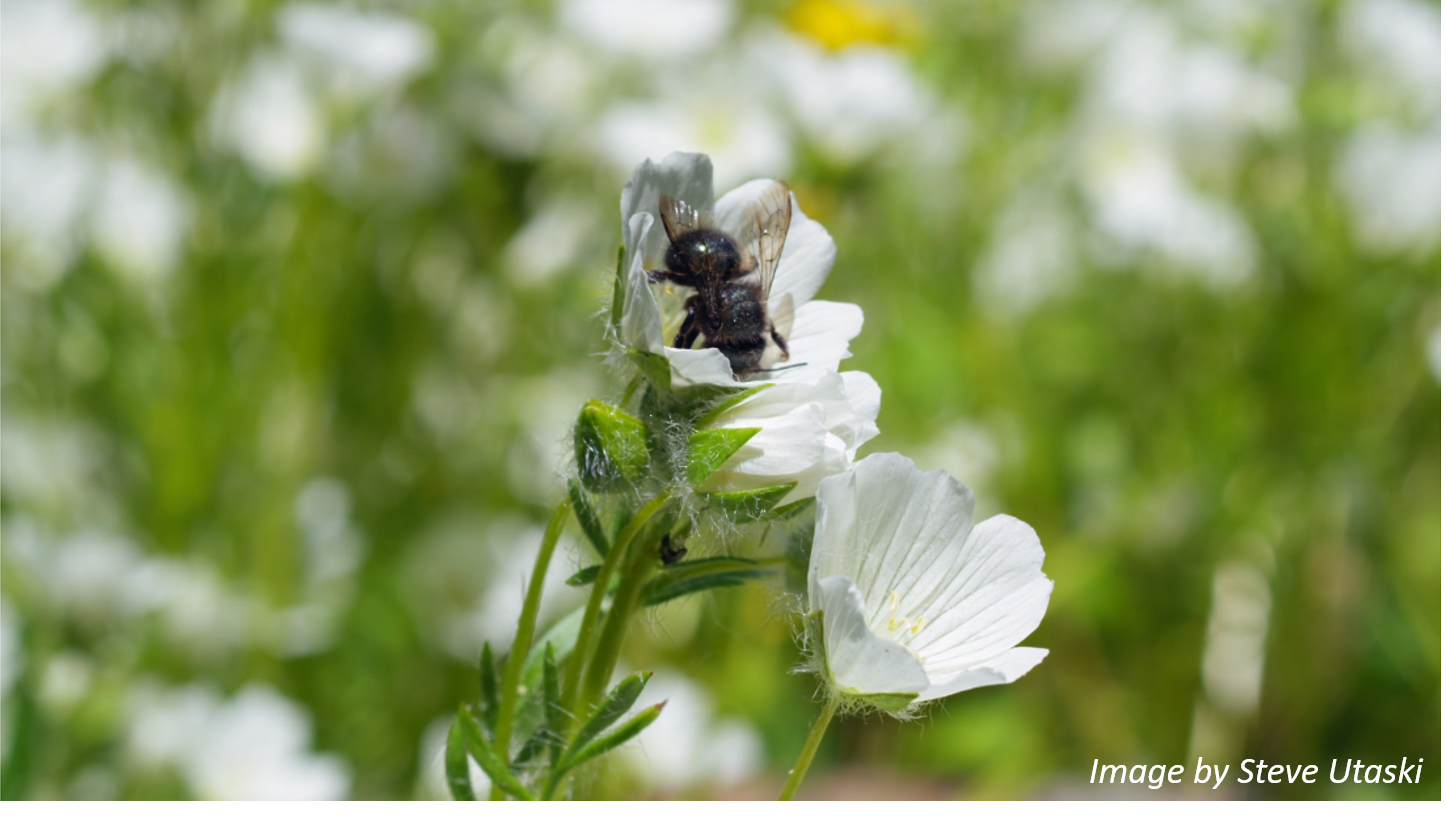
Mason bee visiting a flower

North America boasts approximately 4,000 native bee species, ranging in size and shape from bumble bees to sweat bees, none of which build hives. Bumble bees comprise about 40 species and are quite obvious, yet the lesser known are easily confused with other less desirable flies. The mason bees.

Mason bees are aptly named for their reproductive habits. The female mason bee often occupies holes in wood with larvae secured behind mud plugs for safe development. Mason bees don’t excavate holes, rather they clean debris from suitable spaces, pack them with pollen that they carry in on their belly, and seal in an egg. The eggs of female offspring are deposited first, at the back of the space for protection from predators while male eggs are stacked in front. Eggs are laid in May, and larvae hatch and feed on the pollen until the following spring, when they emerge to complete their lifecycle.

A few common species like the blue orchard bee (Osmia lignaria) frequent our gardens and orchards, as well as our landscaped city blocks and urban homes. While some native species, like the emerald green sweat bee Agapostemon femoratus are obvious, mason bees are nondescript, dark colored or lightly striped, and smaller than honey bees. These are the bees that we see frequently but pay little mind or mistake for something else.

USGS Blue Orchard Mason Bee 2

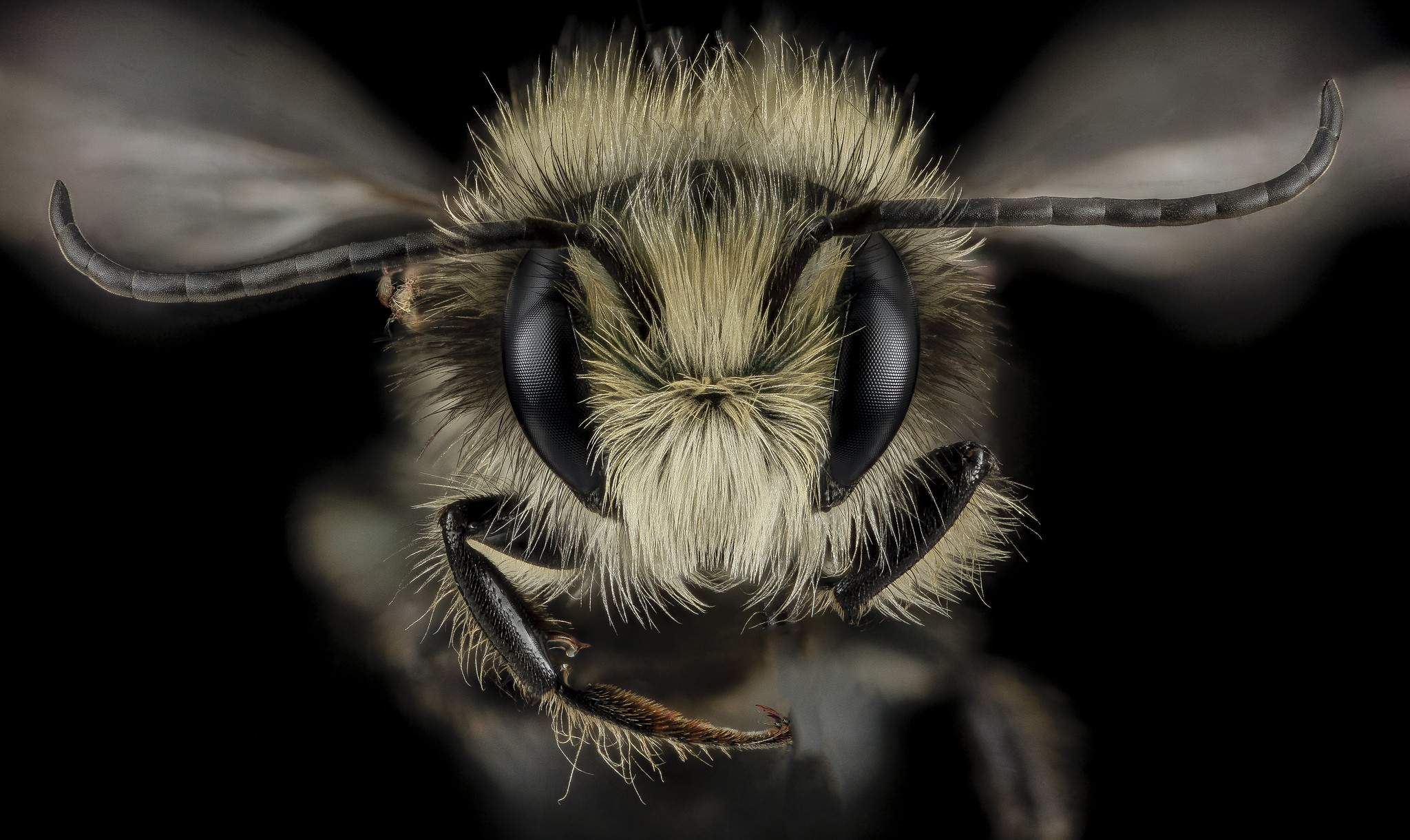
Blue orchard bee (photo by USGS)

Mason bees are docile and lead solitary lives. Since they only reproduce once each year, they don’t need extensive hives or honey production, but also forfeit the glamour of their extraordinary pollination abilities. A single mason bee can visit up to 2,000 flowers per day and just a few mason bees can pollinate the same number of fruit trees as thousands of honey bees. For this reason, the blue orchard mason bee is prized as one of the few native pollinators managed in agriculture.

Jim Watts, founder of Rent Mason Bees in Woodinville, Washington, knows the value and business of native mason bees. Rent Mason Bees offers a pollination service much like commercial apiaries, but Watts’ crop is not honey. Its more bees. Rent Mason Bees is devoted to making mason bees available for everyone from large-scale pollination needs such as commercial orchards, right down to a studio apartment, and everything in between. And the process begins with you.

At present, with a global pandemic threatening our food production capabilities at the national level, food security has invigorated many worldwide to seek homesteading opportunities. Farm and garden stores and mail order catalogs have seen baby chicks flying out the door, as well as seed sources exhausted by a fresh flush of gardeners eager to fill new beds, prepped while in social isolation, with the hope of eventually sustaining themselves to some degree. And, as those new vegetables and orchards begin to bloom, the pollination of native mason bees can bolster the bounty, simply through their effectiveness at visiting and fertilizing so many flowers.

So, where do you play into all of this? You guessed it. You can rent mason bees from Rent Mason Bees. Watts and his team have developed a precise system for providing healthy mason bees and bee houses to residential and farm owners for their pollination benefits. By providing bees and bee boxes designed to attract mason bees for egg laying, Watts’ team can collect the larvae at the end of the mason bee lifecycle as they lie dormant until the next spring.

Picture4

Mason bee box provided to a residence by Rent Mason Bees

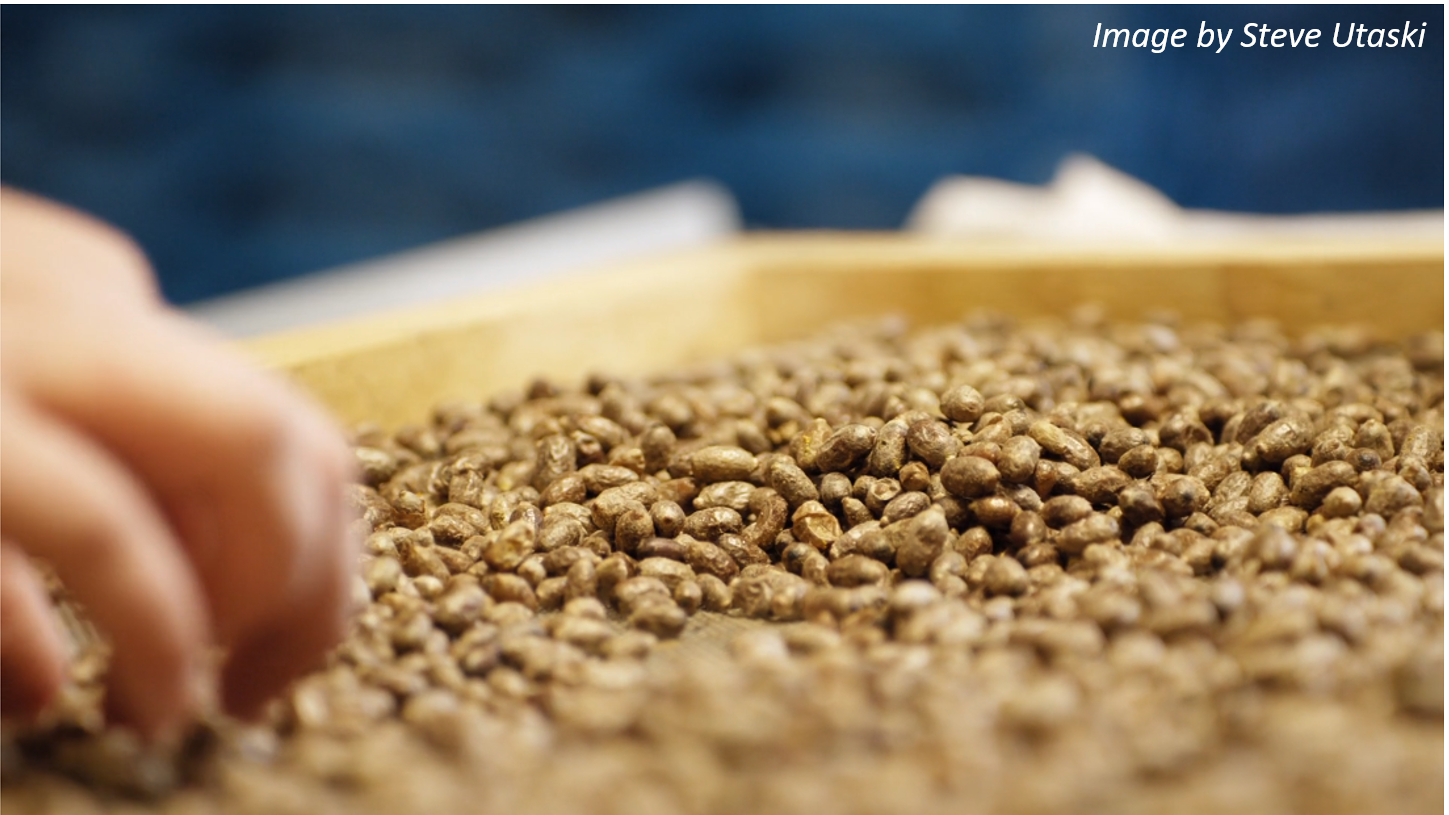
A brilliant, seven-minute documentary, The Bee Farmers, by filmmaker Steve Utaski, walks through the Rent Mason Bees process as they deliver bees and boxes for pollination, then collect, clean and store the larvae, which are encased in cocoons that look a little like coffee beans, in preparation for delivery the next year. The bee larvae that come from residential areas are distributed to interested large food crop producers where the bees ensure a healthy crop set to feed you, your family and our nation. As the cocoons are prepared for winter storage, the bee houses are sterilized and prepared for renting again the following season. By participating in the program, anyone has the ability to contribute to their personal and national food security and the success of local farm-to-table operations. And it doesn’t end there.

Watts’ operation propagates over 10 million native bees annually, contributing to the conservation of a desirable, local species that is presently experiencing population pressures from various land and chemical uses. At present, scientists estimate 25% of native bee species are on the brink of extinction. This makes the residential aspect of Watts’ mason bee operation so critical. With over 4,000 renters contributing cocoons, Rent Mason Bees ensures a fresh yield of pollinators each year.

The benefits of mason bee pollination and the logistics of Rent Mason Bees is captivatingly portrayed in The Bee Farmers to include the process of bee pollination and larvae deposition in stunning detail and story-telling. But Utaski’s attention to the ancillary benefit of community outreach and education, which Rent Mason Bees thrives on, is the most compelling aspect of the residential part of the program from, this biologist’s perspective.

Picture6

Extracting cocoons from a bee box

Biologist Olivia Shangrow with Rent Mason Bees attends public events, spreading the word and encouraging new renters to take part in the mason bee lifecycle and conservation. Parents can host a bee box and teach their children about the importance of pollination while keeping tabs on when and how the females populate the boxes with eggs. Because mason bees don’t colonize to protect a sole queen, mason bees are non-aggressive and family safe. The program also lends itself well to larger community-based projects, be it a host community garden or a community event where neighbors come together as a team to rent bees for the community.

Utaski’s film portrays the meaning of this program to Seattle residents, yet captures another less apparent, yet critically important detail. Our society at present is strongly self-reliant. In the age of social media, community neighbors are generally less social with one another on a personal level than our grandparents and parents experienced. The development of community-based participation in the Rent Mason Bees program leads to cohesion and cooperation, and collective youth learning and social interaction, away from internet-based platforms, formal education or sports.

Picture7

Cleaned cocoons being prepared for winter storage

Now is the time to reach out to Rent Mason Bees, as mason bee activity peaks in May. And like everyone else, Rent Mason Bees is feeling the stress of the COVID-19 pandemic and Washington’s “Stay at Home” order. Watts’ team is unable to conduct outreach and distribute mason bees effectively, but shipping is still an option. Bees need to find homes and farms where they can pollinate and have the opportunity to reproduce where the larvae can be collected. Otherwise, their 2020 offspring will be significantly reduced.

If you are on the fence, take a few moments to enjoy Steve Utaski’s The Bee Farmers, and read up on our native bees. They are a treasure to the nation, encouraging biodiversity and enhancing flower and vegetable gardens and fruit crops. Visit the U.S. Geological Survey, the Xerces Society and Rent Mason Bees to learn more.

Pushing the Limits – Emphasizing the Hunt over Harvest and the Role of Social Media

I got my first lesson in conservation as a boy, the age of four. Well, maybe not my first lesson, but the first I could remember. My grandfather would carry me atop his shoulders in the farmland woodlots of the Shenandoah Valley, Virginia, as we hunted squirrels with a .22 caliber rifle. And there was no shortage of squirrels.

The bag limit was six in those days, but we never once killed more than three. When I asked grandpa why we would stop hunting before taking our limit, he replied “We only take what we can eat. Leave a few for the next hunt.”

The harvest is the obvious measure of success, and taking a limit of any game provides a rewarding sense of pride and accomplishment. But should the measure of success be the harvest of game, and should we portray taking a limit as the Holy Grail of a hunt?

DSC_0090a

⇑⇑ Lynnhill’s Finnigan with our first ever limit of Washington roosters. ⇑⇑

Poetry in Motion

Sailing across the Palouse, my Llewellin Yuba’s vigorous tail feathering wafted in the breeze, as did her soft, black ears as she bounded. The day was blossoming with the promise of a rare, bluebird morning in late fall. Rich, golden sun rays shown thick across the chilled landscape as if viewed through a Mason jar of honey.

Bounding toward the cusp of the ridgeline, Yuba slowed to a halt, crept up a few feet, and locked into the most beautiful point a setter fanatic could ask for. With tail held high, sunlight streaming through her feathering, her gaze set hard on the short grasses ahead. Approaching the edge, the backdrop was breathtaking. A narrowly carved valley opened up with the dappling of milky green sage and rabbitbrush among the variety of fawn-colored grasses, spent vetches, and basalt outcrops set against the cotton candy pink of the distant horizon with a blue ribbon on top.

Shuffling into Yuba’s fixed gaze, a covey of Huns levitated from the bunchgrass, then bailed over the ridgeline like a cinnamon cloud burst. Mesmerized by the moment, my Fox double trained on the stragglers a little too late. The entire covey floated into the next draw as we looked on from behind, the sun warm against our backs.

Moving on in search of singles and roosters, not a bird one reached my vest that morning. I didn’t care. I got exactly what I went for.

Trumbo - Just Follow the Dog (2)

⇑⇑ Yuba with a bird pinned. This is what every pointing dog owner lives for. The result of the point is mere icing on the cake. ⇑⇑

Sweetening the Pot

In my Uplander Lifestyle blog post, “Anticipate the Flush“, I made a firm statement on the climax of an upland bird hunt.

“Probably the most rewarding experience of bird hunting is approaching for the flush and seeing confidence ablaze in the dog’s eyes. When her whole body is locked and loaded, she glances up at you, then back to the precise location as you approach. Both hunter and pointer anticipating the flush.”

The hunt itself, that poetry in motion cast on a perfect canvas, calls upland hunters more than any other in my experience. And the stats don’t lie here either. Project Upland’s fall 2019 survey elucidated that approximately 75% of ALL uplanders are drawn to the prospect by the dogs. Its more than a game. It’s a partnership between hunter and canine. The search for that moment of purity, perfection and connection can only be found in the uplands.

DSC_0194a

⇑⇑ Releasing the dog is to embark on an upland journey together. Each day is new with various challenges, success and failures. Birds are a bonus. ⇑⇑

More often than not (for most bird hunters), the hunt results in bird(s) in the vest. But is a bird in hand really worth two in the bush? I proffer that it merely sweetens the pot. It’s not necessarily the bird that draws us afield, but the orchestration of the hunt. One could argue that the hunt is meaningless without the bird, and with that I agree. But I am not the only uplander who would volunteer with alacrity for a catch-and-release opportunity. To marvel over the bird and a job well done, then simply return it to Mother Nature to be hunted again another day.

Enduring the Social Scene

Social media is a blessing and a curse. The incredible photography is inspiring and evocative, but brilliant displays of the harvest can unintentionally overemphasize the kill. And for upland bird hunters, pushing a limit sets a high bar, particularly for those new to the field.

Hunting wild birds on public land is a challenge in itself. The vast majority of my hunts end with a single bird; the next most common result being bird-less. I rarely take multiple birds or a mixed bag. That’s not to say that my opportunities are really that rare. Wingshooting ability is certainly at play. But an end-of-the-day photo of a dog sitting behind a tailgate stacked with birds is an unlikely outcome on public lands, generally speaking.

Every uplander revels in the moment, cradling in hand the most beautifully plumed species the uplands have to offer, particularly when taken over flawless dog work. But emphasis on harvest can reduce the significance of the hunt itself.

The instant gratification of social media and the desire the be “Instafamous” puts tremendous pressure on performance. What’s more is that for an up-and-comer to the upland realm, social media has the potential to stunt one’s confidence in their young dog, etc. Once new to the upland scene myself, seeing other folks in my area continually posting photos of birds and boasting limits set me back a couple years in having 100% confidence in the ability of my setters. Only after some particularly good hunts in the same season did I understand that when my girls weren’t finding birds, there were no birds to be found.

Screenshot_20200216-192718_Instagram

⇑⇑ Setters doing setter things. No better reason to take up upland hunting! ⇑⇑

Occupy the Canvas

Worry not of the success of others on social media. The best uplanders out there offer a holistic approach to upland hunting from the significance of carrying an heirloom shotgun, to the memories of grouse camp, hunting with family, and a stylish canine on staunch point.

Utilize social media to seek the inspiration and learning from your upland brethren. Revel in their successes and reach out to expand your knowledge and opportunities.

Never lose sight of the significance of the hunt. Boots on the ground behind your own dog or among your favorite coverts with that particular, familiar scattergun in hand is the setting for any work of upland art.

Push the limits of your body and the terrain (with your dog’s conditioning and health in mind). Cherish the days afield with an empty vest or meager single as much as the truly epic moments. Immerse yourself in the beauty and innocence of Mother Nature’s canvas. Chase the Flush!

Trumbo - Late-season Roosters (2)

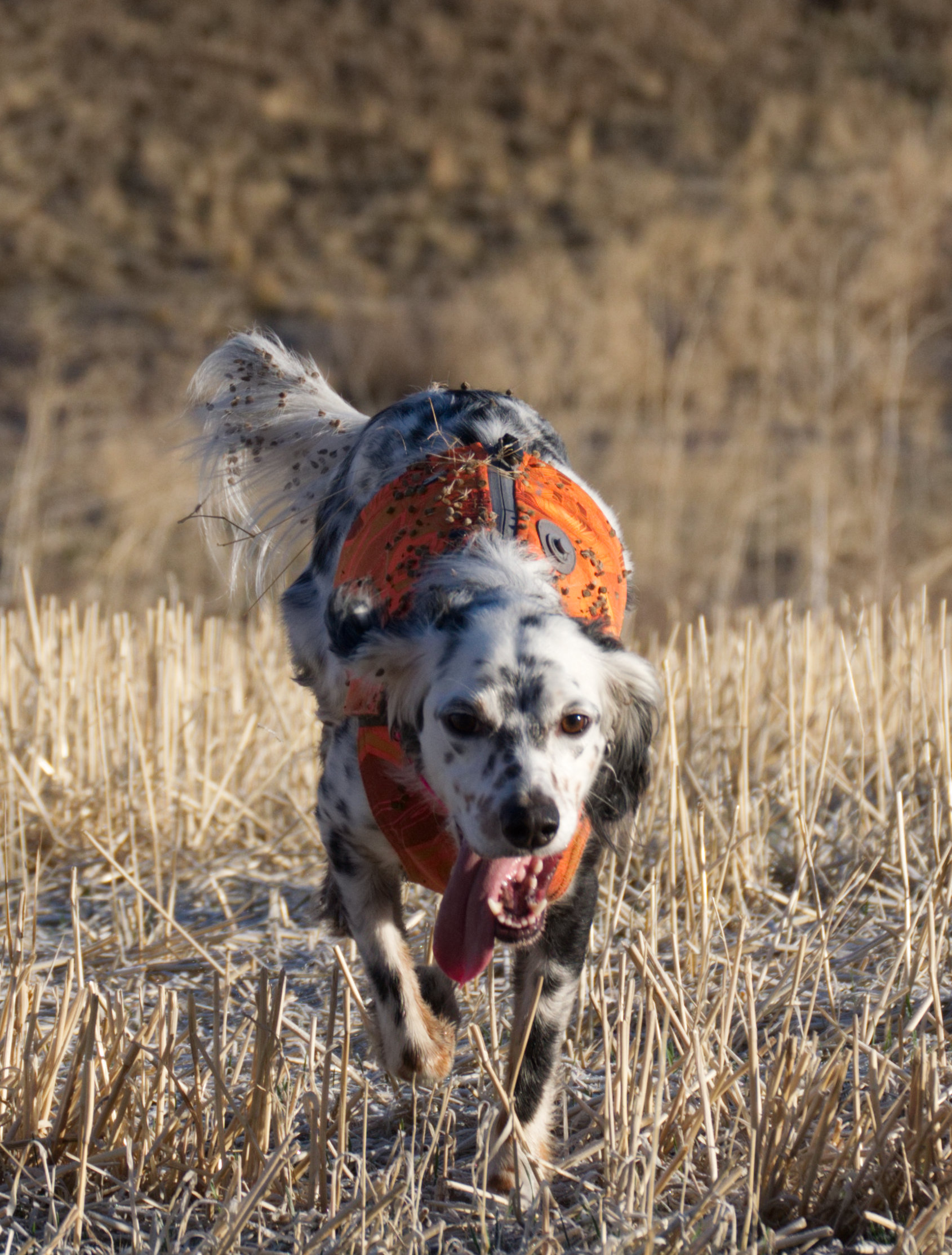
⇑⇑ A picture is worth 1,000 words. Yuba has a rooster pinned here. Her tail feathering was so full of houndstongue seeds that it hurt too bad to present a high flagging tail on point. Her eyes told the whole story, and capturing this image was worth far more than the rooster my buddy bagged over her just moments later! ⇑⇑

Can Hunting Keep us Human?

Paula Young Lee poses the question in the High Country News. If this strikes you as a philosophical diatribe, you may be correct. But in an era where hunting is increasingly despised (read: misunderstood), the deeper meaning behind such ecosystem interaction at the human level of cognizance is indeed ponderous.

Hunting’s broader importance to human existence reconnects the severance between human life-history and the complex society we have developed. Humans operate under the disillusion that humans are superior to the natural ecosystem, having no association with the natural world or ecosystem function. But the hunter views things differently.

DSC_1124

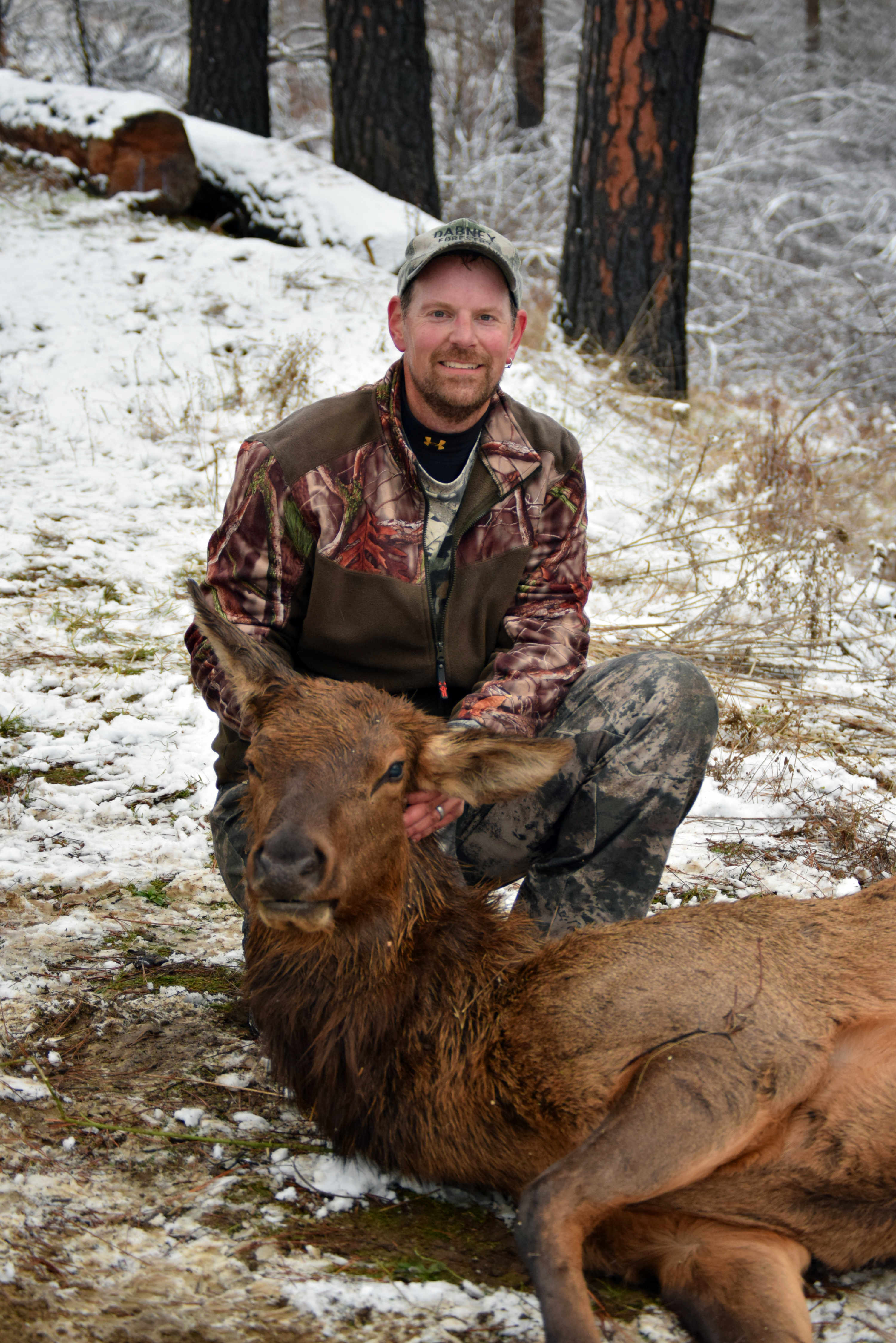
⇑⇑ Above: the author with a cow elk, his first, taken on the Idaho winter range, December 2018. Hard earned and well respected. The tags for this special draw hunt have since been stripped from the public and given to private landowners as depredation tags. ⇑⇑

“It may seem like sophistry to argue that hunting protects wildlife, but the act of hunting encompasses far more than shooting a wild animal, and it neither starts nor ends with a death. The hunt itself is part of a much larger continuum.”

Diving deeper into the meaning of the hunt, Lee discusses the spiritual connection between hunter and prey, and that the hunter views wild game as a blessed gift. Lee reinforces her point of the larger continuum through an economics analogy related to the gift of wild game.

DSC_0018a

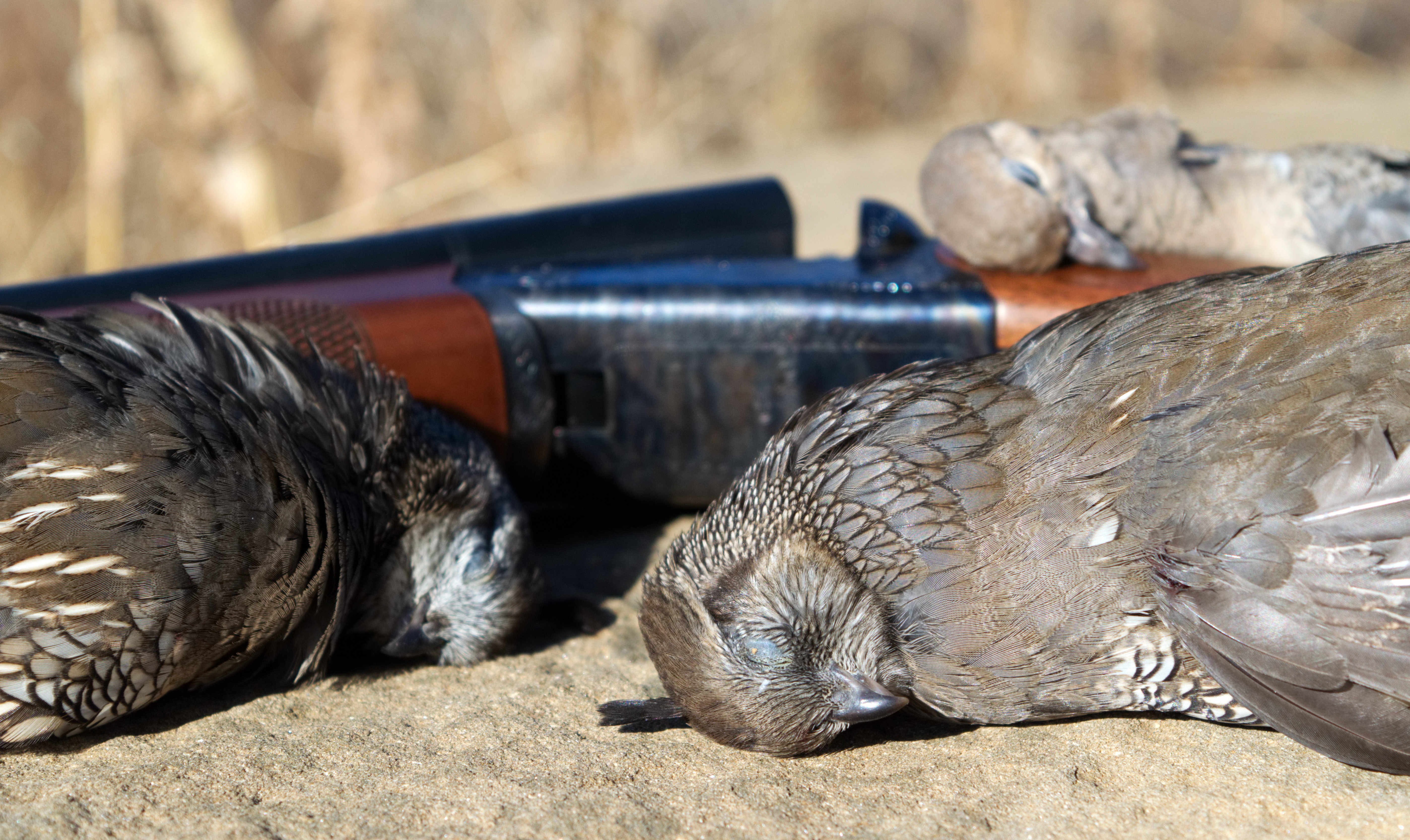
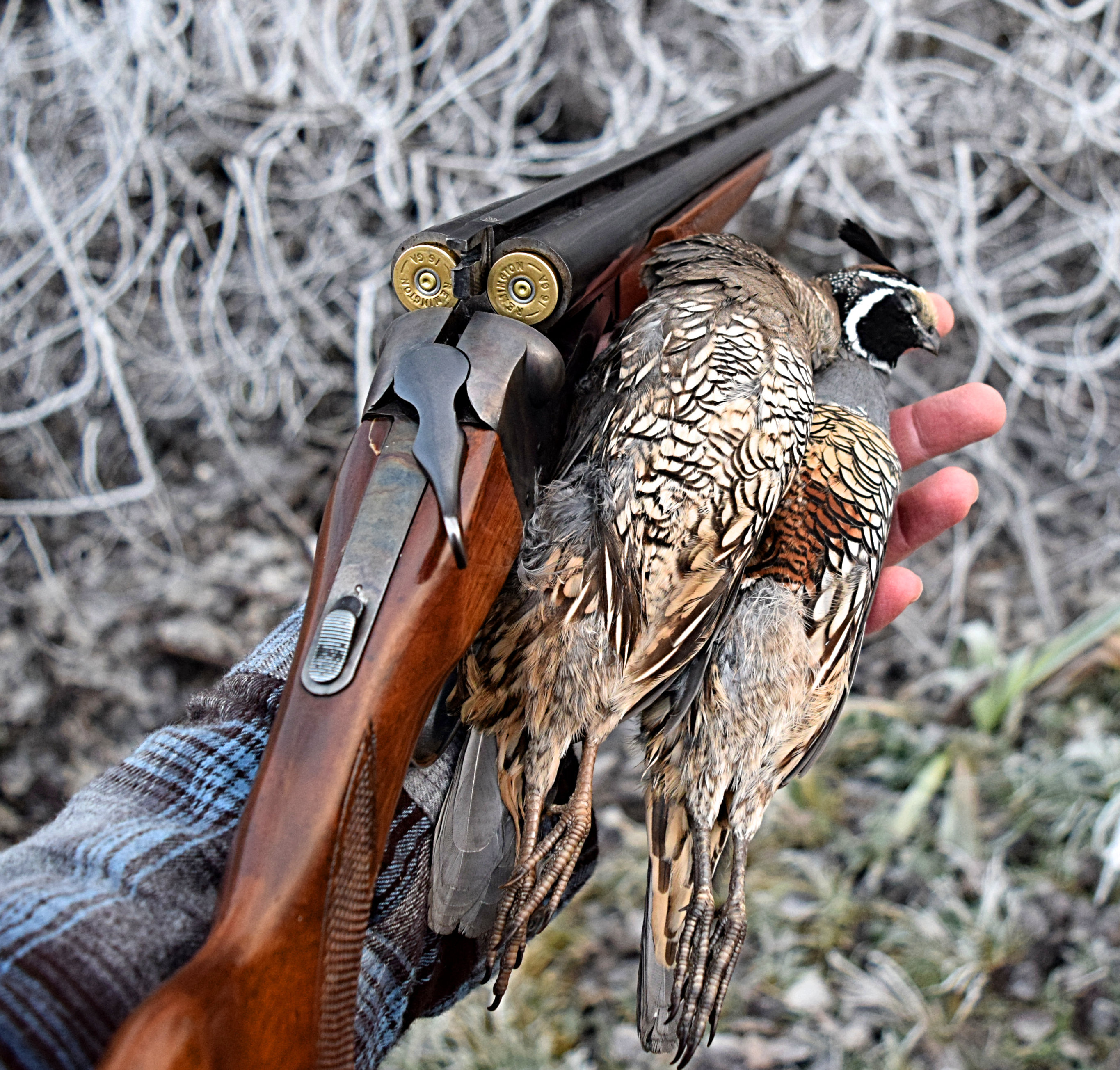
⇑⇑ Above: A successful valley quail hunt with two hens falling to a pointing dog and swift gun work. This interaction with the canine and upland bird plays a crucial role in spiritual rejuvenation for the hunter, who, in turn, gives back to conservation. ⇑⇑

“In a gift economy, the act of giving compels the person who receives the gift to reciprocate. A gift can be refused, but that refusal has consequences. Hence, ethical hunters reciprocate by protecting the wilderness, giving of themselves to ensure that the forest stays the forest….”

Hunting maintains our connection with and works to conserve our place in the ecosystem, and the ecosystem itself. The preservation of human nature.

Upland Stewardship Begins at Home

What’s the #1 threat to habitat on undeveloped public lands? If you guessed invasive plant species, you get a gold star for the day. Overall, habitat lost to civil development is a critical threat to fish and wildlife, putting tremendous importance on conservation and management of those precious public acres still intact.

Managing public land is important to provide habitat suitable for wildlife species and is accomplished through taxpayer and sportsman’s funds. For federal lands, this means congressional appropriations must be approved for specific geographic areas and funding limits.

While public lands, both state and federal, are at much lower risk of civil development, the economics of habitat management is a major driver in our ability to maintaining high quality habitat, and here is why.

Invasive species are incredibly competitive and successful at overtaking desired native species. With no natural predator controls (i.e. herbivory and parasitism) and an adaptive edge to the climates in which they occur, many species can create monocultures in short order. What’s more is that the increasing cost of invasive species control detracts from government ability to fund general habitat management and enhancement.

Picture2

Once established, eradicating an invasive plant is incredibly difficult and extremely costly, in the billions of dollars nationwide, annually. Our ability to control invasive species on public lands can change dramatically with political leadership. And when natural resources budgets are cut, our ability to effectively maintain habitat is hamstrung.

Early Detection and Rapid Response is the normal mode of operation for habitat managers, but budget cuts cause vulnerability in on-the-ground effectiveness. Labor cuts can reduce the number of employees and hours spent afield performing Early Detection monitoring. Supply cuts can reduce the available tools to implement Rapid Response once invasive species are detected, as well as reduce the overall time or acreage that biologists can treat.

High-quality habitat is not just nice to have for an easy, clean hunt. It’s a must for sustainable upland bird species and hunter opportunity. Its easy to assume that habitat management and controlling invasive species lies in the hands of qualified biologists, but make no mistake, quality habitat starts at home with you, the general public.

20191020_122336

⇑⇑ The seat cover in my Tundra harbors a number of invasive species ⇑⇑

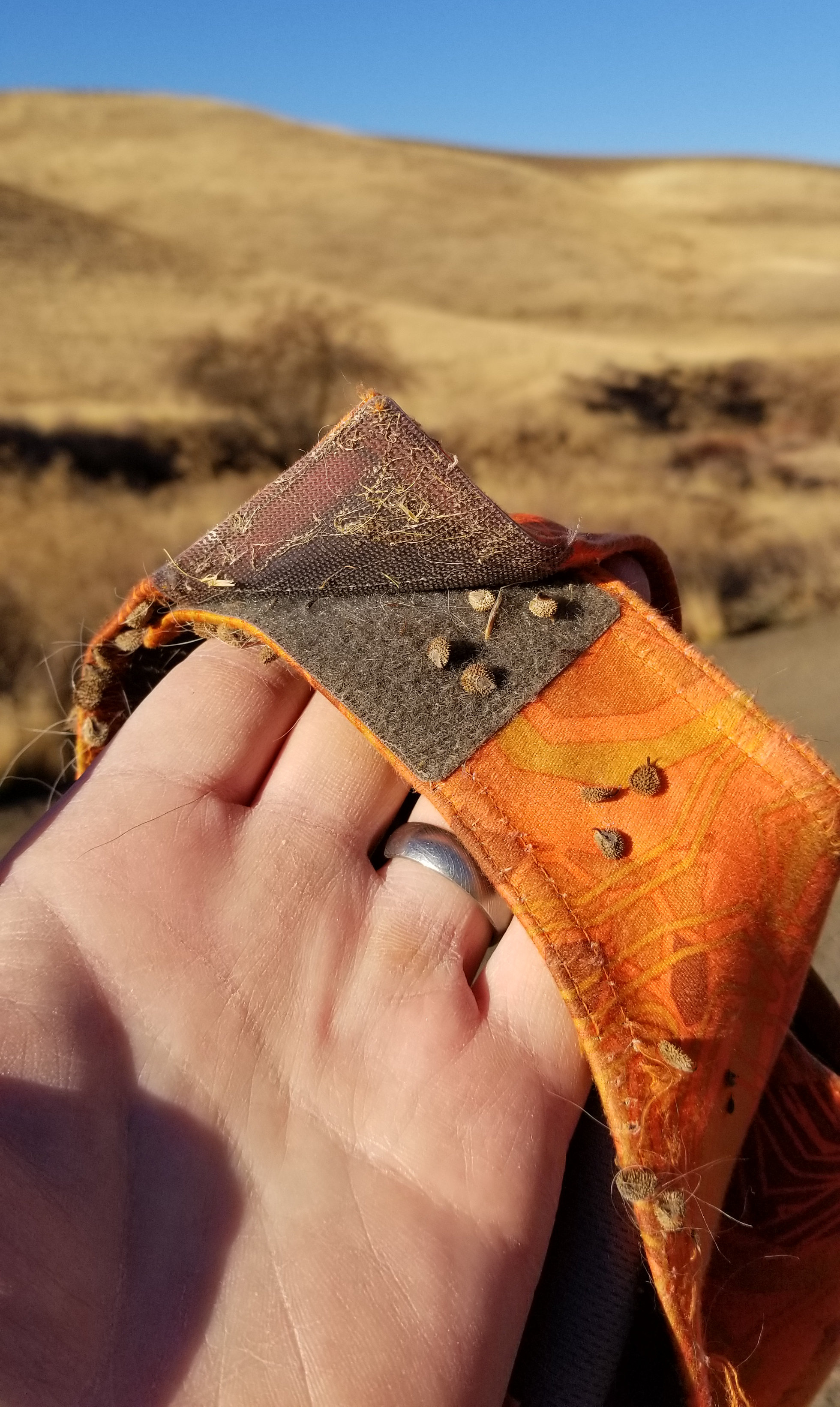
As our talented canines careen across the grasslands searching for sharptails or cut through brush following a running grouse trail, their fur picks up invasive weed seeds that can be easily spread to otherwise weed free areas. Tailgate checks and post-hunt spa treatments (for those of us who own long-haired pups like setters and Munsterlanders)  are necessary to remove to potentially harmful grass awns and bur-like seeds.

Most importantly, uplanders that embark on rooster road trips would be remiss if they failed to clean the nooks and crannies of their bird hunting chariot prior to driving half way across the nation. A single germinated seed from a nasty invader like cheat grass (Bromus tectorum) can quickly threaten native species and impact habitat suitability.

Be sure to clean out the truck bed, pet crates and blankets, truck seats and seat covers, spray down floor mats and vacuum the crevasses that can harbor seeds.

20191020_121840

⇑⇑ Cleaning vests, kennels, truck beds, and interiors is critical ⇑⇑

If your truck cap has a carpet liner, inspect it with scrutiny. Your dog will shake in the truck bed, flinging weed seeds onto the ceiling and anywhere else they may attach, simply waiting to be offloaded in an otherwise clean area 1,000 miles from where they were picked up.

And the cleaning spree should not end with the truck and kennels. Our vests and clothing can trap a terrifying number of seeds. When was the last time you check your hunting vest pockets for seeds? Hundreds of grass seeds can gather in vest pockets as we traverse the prairies. Dog vests can capture a number of species as well, like bur chervil (Anthriscus caucalis), which wreaks havoc on native grasses and even competes with yellow starthistle (Centaurea solstitialis) in the arid west.

20191020_121913a

⇑⇑ A water bottle pocket of my hunting vest captures many seeds and plant debris ⇑⇑

Conservation and habitat management are influenced by each and every one of us. Its your duty as an uplander to exercise your stewardship abilities and battle the spread of invasive species. The future of our public natural resources and habitat depend on it.

Upland Destiny

The feel of the old, familiar stock brings a smile to my face; slick, cold, comfortable. The foregrip checkering is rough against my left hand. Rolling the gun under the lights, the fox engraved on the underside of the box peers smugly up at me as if to say “If it flies, it dies!

The marbled bluing on the box appears prismatic with hints of purple and bronze. Admiring the precise barrel fit into the action, my thoughts drift to a moment afield under an overcast sky. The barrels are broken open over a flannel-sleeved forearm above tawny bunchgrass; two spent shells presented by a single-piece extractor.

DSC_0971

Double triggers are guarded safely by a softly rounded, modest steel housing. The safety is nestled a comfortable measure behind the action lever on the tang. A custom recoil pad fits beautifully against the dark walnut stock creating the perfect length and fit. The gun shoulders smoothly; the rib meeting the eye impeccably.

The width of the side-by-side barrels and sight window instills a feeling of confidence, foreshadowed by the smug fox engraving. With my eye on the bead, dozens of hunts past flood into memory where staunch points and explosive flushes were met with accuracy, putting a period on an exquisite moment of poetry; a momentary dance backlit by the glowing embers of deep passion and firm upland style.

The lettering on the left barrel boasts sixteen-gauge. Marveling at the double in my father’s gun cabinet as a small boy in Appalachia, I was unaware that a sixteen-gauge existed. No one could have known that nearly forty years hence, it would swing through and place in hand the spectacular upland bird species of the western grasslands over my own Llewellin setters.

This double harvested my first rooster pheasant over a pointing dog; my first and oldest Llewellin. I toted it through my small bunchgrass pasture the first fall that I owned land, where it harvested a stunning wild rooster; just one, save the rest for my winter picture-window entertainment.

DSC_1159_insta2

It harvested my second Llewellin’s first wild rooster from a frost-encrusted wonderland of reed canary grass and Woods’ rose one frigid January morning. It came to shoulder and found my first Hun as a cloud of cinnamon plumage erupted frighteningly underfoot.

But its significance is deeper than the harvest. It’s the entire package. This old double is a pillar of my upland lifestyle. The feel of the stock in my hands, the sheen of the deep bluing, the sly fox engraving, the aroma of solvent and lubricant, the double triggers with the front trigger set awkwardly far forward, and the thumb safety placed exactly at the right spot, which clicks satisfactorily when the butt hits my shoulder.

What’s more is the feeling that my father walks beside me, and when the flush is just right, he may even guide the gun to shoulder in fluid motion with the bead instantly tracking the bird’s trajectory.

20181103_121022

Nary an upland hunt is as sweet as those spent traversing the endless miles of rolling Palouse and riparian quail coverts with a perfectly-ticked setter out front and this old double broken over my shoulder. Whether fired or simply packed in anticipation, its more than a fine firearm. It’s a companion. A large part of the upland hunter that I am today.

Is my love affair with this old double is merely coincidence? I rather muse it as a bond meant to be. A pairing in the cards since before my own conception. My upland destiny.

Grass Awns and Gun Dogs

Have you ever stopped to consider the impact upland bird hunting has on your gun dog? Birds hunters are well aware of the physical exertion on ourselves, whether its pounding the prairie for sharptails and pheasant, or pushing through draws of aspen for ruffies. But I often ponder how many hunters really understand the effort a gun dog puts into a hunt, or the stress they endure.

Upland bird hunting is a full-contact sport for a your dog. No, there are no physical altercations with other dogs (generally…), although one of our feathered quarry may be run down and tackled on occasion, but the conditions endured by a gun dog in the field are downright hazardous.

In the grouse coverts, thickets of woody shrubs and aspen, prickly hawthorn, and windfalls stand to challenge your dog’s stamina, but can also poke, pinch, scratch, and gouge. In the southwest quail country, cactus, mesquite, barbed wire, venomous critters, and a hot, dry climate stand to work your dog into the ground. The rolling prairie appears to be the most benign of the common western settings, but are you aware that your hunting companion covers three to seven times the ground you do in a day’s jaunt, not to mention porcupines, badgers, and even grizzly bears on the plains of the Rocky Mountain Front?

Gun dogs are prone to exposure to a variety of habitats in pursuit of upland game across a given season, but among the plethora of potentially harmful phenomena in the field, grass awns stand among the top contenders for most harmful. While there are a number of precautions and post-hunt measures one can take to ensure the well-being of your fur baby, grass awns can go undetected, wreaking havoc on you pup’s health.

Two common, menacing grassesfoxtail barley (left) and cheat grass (right).

Grass awns are responsible for a number of unexplained illnesses, and even deaths among gun dogs annually. But how can a grass seed be so injurious? In the western US, several grass species including cheat grass (Bromus tectorum), foxtail barley (Hordeum jubatum), and cereal rye (Secale cereale), which are largely invasive grass species, form barbed tails on their seeds or awns. The awns attach to the dog’s fur, and the sharp point of the awn may work its way into the skin between toes, in ears, eyes, mouth, nose, arm-pits, etc., and the awn barbs continue to work the awn deeper into the tissue until it can enter the interior body cavity or muscle tissue.

The awn may carry bacteria as it enters the dog’s body, and/or it may carry bacteria that are normal inhabitants of one part of the body, usually the mouth, into other parts of the body where it is abnormal, establishing an infection, typically in the form of an abscess.

As we approach and enter upland bird seasons, late summer through fall, grasses dry out and the awns loosen, becoming prone to drop. The best advice? A careful tailgate inspection of your dog before leaving the field may allow removal and avert any illness. But, with awns that have been ingested, odds are that the damage is already done by the time you and your dog leave the field. Routinely check your dog for swellings, particularly at the lower rear sections of the rib-cage, a prime site for abscess development.

What to look for:

  • Hair: Matted hair that may eventually lead to sores against the skin if not removed.
  • Ear canal: The dog shakes the head, scratches or rubs the ears, holds head at a slightly tilted angle.
  • Between the eye/eyelid: The eyes of the dog get inflamed, sometimes including discharge or tears.
  • Nose: The dog sneezes, paws at the nose, and may experience nasal discharge
  • Gums, Tongue, Mouth: If swallowed, grass awns may stick to the back of the throat causing inflammation and swelling.
  • Lungs and Other Organs (inhalation or migration): The dog shows signs of serious sickness, coughing, short breath, and vomiting.
  • Rectum and Anal Glands: dog abnormally licking or scooting on the ground, trying to defecate often or for prolonged periods.

Zeta at the vetZeta at the vet, June 2019, to have cheat grass awns removed from both anal glands.

Learn to recognize hazardous plants, and be watchful where you are hunting, training, or just exercising your dog.  Typically, a simple tailgate inspection post-hunt or run to remove awns before they have the chance to penetrate the skin and begin to migrate will eliminate problem awns, but inspection may not always reveal hidden awns immediately.  A best practice is continued monitoring of your pup’s behavior after hunting through dangerous grasses. Being mindful of the vegetation in your hunting or training areas, coupled with thorough inspections will keep your four-legged partner pointing or flushing long into their upland career.

Seven Years a Bird Dog Dad

I moved to the southeast Washington State in 2011 shortly after finishing graduate school. It was the first time I had lived in pheasant country. That fall, I harvested my first two roosters thanks to an old yellow lab who was flushing for hunters that happened to pull into the same parking spot at the same time. The feeling of holding that first big, beautiful rooster, admiring his plumage and impressive tail will never betray memory, save for dementia in my older years.

My wife, Ali, was living in California at the time and trying to make her way to Washington. At the notion of hunting pheasant, she insisted on a bird dog pup and began poring over websites and magazine articles, researching different breeds and their characteristics.  She is a bit of a sucker for good looks, mild temperament, style, and grace (and somehow wound up with me), and these traits led her to setters. She finally landed on a Llewellin setter, about which I knew nothing. I was not really interested in a bird dog at the time, but her persistence and disregard for my input (a timeless tradition) resulted in an orange belton pup we call Lynnhill’s Finnigan, Finn for short.

379194_10101418885743453_34390626_n

True to Stockholm’s Syndrome, we fell in love with this beautiful, tiny, spawn of Satan. She was the worst behaved puppy I have ever had the misfortune of raising. Bold in her infant months, anxious and terrified the rest of her first year. She refused to be house-broken or crate-train, and shredded everything including mattresses, wall trim, and any other furniture well into her thirteenth month. She screamed for dear life every time we left the house, literally the entire time we were gone, according to neighbors. She was flat not trainable. I didn’t even consider training her to hunt until she was about eighteen months old. The one thing she did well was walk on a leash, so I took her to a park outside of town most evenings and weekends where quail and pheasant were common to keep her excited about being afield.

Upon finally deciding to introduce basic commands, Finn was easily bored, like most pups, but contrary to my immediate assessment, she was sharp, and picked up the commands quite well. All hope was lost, however, when Ali arrived home from work one evening with a pair of white pigeons. I built a small enclosure in the barn on the farm we were renting, bought a pair of kick traps, and began hiding the birds in the grass and brush around the farm.

Walking Finn on a check-cord, we always began our approach downwind of the bird. Finn would cover the area impressively well, but would never honor the scent. She could smell the bird. That much was clear. Her head would snap into the scent cone, but she continued to sail aimlessly as if being forced toward the bird against her will. In vain, we tried nearly everything we could to get Finn to stop or search for the bird upon catching the scent.

Nevertheless, I hunted Finn at age two with great frustration, but I always tried to keep it fun for her. Around Finn’s second birthday, my wife broke down and bought a second Llewellin, Yuba, with the hopes that she would have a bit more hunting prowess. Yuba was quite a different pup. As a short, stocky tricolor, what Yuba lacked in grace and stature she more than compensated for in prey drive and intelligence. Within a couple months she was crate-trained and quite obedient. Most satisfying was her attention to the songbirds in the yard.

11140092_10102959544131721_5488568607664739472_n

We worked Yuba alongside Finn on the caged pigeons and hikes through bird habitat where she display immense interest and skill. Simultaneously, Finn began to settle down and mature a bit between her second and third season. It was clear that things were coming together, and I think Finn’s maturing helped Yuba learn so much quicker than Finn had as a pup.

When the pheasant season rolled around in 2016, Yuba was just over one year old and I was eager to hunt her. We began that season expecting nothing from either dog; however, we found ourselves smothered in birds opening day. Finn actually appeared to be hunting, but we didn’t count our roosters too early; not before we found her locked up solid and the first bird of the morning hit my vest. Miraculously, a second rooster fell to my Fox sixteen-gauge not ten minutes later. By the time the second rooster hit the ground, Yuba’s prey drive shone fiercely. The light bulb illuminated for Finn that day, and by the third day of the season she was methodically covering ground, honoring the scent cone, slowing down and using her nose, and pointing like a champion.

By the fifth day of the season, Yuba and Finn engaged in friendly competition of who could point the most birds and hold point the longest. Working both girls by myself most days, it was no news to lose track of them, find one on point, and spot the other locked up as I went in for the flush. With repeated exposure they instinctively began backing each other. I nearly fainted upon my first witness of this phenomenon.

DSC_0303a

During the 2017 season, the girls hit the ground running with virtually no prior off-season yard work. Both pups worked famously and I won’t soon forget Yuba’s exuberant eyes as she stood hard and proud, pinning fast the largest wild rooster I have ever seen. He flushed nearly under Yuba’s face as I closed in. My startle at his size and beauty caused me to whiff both barrels on his steep ascent. We stood in awe, looking after the handsome rooster sailing across the grasslands. We could have limited out for the first time that morning, but ole dad was a disappointment with the scatter gun.

As a first time bird dog owner and a mediocre trainer at best, my pups and I have learned a lot from each other; the greatest lesson being patience and persistence. Looking back over the early seasons, I wouldn’t trade the frustrating hunts for anything as they make the reliability of the girls so much sweeter these days. Zeta (my youngest) is not progressing as Finn and Yuba did, but time is on our side. If have learned anything, it’s that a fine dog can be developed when the time is right, and the upcoming season will be her second. A lot can change in the blink of an eye, and I anticipate North Dakota will be the game changer. At some point in the not too distant future, I will reflect proudly on my trials with Zeta. And as dog dad, I cherish the early days.

DSC_0960

Product Review: Ranger and Worker Vests by Hurtta

With the upland season far enough past that my office legs have caught up with me, my time for reflection on the recent upland bird season has brought to bear a review of two dog vests by Hurtta.

For those not familiar with Hurtta, this Finnish company opened its doors in 2002 and is quite popular among European countries for their canine accessories. Founded by clothing professionals with a need to outfit their own dogs with functional performance gear in snow country, they reached out to dog owners around the globe for inspiration, designing a variety of coats, vests, harnesses, collars, and more to provide comfort and protection.

More than twenty years hence, Hurrta’s success encouraged the opening of a North American branch, Hurtta America (@Hurtta.America), to serve the US and Canada. To promote sales and awareness, Hurtta America reached out to folks through Instagram, offering free products in exchange for testing and marketing opportunity. As luck would have it, my wife Ali (@SixTailsSetters) was chosen to be a product tester.

We selected the Ranger (below left) and Worker (below right)vests in orange, testing their performance against a season of bird hunting from the September grouse coverts, to the icy December pheasant haunts of the Washington Palouse. Here is how they shook out.

Specs

Similarities

Right off the bat you will notice the style and beauty of these vests. They are just flat sharp on my Llewellin setters.

Both vests are made with a light-weight, stretchy, breathable, very quiet material with snug fit. Hurtta boasts their “Houndtex” weatherproofing layer that is treated with Clariant Sanitized® containing permethrin as the active substance protecting against insects such as mosquitos, horseflies, and ticks. (NOTE: permethrin is toxic to cats.) Both vests have high-visibility 3M® reflective material and zip down the back, and a button-like apparatus on the top left shoulder to attached an LED for night activities.

DSC_0010a

Differences

The Worker is a longer vest with a Cordura® belly fabric that extends from the neck back. There are lines along the back of the belly flap indicating a trim-to-fit (I did not trim for our setters). The Worker neck line extends a bit higher than the Ranger. The Worker also has removable straps along the neck meant to secure a GPS collar.

The Ranger is more adjustable in size, meaning it has Velcro-like front shoulder straps that can be adjusted, where the Worker is a solid piece vest.

Fit and Comfort

“Tight-fitting” is Hurtta’s description of these vests, and they are not kidding. Based on Hurtta’s sizing chart, we ordered medium vests. The Ranger would not fit our larger 35-pound Llewellin, Finn, but Fit our smallest 28-pound Llewellin, Yuba, perfectly. It stretched exactly to the back of her rib cage and fit snug around her chest.

The snug fit was great for reducing the amount of grass and twig debris and weed seeds from getting into the vest. Both vests appeared to be comfortable, the soft fabric being gentle on their armpits.

DSC_0344b

Heat and Cold

The thin material these vests are made of provides absolutely no warmth, nor did I expect it to. The upside is that these vests are exceptional for September – October when the temperature is still warm. At no time did the vest cause my girls get too warm hunting early-season grouse.

The downside is that these vests are not great for high-energy setters or pointing dogs with little body fat and thin coats once winter decides to dabble in your hunt. Yuba was wearing her Ranger when she went into hypoglycemic seizure on a wet, icy day afield. The cold temps contributed to the seizure. There were a number of other factors involved (see my earlier blog post An Ounce of Prevention) and an insulated vest alone would not have prevented the seizure, but certainly would have been a better choice over the Ranger.

Noise and Utility

One of my favorite features is how quiet the vest material is. With birds like pheasant that spook at the slightest disturbance, these vests are nearly silent through timber and grasslands. I firmly believe that this played a role in the number of successful points my girls had on pheasant over the 2018 season.

The reflective strips and orange color provide excellent visibility at all times. Seeing a small dog in the bunchgrass or riparian thickets can be more than tricky, particularly if you hunt without electronics. A small dog on point can be hard to spot, but much easier with a good, bright vest.

The zipper down the back of the vest is an excellent feature as well. Vests that clip on have straps that can loosen or get caught on brush, but the low profile and lack of bulky hardware made these vests great for thick cover. The stretch of the fabric is also forgiving where brush can grab bulky material.

DSC_0367

One minor, yet thoughtful feature is a button on the back near the start of the zipper. To put the vest on your pup, snap the button together and it holds the fabric in place as you zip it up. This is superb for squirmy pups.

Durability

Durability is lacking in comparison to some of the more rugged vests that use rip-stop type fabrics (e.g. Sylmar Bodyguard). Weed seeds like yellow starthistle spikes did not penetrate any more than other vests we have used, but the stitching is far too weak for a hunting dog vest.

Fabric around the neck and armpits is surged with a fine thread comparable to what may be used on a tee-shirt. The Ranger neck stitching was in tatters after about two hours in grouse cover. With that said, the fabric itself never frayed, stitching be damned. I hunted Yuba in that vest for two months afterward with no issues.

20181205_120947

Tattered neck stitching on the Ranger ⇑⇑.

Another plus is that the fabric held up to barbed wire much better than I expected. My setters believe there is always a bird on the other side of a fence, so we had many encounters this past season, but only twice did Finn hit a fence hard enough to tear the fabric on the Worker; the Ranger suffered not one tear.

20181205_120004

Barbed-wire tears on the Worker ⇑⇑.

Speaking of barbed wire, the LED attachment button could stand for heavier stitching as well, but again, it withstood a lot more abuse than I anticipated.

20181222_094447

LED attachment “button”  nearly ripped off ⇑⇑.

Hitchhikers

Weed seeds stuck readily to the fabric, but for the most part were easily brushed off. A small, black weed seed known as the stickseed did a number on the soft armpit and neck fabric edges and stitching. There are permanent stickseeds in this area of both vests. Otherwise, the fabric stood up to the roughness of the seeds quite well.

20181119_083959

Houndstongue and small, black stickseeds embedded in the armpit fabric on the Ranger ⇑⇑.

On the Ranger, grass debris and weed seeds get into the Velcro-like patches on the shoulders over time, causing the corners to peel up. They never came completely unhooked in the field, but cleaning these patches out can be troublesome.

20181119_084322

Houndstongue, stickseeds, and grass debris stuck in the Velcro-like shoulder straps on the Ranger ⇑⇑.

Overall Satisfaction

Overall, I was impressed with the vests. They were comfortable, cool in hot weather, relatively durable, visible, stylish, and low-profile in heavy cover. Weed seeds were a minor issue and the fabric held up to rough stuff like barbed wire as well as could be expected.

My one recommendation for Hurtta would be to use heavier thread to surge the fabric edges.

If I had to give these vests a numerical rating, I would go 4 out of 5 stars with the Worker being the better vest. My girls will be wearing their vests again next fall when the September grouse season opens, and I anticipate this will be the case for several years to come.

You can find Hurtta products at https://www.hurtta247.com/.  The Ranger and Worker vests are priced at $45 and $55, respectively. If style and comfort are important to you, you will be hard pressed to find another vest comparable to the Hurtta line. If durability is number one, you can find tougher vests, such as they Sylmar Bodyguard (about the same price), which we also use in the field and recommend.

DSC_0995

Yuba and her Ranger vest looking sharp and sporting a fair covering of houndstongue ⇑⇑.

God Loves a Pointing Dog

Obnoxiously loud, the alarm clock shattered a peaceful sleep. I awoke to another day off, but Ali had commitments at the office. Working through the morning routine, I slipped into a tee-shirt, stumbled into the kitchen, and ground some fresh beans for the pot. The cats squawked for breakfast as the pups stretched and shook in preparation for their morning duty. All seemed to be quite typical.

It had been seven days since Yuba developed a severe allergic reaction to who knows what. After four vet visits, the cause remains undiagnosed, but our suspicion lies with a leptospirosis vaccine administered on December 5th. Nevertheless, Yuba’s bout with a hypoglycemic seizure on the 10th, followed by severe hives, vomiting, and diarrhea for the past week has left the little Llew tuckered and vulnerable.

With the coffee brewing, I shuffled to the front door in the dim lighting of the Christmas tree. And much to my surprise, there were three perky setters waiting eagerly for the door to swing ajar.

DSC_0176

Yuba had barely begun to eat on her own the day prior, partially due to the quantities and variety of medications I had forced upon her for the past week. But upon reentering the house, she trotted to her crate, sat upright, and gave me the beckoning glare of a pup in dire need of breakfast.

I obliged with a small helping of kibble mixed with a little tasty canned food and an antibiotic pill tossed in. She indiscriminately ate it, pill and all. We were both quite satisfied with this, as well as the fact that there were no messes to clean from overnight. Yuba quickly staked her claim of the love seat and drifted off into a crack-of-dawn, winter’s morn dog nap which only a hunting dog can do justice.

Upon bringing Ali her morning coffee in bed and feeding the rest of the herd, I took up residence on the couch to proof-read an article I was about to submit to Pheasants Forever Magazine. Ali headed off to work as the girls and I hung out on the couch. But a miracle happened just before 7:30am when a boastful, cackling rooster pheasant soared straight over the house.

DSC_1079a (2)

Yuba erupted from slumber and dashed across the room, perching swiftly atop the far couch arm, where she kept watch over the wheat field and a pair of roosters feeding in the damp morning fog. Now this was looking more like recovery!

About an hour later, I headed out the door with the girls to fill bird feeders and visit the mail box. But before I could get my Muck Boots on, Yuba and Zeta were both on point in the driveway as our flock of California quail scampered through the blackberries and down the road on their morning commute to breakfast.

Thinking the chores could wait, I crated Zeta, then slipped out with my Ithaca Model 37 and a couple 6-shot. Yuba remained on point.

DSC_1069a

Lingering by the driveway until all the quail had passed, I swung the paddock gate open and released Yuba to peruse the overgrown swale that spans the length of our property. Thick with white alder, woods rose, blackberry, and a couple old Russian olives, the deep swale flows with surface spring water all year and provides food and shelter for the quail, pheasant, a few whitettails and mule deer.

I hadn’t made it 30 feet into the paddock when Yuba turned into the swale and locked up. Nervous little birds chirped and scurried in the tangle leaving me little shooting room, so I dialed the polychoke to a notch between Improved Cylinder and Modified. I was being picky as well, waiting for a single male.  And, as luck would have it, a single male flushed and fell to the old 37, coming to rest at the bottom of the swale beneath a nasty mess of tree limbs and blackberry tendrils.

One hundred quail must have flushed upon the report the shotgun leaving Yuba and I to stare in silence at the final movements of the beautiful little bird gifted us this fine, wet morning. Encouraging Yuba to “Get that bird!” , she merely traversed the swale and pursued the larger flock. “Lord, send me a retriever!”, I pleaded as I slid down the muddy embankment into the fallen, slimy, algae-stained tree limbs, all the while snagged and shredded by the piercing clutches of blackberry

20181224_091812

Completing the retrieve, I called Yuba back to bask in her victory, and it occurred to me that God must love a pointing dog too. Coming out of a week of hell into the promise of Christmas, Yuba was gifted a short, successful, Christmas Eve hunt on the homestead when I thought she may only have one more shot in mid-January.

I grabbed an old whitetail shed I found on a hunt two days prior and staged a couple photos on my old fence row before heading back inside with my not yet fully recovered pup. Satisfied with her outing, Yuba climbed back up onto the love seat, curled into a setter ball, and drifted off into a post-hunt snooze, that again, only a hunting dog can do justice.

Merry Christmas, indeed!

DSC_1106a

An Ounce of Prevention

The Backstory

Yuba sat trembling atop my lap, peering out the back of the cabin as the 225 horsepower Yamaha outboard thrust the North River Seahawk onto plane. The night brought freezing rain and wet snow, but the morning was dawning beautifully; the Snake River meandering its way between fog banks under a pink cotton candy sunrise. On board we had Dave, Brett, Rhett, two old, rotund Brittanys, and Yuba and I.

Our plan was to swing into a remote US Army Corps of Engineers habitat unit and split up. Cautioning the guys about Yuba’s big-running tendency, Dave, the only dog-less crew member, volunteered to hang with Yuba and I, while Rhett and Brett took the Brittanys to the other end of the property. Yuba is certainly the baby of the family, terrified of water, and is unsure of strange dogs, but she hit the ground running as the boat slid in under the Russian olives at the foot of a looming basalt bluff.

Dave and I barely made it around the toe of the bluff when we strolled right into a flock Rio Grande wild turkey. Yuba had seen a single or two, but the flock of 30 birds erupting from under the Russian olives sent her into a new dimension of crazy. Carrying a valid turkey tag, I wasted no time releasing a round of 4-shot steel from my old Ithaca model 37 pump, resulting in a notched tag and heavy vest.

DSC_0238

From Yuba’s perspective, the Rio hen was simply a giant prairie grouse with strong scent. And clearly, they were fair game as ole dad bagged one instantly. Therefore, in classic pointing dog fashion, she bounded off to peg the next bird. The turkeys amusingly dispersed like a flock of quail among the grassland. Yuba pointed and we flushed about a dozen singles throughout the hunt. But the real show began when we got into the pheasant.

As if Yuba weren’t crazy enough, there were dozens of pheasant along the riverbank, hiding in the false indigo and flushing wild. As we pinched in toward Brett and Rhett, the pheasant started busting in all directions, bird dogs were pointing, scurrying, and looking for birds to retrieve from a volley of shots.

I noticed I was on the whistle a lot more than normal as Yuba careened in, around, and through every bit of cover she could find. But even in the chaos and sensory overload, I was impressed with her finding and pointing prowess, telegraphing with precision where a bird was, should be, or was headed. The entire show was simply unprecedented.

I never touched a rooster all morning, but was amped and proud as we made our way back to our pick-up point. Yuba was beat, of that I was sure, but I had little worry as she was actively and intelligently hunting the entire morning. Still, I kept a keen eye on her as I am accustomed to her hips getting stiff and sore as a result of dysplasia. So, it was no news when she suddenly started to show some signs of hip pain, or so I assumed, from a seemingly stiff gait.
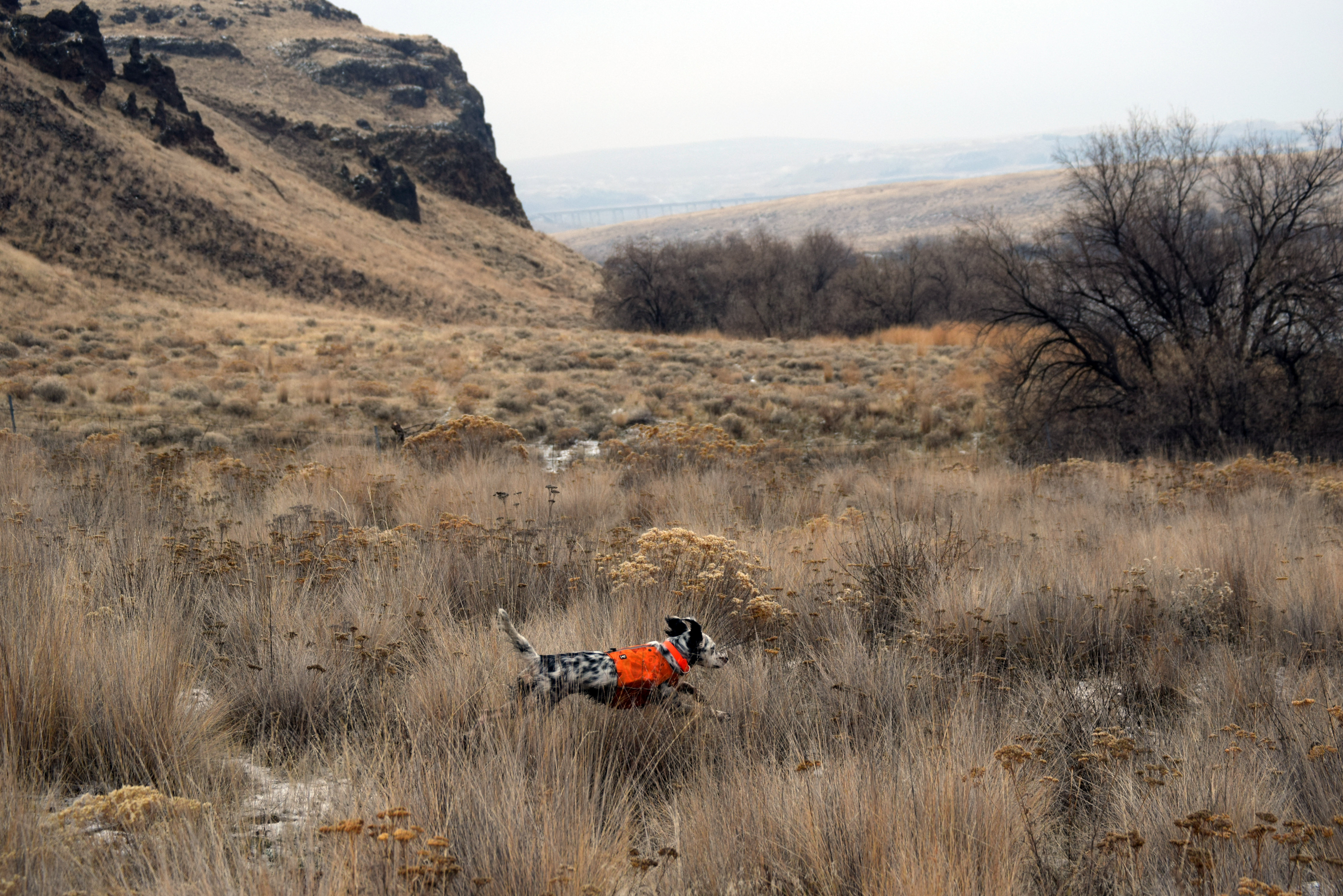
DSC_0214

Almost to the boat, I noticed Yuba’s hind legs quiver a bit, so I scooped her up and carried her the rest of the way. Her reward for an incredible hunt would be to warm up, grab a snack, and retire from the afternoon hunt. Handing her up to Brett, I swung myself aboard, regained my feet, and reached out to take my tired little setter. But confusion was replaced with dread as I noticed her eyes clenched in pain, followed by the unmistakable convulsions of a seizure.

“Holy shit, she’s seizing!” I yelled to Brett, who swiftly laid her out on the large, cushioned bench seat in the boat’s cabin.

I wrapped her in my insulated overalls while Brett cradled Yuba’s head. Seizures can present with a variety bodily functions, pains, and other involuntary motions and sounds. An eternal minute passed as every muscle in her tiny body went board-stiff, but the worst of it was her uncontrollable screaming.

With muscles finally relaxing and cognizance regaining, the pain must have been unbearable; the cause I am left to assume was perceived as some unknown predator. Large, dilated pupils searched to unveil the culprit as she pled for mercy. Terror, confusion, and panic were evident as Brett and I spoke softly, stroking her ears in an attempt to sooth her fear, if nothing else.

At the two-minute mark, she began to quiet. The convulsions had completely ceased and sore muscles relaxed. I scooped her up, still wrapped in my now defiled overalls, and sat with her curled on my lap like a newborn pup. Brett solemnly motored toward the marina.

She had come out of it. That was the first blessing, but I had no way of really checking her neurological signs as of yet. Suspicious that the cause was either an electrolyte or glucose deficiency, I went for a honey packet, which I had readily on hand for this very situation. She lapped at it eagerly.

Back at the truck, I tucked Yuba in softly among a fleece blanket and the overalls, and offered some water, which she happily drank. She was showing no sign of impaired motor skills, but was still clearly wiped from the exertion of the hunt and seizure. Dropping the Tundra into drive, I dialed the local vet, announcing I would see her in 45 minutes, if not sooner.

Keeping tabs on the groggy pup, I randomly whistled or called her name. She always responded. Carrying her across the threshold at the vet’s office, she wagged at the receptionist, and sat upright on my lap in the waiting room. The visit was short and sweet, and Yuba’s behavior improved immensely in that insignificant amount of time.

The diagnosis was as I suspected afield. Hypoglycemia. More appropriately, Hunting Dog Hypoglycemia (HDH).
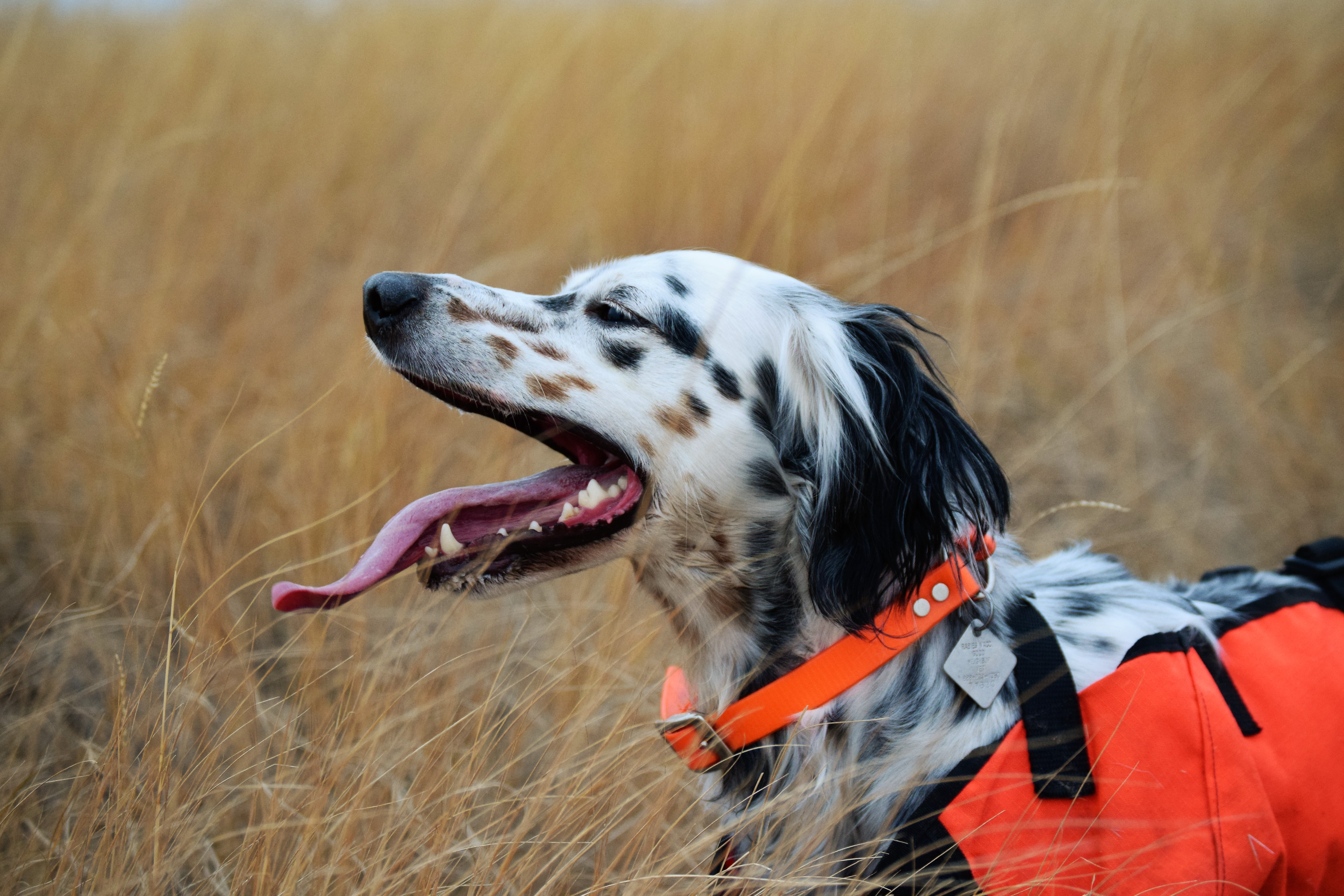
DSC_0088

What is HDH?

I believe most folks know what hypoglycemia is, but in case you don’t, its low blood sugar. A pup’s normal blood sugar should range somewhere between about 70-150 ml/dl. A dog experiencing HDH will have a value likely below 50 ml/dl. Dr. Shawn Wayment (DVM, @birddogdoc on Instagram) explains that HDH occurs when a canine athlete exerts itself in strenuous exercise thereby rapidly depleting their blood sugar (glucose) before their reserves can be remobilized or released from glycogen storages from the muscle and liver.

Symptoms

There are a number of reliable resources on HDH that share common symptoms that may include the following.

  • General fatigue
  • Staggering
  • Trembling
  • Shaking
  • Nervousness
  • Anxiety
  • Weakness
  • Ataxia (loss of control of bodily movements)

As with any medical condition, no two cases will necessarily present alike. Athletes fatigue when they work hard, whether two- or four-legged. Yuba was showing fatigue as she has on every hunt for the past four seasons, but no other symptoms until about five minutes prior to her seizure. At that time, her demeanor appeared similar to her pre-FHO days when her hips began to hurt and stiffen.

Causes

Dr. Wayment refers to current literature on HDH pointing to a lack of condition as a common cause; however, he believes that this is simply not the whole truth and has “…seen it happen in very well-conditioned canine athletes.” That now makes two of us as Yuba is at the height of her physical ability for the season.

So, what really caused Yuba’s bout of HDH? My hypothesis is the perfect storm of conditions creating utter chaos, sensory overload, and compensation for environmental conditions. The novelty of the hunt in general is my overarching suspicion, the specific points exacerbating Yuba’s metabolic rate being the following.

  1. General adrenaline and anxiety for an hour before the hunt: Yuba knew we were headed out hunting and was trembling with anticipation the entire truck ride and wait for our comrades.
  2. First time boat ride: Yuba doesn’t like water more than about a foot deep. She was nervous just walking down the dock to the boat, much less roaring down the river on water she knew was deeper than she is tall.
  3. Strange dogs: Yuba loves people, but the two strange, yet sweet and well-meaning Brittanys, further prodded her nerves and desire to curl up in my lap for security.
  4. Turkeys: Yuba had seen a turkey or two before, but the dozens of turkeys that flushed into the grasslands like a flock of quail inundated the area with bird scent. She was working and pointing turkeys left and right the entire hunt. Upon her first find, it was difficult pulling her off of the scent at all. This was uncharted territory for her.
  5. Pheasant: There were also dozens of pheasant. Everywhere. Between the turkeys and pheasant, she didn’t know which way to go or which scent to key in on and was totally jazzed about it.
  6. Shooting: The two groups of hunters began at opposite ends and worked toward each other with a barrage of shots throughout the hunt. When the gun fires, Yuba kicks into high gear looking for the dead bird, then tears off in search of the next live bird. Focus was a bit problematic as she wasn’t sure what she should do at times.
  7. Frigid Conditions: We had been hunting since September, but this was the first actually cold day afield. And it wasn’t just cold, but wet from icy precipitation. She was soaked and chilly causing additional caloric burn to maintain body temperature.
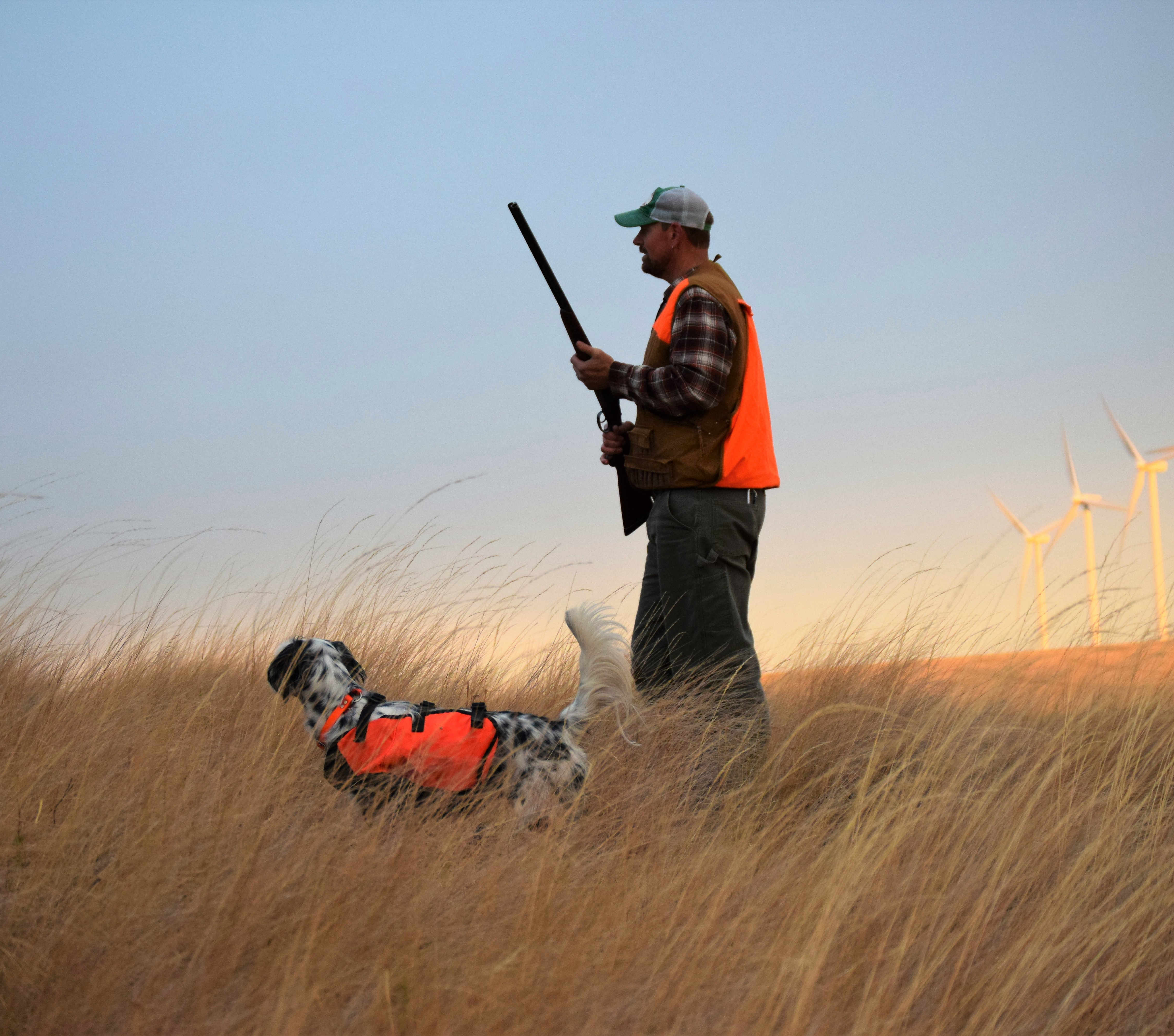
 

DSC_0003-1

Prevention

The old saying that “an ounce of prevention is worth a pound of cure” could not be more true as you cradle your ailing pup in the field with little to nothing you can do to remedy the situation. I was prepared with the necessary items to keep her energy up, but I neglected to enforce break time to care for her. When Yuba is on fire and thoroughly enjoying the hunt, I have to leash her to make her stay put for breaks. I failed to do this on this particular hunt and will not make that mistake again.

Furthermore, a warmer vest that could keep a lean, 28-pound setter drier may have been enough to keep her energy burn rate to a more normal level.

Proper diet, rations, and conditioning are a must for our four-legged upland athletes. How often to feed your dog is another question that I refrain from debating, but some veterinarians suggests that feeding the appropriate daily ration once per day would condition a dog’s body to store a larger liver glycogen reserve to draw from during strenuous activity.

Dr. Wayment also suggests that feeding a dog 10% of its calculated daily ration every two hours during strenuous activity has shown success in preventing HDH symptoms.

Emergency Treatment

What did I do right during this whole debacle? I provided warmth immediately, and water, honey, and rest once the seizing stopped. Yuba came out of it well, was responsive, excited about the honey, and didn’t show any obvious, alarming symptoms of neurological deficiencies. Nevertheless, I rushed Yuba to the vet for an exam, which was one hour to the minute from the onset of her seizure.

The same resources providing information on HDH symptoms also provide a variety of treatment options listed below. Whichever product you choose, at least 50% glucose is key. A couple ounces should suffice if needed in a pinch, but be prepared to feed your dog in short order and rest them the remainder of the day.

  • 50% Dextrose solution (50% glucose)
  • Karo syrup/corn syrup (100% glucose)
  • High fructose corn syrup (50% glucose)
  • Honey (50% glucose/50% fructose)
  • Maple syrup
  • Jelly/jam
  • Pure fruit juice
  • Nutri-Cal supplement

Dr. Wayment suggests applying to the oral mucous membranes for rapid enzyme break down; however, you should exercise caution. It may be best to wait for the seizing to end before trying to orally administer any of the above. Seizing animals obviously have no voluntary control over their body, including the mouth. Fingers near the teeth could end badly and at no fault or intention of your pup.

DSC_0911a

Looking Ahead

I learned the hard way to recognize conditions that may be hazardous to my pup’s health, aside from the obvious. Be cognizant of how novel experiences may impose additional stress on your pup.

Do not dismiss symptoms. This is Yuba’s first season hunting post-FHO surgery on her right hip. She is a new dog with relentless enthusiasm and desire, but the former three seasons of monitoring her pain level through her body language left me to assume that any symptoms she expressed were caused by her other, still arthritic hip. This was clearly not so. I don’t recommend looking for the metaphorical zebra at all times, but I do suggest being suspicious enough of the horse to consider a zebra in disguise.

Preparation does not equal prevention without proper action. Keep an eye on your pup and the clock. This can be a tall order amidst insane action, particularly when you rely on your pup to show you when he or she needs a break. But in Yuba’s case, and possibly the case with other pups in peak condition, no obvious symptoms of extreme exertion or energy expense may be noticeable. Had I forced a break and a snack just once, it likely would have prevented the seizure.

While Yuba’s story has a happy ending, a proportion of these cases end fatally. Keep your pup’s energy up, and by all means, if you recognize any of the above symptoms of HDH, allow your pup to rest the remainder of the day. When caught early, pups can bounce back rather quickly. But finding a few additional birds is not worth the risk, lest you be the next to publish the unfortunate story of your pup’s demise in the Pointing Dog Journal subscriber forum.

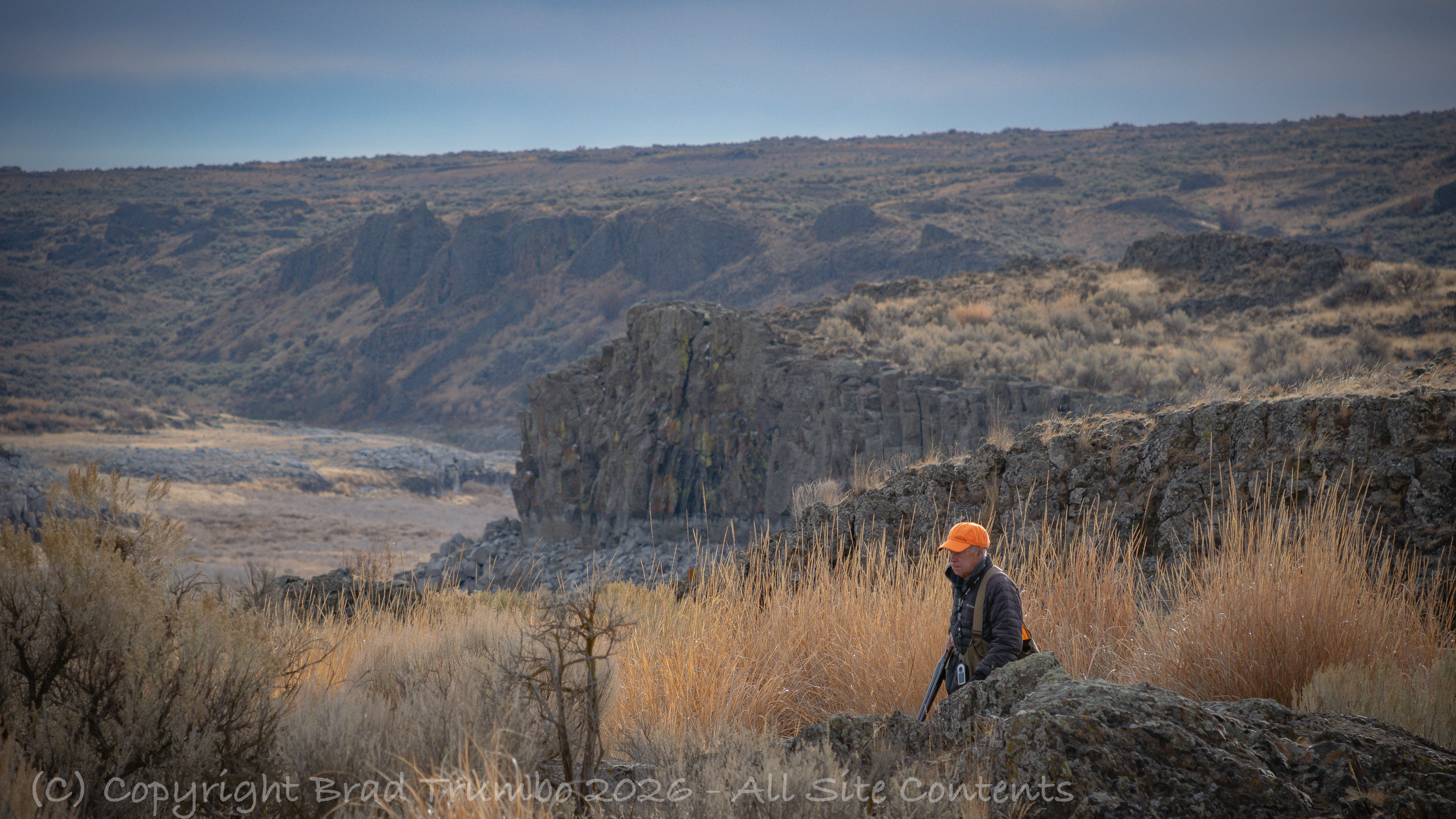
A Plug for Big-River Walleye

In the frothy toss of the dam tailrace, the little Smoker bobbed and dodged like a duck floating down a river rapid. Luckily, the dam was spilling only a minor volume, so conditions were still safe. The game plan was to drop a couple plugs behind the boat and troll across of the unique terrain that lay below the surface of the conflicting currents.

What to Look For

On the big river, walleye are generally structure-oriented in the sense that boulders, rock piles, troughs, and other terrain variations provide velocity breaks and concealment that fish can use to their advantage as forage passes by with the flow. Our target habitat was shelves and drop-offs in a depth range of 18-25 feet.

A plug for big river walleye (6)-1

Read the full post here, at Angler Pros.

Fly Fishing Essentials for Deep Summer Salmonids

Lake fishing for trout species can be dynamite almost any time of the year, but water temperature and heat can dictate when and how to fish for trout more than other species. When dry fly, or even nymph action slows during the dog days of summer, one fail-safe method is deep water streamer fishing. In my prior post, Flying Deep for Desert Cutthroat, I discuss deep water streamer tactics specifically for Lahontan cutthroat, but there are essential gear items every fly fisherman needs to beat the odds of a mid-summer salmonid shutdown.

Flying Deep for Desert Cutthroat

I went for my fly buried deep in the underside of his snout, then realized it was not mine. My streamer, lodged in its tongue. The barbless hook easily popped free. The former, losing fisherman apparently succumbed to the death rolls as a length of tippet and a small, olive, beaded streamer were wrapped tightly around its snout. I unwound the line, freed the fly, and quickly released the behemoth to dash the hopes of yet another angler who will no doubt break him off out of excitement or being too aggressive.

Lahontan Cutthroat are an Entirely Different Animal

DSC_0931

Read the full post here, at Angler Pros.

Haying Best Management Practices for Wildlife

Farming and habitat practices to maintain healthy CRP and alfalfa stands provides significant nesting and brood rearing benefits to upland game birds, fawning areas for deer, and nesting and roosting habitat for wild turkey in the early spring and summer. Long, overhanging grasses provide nesting cover while broad-leaf plants like alfalfa and other native forbs provide insect forage for fledgling broods and hens. These stands draw and hold birds but have been called “ecological traps” in areas where haying regularly occurs.

The term ecological trap refers to a beneficial condition that attracts wildlife, but results in additive mortality, affecting the population overall. Quality CRP and alfalfa stands fit the scenario well where haying normally occurs during nesting season.

As haying equipment approaches, a hen pheasant may not vacate eggs or chicks, rather hunker down and use her camouflage for protection as a tractor passes by. This leaves birds vulnerable to the following mower which may be offset from the tractor. Likewise, small mammals and deer fawns use similar camouflage techniques and experience similar vulnerabilities to upland birds.

Best Management Practices

To minimize the potential hazardous effects of haying on wildlife, the Natural Resource Conservation Service has developed a few simple best management practices.

1) Defer haying. Apply and maintain at least two of the following management actions specifically for improving or protecting grassland functions for target wildlife species.

  • Do not cut hay on at least 1/3 of the hay acres each year. Idle strips or blocks must be at least 30 feet wide.
  • For at least 1/3 of the hay acreage, hay cutting must be either before and/or after the primary nesting or fawning seasons based on state established dates for the targeted species.
  • Increase forage heights after mowing to state specified minimum heights for the targeted species on all hayed acres.

2) For all haying during the nesting/fawning season implement at least two of the following to flush wildlife from hay fields during the mowing operation:

  • A flush bar attachment will be required on the mower (see figure below).
  • All mowing will be done during daylight hours.
  • Haying pattern:
    • Begin on one end of the field and work back and forth across the field, OR;
    • Begin in the center of the field and work outward.

Following these simple practices can greatly reduce unintentional wildlife mortality, further increasing the benefits of environmentally friendly farming.

flushing bar

Image from the Natural Resource Conservation Service.


Invasive Plant Management: Where to Begin?

Have you ever been faced with a task that was seemingly insurmountable? Maybe felt an overwhelming sense of responsibility for something entirely impossible to control? This is precisely how many public land managers feel every day as they struggle to maintain and restore quality fish and wildlife habitat among a world of progressively formidable invasive plant species.

Invasive plants that we (everyone) commonly refer to as “weeds” can be a mammoth problem because of their adaptability and competitive advantage over native plant species. While weeds are present and troublesome across the world, in the US, the western states struggle particularly due to dry climate. Weeds have adapted to dryland famously and express astronomical seed production, germination success, early germination before native plants, and furious growth rates in some instances.

Healthy grasslands are a prime example of an ecosystem highly susceptible to noxious weeds. Where healthy native grass stands occur, weeds may commonly be found interspersed, but in relatively manageable numbers. However, if a major disturbance occurs that destroys or inhibits those native grasses from quick regrowth, the seed bank from noxious weed species can be activated and flourish immediately, forming dense monocultures in one season.

Picture3

To some, this may sound like the plot from a horror movie. The problems that noxious weeds impose on quality habitat are all too real. For readers that are members of the Rocky Mountain Elk Foundation, the July-August, 2017, edition of Bugle Magazine presents a two-article special on noxious weeds that puts the potential impacts and the struggle for control into clear perspective.

Picture2

Control methods such as pulling and spot spraying can be effective in quality habitats, but where to begin tackling major weed infestations can be mentally crippling. Nothing is more humiliating and defeating to a public land manager than failing to keep ahead of the weeds. On more than one occasion I have felt as though I failed the wildlife, taxpayer, and fellow sportsmen and women upon finding a noxious weed hell of Canada thistle, Russian thistle, and kochia on public land under my supervision. Recovering from the initial shock, I try to keep cool, consider the options, and make a game plan. The best place to start? Somewhere! More specifically, here are a few tips and considerations to get you moving.

HERBICIDE APPLICATIONS

Herbicides are quick, and generally effective, but application methods can be costly depending on habitat type, the presence of sensitive desirable species, and the acreage needing treatment. Keeping noxious weeds from flowering is key, but I find that broadleaf herbicides like Amine 2-4-D are most effective when it’s hot and dry (July – August). Unfortunately, by this time of the year, a lot of weeds are already flowering. Even if flowers are immature and have not been pollinated, seeds may be viable. Hitting weeds in the early, rosette stage (March – May) can help get ahead of the game.

Picture4

I recommend learning about the plants you are treating before diving into a treatment. Timing can be critical, and for plants like Canada thistle that reproduce through roots, not just via seed, a fall application before green thistle dies back for winter can give you an advantage in the coming spring.

LIVESTOCK CONTROL

Goats have proven a useful tool in mowing through vegetation. Anyone unfortunate enough to have goats trespass onto their property can attest to their voracious appetite. Goats can clear vegetation to the ground in little time allowing for effective herbicide treatments behind grazing. Furthermore, appropriately timed grazing may knock back noxious weeds long enough to allow desirable species time to germinate and stand a chance of competing, and possibly thriving.

Some commercial outfits rent goat herds specifically for weed control. I am unsure of what a common rate may be for this service, but it is certainly something to consider if you would rather avoid applying herbicides, but maintain a chance at success. Prepare for several seasons of grazing.

MOWING

Keeping vegetation mowed back is a good option for weed control, but have you ever mowed a plant like yellow starthistle? If so, you know darn well that it takes to a pruning by flowering aggressively. The next thing you know, its three inches tall in full bloom. Mowing is best used in combination with herbicides. Herbicide applications are more efficient and effective when the vegetation is low and plants have less mass to treat. A couple seasons of mowing and herbicide application can be quite effective, but you have to be willing to give up usable wildlife habitat during treatment to be successful.
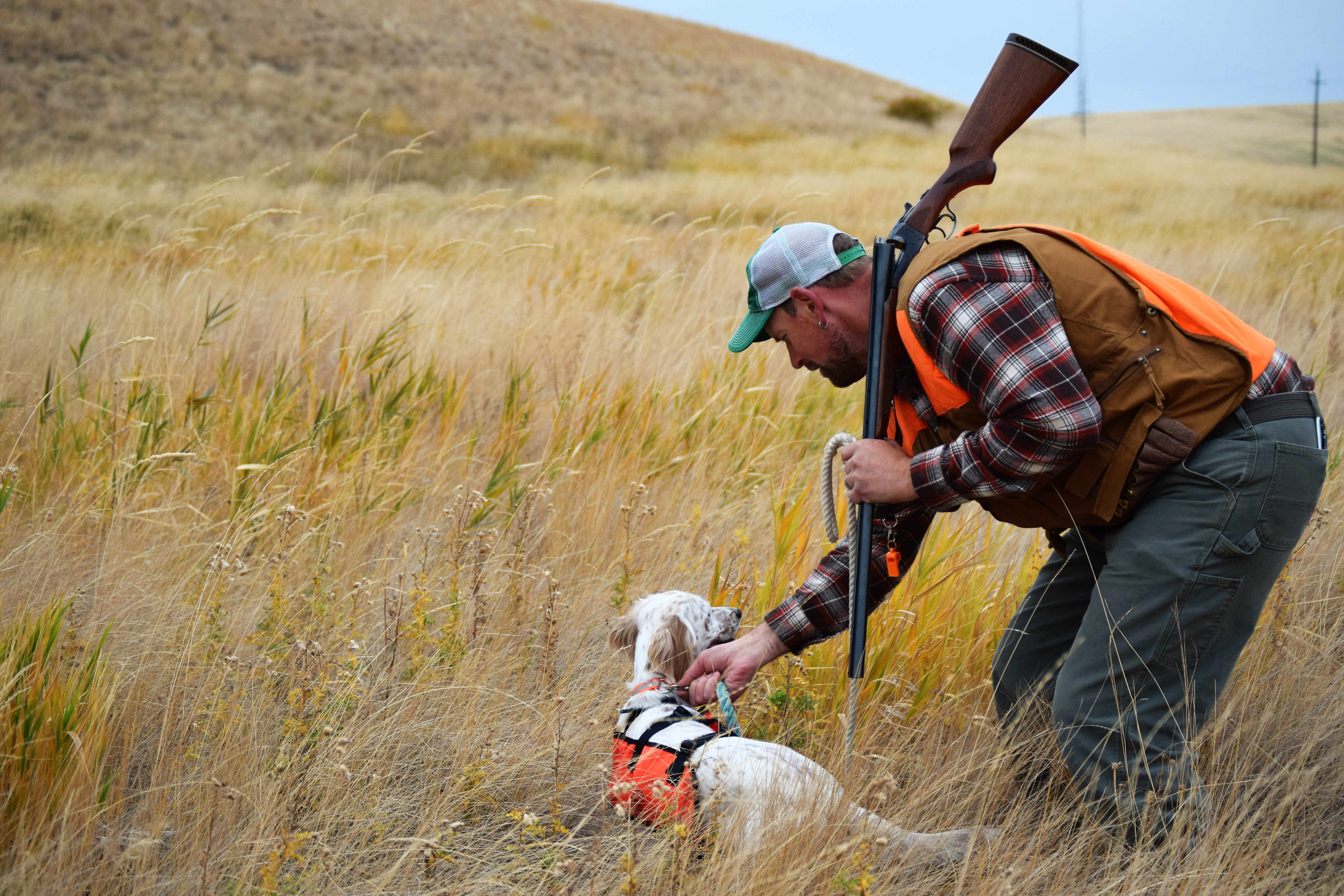
Picture5

DISKING AND HARROWING

Disking and harrowing can be used to keep noxious weeds from establishing. Regular cultivation activates the seed bank, allows plants to grow, then uproots them before they flower. Like mowing, this method requires habitat to be essentially lost during treatment, but disking can significantly tax the seed bank, allowing for reseeding with native, desired grasses and forbs.

One disadvantage is the potential for erosion. If rain or snow melt could cause runoff problems and scour the habitat area, particularly if runoff could enter a stream, you may want to select another method.

That sums up some common, effective approaches to noxious weed control, which fit cooperatively with the grassland management techniques discussed in the previous post. The severity of an infestation can help determine the best course of action, but I like to approach it as though I were considering surgery to correct a medical crisis. When possible, go with the topical treatments before digging in to remove an organ.

If you want to get serious about habitat improvement, accept up front that the weed control battle requires commitment. There will be no instant gratification (except maybe from herbicide-shriveled weeds), so settle in for a long-term game. I recommend making fast friends with folks who either have the farm equipment you need, or those willing to volunteer their time pulling weeds. And, as always, feel free to consult your friends on the Pheasants Forever chapter habitat committee.

Grassland Management for Upland Birds

Pheasants Forever emphasizes native grasses being a limiting factor for upland game bird nesting and brooding. For this reason, Blue Mountain Pheasants Forever focuses and invests locally in southeast Washington habitat enhancement projects with a native grassland focus. However, identifying and understanding limiting habitat factors for focused improvement programs is deeper than quantifying acreages of cover and crop types.

A healthy native grassland includes grasses that provide adequate nesting cover and open ground space and forbs for brood rearing and foraging.

finn in bunchgrass

To better understand the status of upland bird habitat and limiting factors, I selected about a dozen pertinent scientific journal articles from around the world and found several common themes revolving around one main conclusion. A loss of native grasslands has led to a noticeable decline in game bird populations. For example, between 1980 and 1995, the Washington Department of Fish and Wildlife (WDFW) noted the number of pheasant harvested declined from 500,000 birds to 70,000 birds annually.

There were a few other common points, as well as grassland management practices that are summarized below.

Common Worldwide Themes:

  • As agriculture practices have evolved and become more efficient and effective, more grasslands have been converted to cropland, thus reducing available quality nesting and brood rearing habitat.
  • As grassland species composition changes from frequent mowing, grazing, or haying, available food sources for upland birds wane, particularly for juveniles.
  • Maintaining robust stands of native grasses is key to upland bird reproduction success and winter survival.

While it’s clear that fallow, native grasses are crucial for reproduction and brood rearing, dense riparian and wetland areas provide critical winter cover as well. Shrubs and cattails provide wind breaks and refuge from extreme cold.

grassland

Habitat area is not critical, but research suggests that game birds prefer smaller grasslands (less than 8 acres). This supports Conservation Reserve Program agriculture buffer management and enhancement practices.

Finally, providing a variety of grasses and forbs is important for brood rearing. Adult pheasant feed primarily on grains, but laying hens and chicks require insects for growth and development. Broadleaf plants, such as native weeds and forbs, provide this important food source.

Several different habitat management actions can be implemented to maintain healthy stands of native grasses, whether in a pasture or crop field buffer. Below are the most effective actions.

Management Actions

  • Prescribed Burning: Prescribed burning mimics natural grassland processes which clean out heavy thatch and return nutrients to the soil. Burning invigorates grasses and opens the stand at ground level providing  forage cover for chicks. This technique may be one of the most effective management tools.
  • Disking: Disking breaks up grasses and opens the stand at the ground level providing foraging cover for chicks, encourages decomposition and organic nutrient inputs, and stimulates seed bank germination. Disking may be recommended in lieu of burning, but is less effective.
  • Herbicide Applications: Herbicides have proven effective and important in controlling noxious weeds and are commonly applied locally. Literature review did not pinpoint dramatic direct effects of herbicide applications on game birds, but indirect effects including reduced insect forage were noted. While herbicides are not recommended for use in early successional vegetation, appropriate herbicide use in combination with the above actions is recommended.

Scientific literature confirms that habitat loss has led to a major decline in game bird populations worldwide, and nesting and brood rearing habitat are limiting factors. The Pheasants Forever mission includes habitat creation and enhancement as a focal point, not only for pheasant, but for all native vegetation and wildlife. Whether you can provide 2 or 200 habitat acres, a little management can provide big benefits, and BMPF is available to assist.

pf pollinator

Small-Tract Habitat Provides Big Benefits

In southeast Washington, and many other big agriculture areas, hunters are blessed with vast farmland enrolled in the Conservation Reserve Program (CRP) through the Farm Service Agency. Basically, through CRP, Farm Service pays farmers and land owners an acreage rental fee for reestablishing or enhancing habitat. The CRP acres are invaluable to wildlife and hunters.

While it’s great to have large farm tracts enrolled in CRP, one common misconception about habitat enhancement is that little benefit comes from small tracts (~10 acres or less).  Whether you have 1 or 1,000 acres, there are simple, cost effective options that can draw and hold upland birds, as well as other wildlife. Here are some options and techniques you may be able to implement at home.

Food plots are always a solid option for providing important forage. Broadleaf plants such as brassicas (turnips), sunflowers, peas, and alfalfa provide crucial insect forage for young birds, while grains such as wheat, sorghum, and millet provide seed forage for adults. You may want to experiment with your own mix of crop species to maximize benefits for upland birds, deer, and pollinators while you are at it. I plant brassicas and spring wheat in my 0.2-acre plot and have been pleased with the number of pheasant, quail, and deer that make it a regular stop in their daily forage routine. Planting food plots can be quite simple requiring only a tiller or drill seeder, glyphosate (herbicide), and seed.

food plot

Brush piles are another great option providing forage and dense escape cover, protecting upland birds from predators, wind, and precipitation. Brush piles may be strategically placed, like in food plots or near other forage and watering areas for maximum benefit. Another bonus is that brush piles can be free (minus some sweat and gas) if you have any clean-up projects going on around your property. I deposit all of my tree and shrub debris in piles and large coveys of California quail use them consistently, even within an hour of having created them.

brush pile

Another technique described as “edge feathering” can be useful if you have more than one habitat type on your property. For example, if you have a stand of trees that gives way to a grass pasture and can give up the pasture fringe, trees can be dropped along the pasture edge to allow grass to grow up around the downed trees providing quick escape cover and brood-rearing habitat.

Finally, invasive species removal and planting native trees, shrubs, grasses, and forbes are options to provide a variety of valuable cover types and forage alternatives. Evergreens like Rocky Mountain juniper can provide important snow and wind breaks and create edge effects that benefit all wildlife species, while native grasses provide critical nesting and brooding habitat for upland birds like pheasant.

More information on small-tract habitat enhancement is available by visiting the Pheasant Forever “Pheasant Blog” at the web address below and consulting Pheasant Forever’s Essential Habitat Guide. If you want to speak to person, feel free to contact me through my Contact page.

Pheasant Blog